

Abbey in Ruins in Valencia Countryside c1838
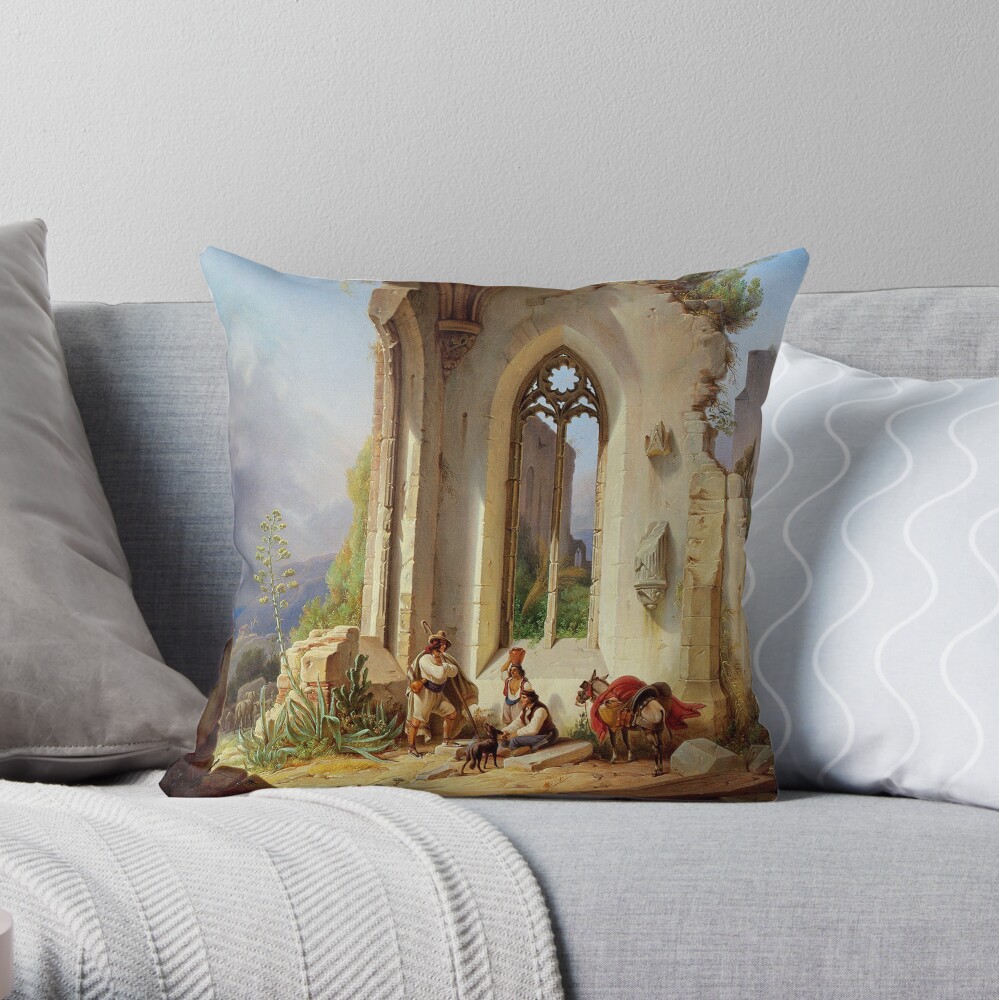
D'Konschtwierk “Abtei zu Ruinen am Valencia Land,” erstallt an 1838 by the German painter Wilhelm Gail (1804 – 1890), presents a romanticized depiction of an ancient abbey set amidst the picturesque and tranquil Valencia countryside. Through the lens of the Romantic movement, which flourished throughout Europe during the late 18th and early 19th centuries, Wilhelm Gail captures the profound interaction between nature and the remnants of human civilization. This painting invites the viewer to contemplate the themes of decay, de Passage vun der Zäit, and the persistence of nature despite the ruinous structures left behind.
Inhaltsverzeechnes
D'Haaptthema: The Abbey in Ruins
The focal point of the painting is the grand, yet dilapidated abbey, whose towering arches and shattered windows have long since ceased to serve their original religious or communal purpose. The ruins of the abbey stand as a testament to a past that is now inaccessible, its once-pristine structure now slowly crumbling due to the ravages of time.
The ornate Gothic architektonescht details still remain visible, showcasing finely executed stone carvings that hint at the abbey’s former glory. Natur, awer, has begun to reclaim what was once a symbol of human creation. Beem, Sträich, and vines now cling to the walls of the abbey, emphasizing the inevitable decline of even the most monumental constructions in the face of nature’s inexorable growth.
Den Terrain a Landschaft
The surrounding terrain of the painting is a vast, open landscape that extends far beyond the ruins, typical of the Spanish countryside in the Valencia region. Déi dréchen, rolling hills stretch into the distance, suggesting the expansive, arid environment that dominated the region. The subtle gradients of earth tones in the soil convey the heat of the region, typical of the Mediterranean climate.
Am Virdergrond, there are patches of grass and wild vegetation that provide a stark contrast to the stonework of the abbey. The land seems to carry an air of quiet desolation, though it is not completely devoid of life. A few animals can be seen in the scene, including a donkey and a small dog, both of which seem to be part of the human presence in the scene.
The figures of men, positioned near the abbey’s remnants, are integral to the scene, offering a human scale to the ruins and reminding the viewer of the fragile relationship between man and the environment.
The Human Figures and Daily Life
Am Virdergrond, three men are depicted, seemingly engaged in a moment of rest after traveling through the countryside. Two of the men are seated on the ground, with one of them tending to the small dog, while the third man stands nearby, leaning on a staff. Each of these figures wears traditional attire of the time, including loose-fitting shirts, wide-brimmed hats, and leather boots, fitting the rural, everyday life of the period.
Their connection to the land is emphasized by their humble presence, and their peaceful interaction with the natural world adds to the timeless feeling of the artwork. Am Hannergrond, a pack donkey, laden with supplies, is tethered near the ruins. This subtle inclusion of animals and the mundane act of rest reflects the theme of human perseverance in a world marked by the passage of time and change.
Liicht, Stëmmung, an Atmosphär
Wilhelm Gail’s careful handling of light and shadow brings a deep sense of realism to the painting, while also evoking an emotional atmosphere. The interplay of sunlight and shadows within the ruins highlights the texture of the stone, creating a three-dimensional quality that draws the viewer’s attention to the faded beauty of the architecture.
A soft light filters in from the left, illuminating the fragments of the once-glorious structure, while the distant hills are bathed in a hazy, gëllen Glanz. The mood of the scene is somber, yet peaceful, with the bright, open sky offering a sense of serenity. The atmosphere created by the natural elements, combined with the starkness of the abbey’s ruins, induces a contemplative feeling about the transitory nature of human achievement and the power of nature to endure.
Symbolism and Romantic Themes
As with many works of the Romantic era, “Abtei zu Ruinen am Valencia Land” expresses the Romantic fascination with nature, d'Sublime, an d'Vergänglechkeet vu mënschleche Kreatiounen. The abandoned abbey symbolizes the passage of time, the decline of religious and institutional authority, and the inevitable decay of human-made structures.
Natur, as seen in the encroaching vines and foliage, is depicted as a force that cannot be controlled, reclaiming what was once its own. The figures of the men, though human, seem insignificant in comparison to the vastness of the landscape, emphasizing the theme of human fragility in the face of time and nature.
Stil an artistesch Techniken
The painting adheres to the style of Romanticism, a movement that emphasized emotion, Individualismus, and the beauty of nature. Wilhelm Gail’s meticulous attention to detail and use of light and shadow convey the influence of German Romantic painters, who often depicted natural landscapes and ruins in a dramatic manner.
His skillful handling of the ruins, combined with the almost ethereal lighting, brings the scene to life, making it both a historical snapshot and a timeless meditation on decay and renewal. The detailed brushwork in the textures of the stone and vegetation provides a heightened sense of realism, drawing attention to the natural beauty of the ruins and their surrounding environment.
Conclusioun
“Abbey in Ruins in Valencia Countryside c1838” by Wilhelm Gail is a masterful example of the Romantic style, combining natural beauty, historical contemplation, an déif Symbolik. The depiction of an ancient, crumbling abbey set against the sprawling Spanish landscape invites viewers to reflect on the transient nature of human endeavors, the inevitability of decay, and the quiet persistence of nature.
Through the artist’s careful use of light, Detail, a Zesummesetzung, the painting not only captures the physical ruins of the abbey but also evokes a deeper, more emotional understanding of time’s passage and the natural forces that shape our world.
Dëst ass eng retouched digital Konscht al Master Reproduktioun vun engem Public Domain Bild dat online kaafen ass als eng gewalzt Leinwanddruck.
Artist Bio Information Is Derived From Wikipedia.org
De Wilhelm war de Jong vun engem Walgalerie Supervisor, an am Aklang mat sengem Papp d'Wënsch nom Lycée fäerdeg, ugefaang Architekturstudium op der Academy of Fine Arts zu München, Däitschland; géif sech awer spéider der Molerei widmen.
Nodeems de Wilhelm seng Studien op der Akademie ofgeschloss huet, hien huet weider Lektioune am Studio vu sengem Schwoer gemaach, de Moler däitsche Moler Peter von Hess a während dëser Zäit, eng Rei Landschaften erstallt hunn, déi hien d'Fauna an d'Bräicher vu senger Heemecht duerstellt.
An 1825 De Wilhelm ass op Invitatioun vum Baron von Malzen an Italien gereest, de kinnekleche Bayeresche Chargé d'affaires um Sardineschen Haff; wärend hien do e puer architektonesch Biller a Genre Stécker erstallt huet, déi als Lithographien ënner den Titelen Roman Monumenter an de Staate vu Sardinien a Popular Szenen vu Genua publizéiert goufen.
No sengem Retour zu München, De Wilhelm huet vill Biller vu Gebaier aus der Erënnerung vu senger Rees erstallt; déi den antike Aquedukt an der Campagna an de Klouschterhaff zu Viterbo abegraff huet, déi vum Public gutt ugeholl goufen, séier e populäre Moler maachen.
An 1830 De Wilhelm huet nees Däitschland verlooss, an dës Kéier huet eng Rees op Paräis, Frankräich ze studéieren; mä nom Ausbroch vun der Julirevolutioun ass hien fortgaang an ass op Chartres gaangen; a vun do géif aner Reesen an Italien a Spuenien huelen fir weider Erhéijung ass artistesch Wëssen a Fäegkeet.
An 1854, De Wilhelm gouf zum Chefplenipotentiaire ernannt a kuerz drop zum Kabinetsrot vum Bayereschen Herzog Nikolaus von Leuchtenberg ernannt..