

The First Awakening of Eve: A Study in Innocence and Revelation
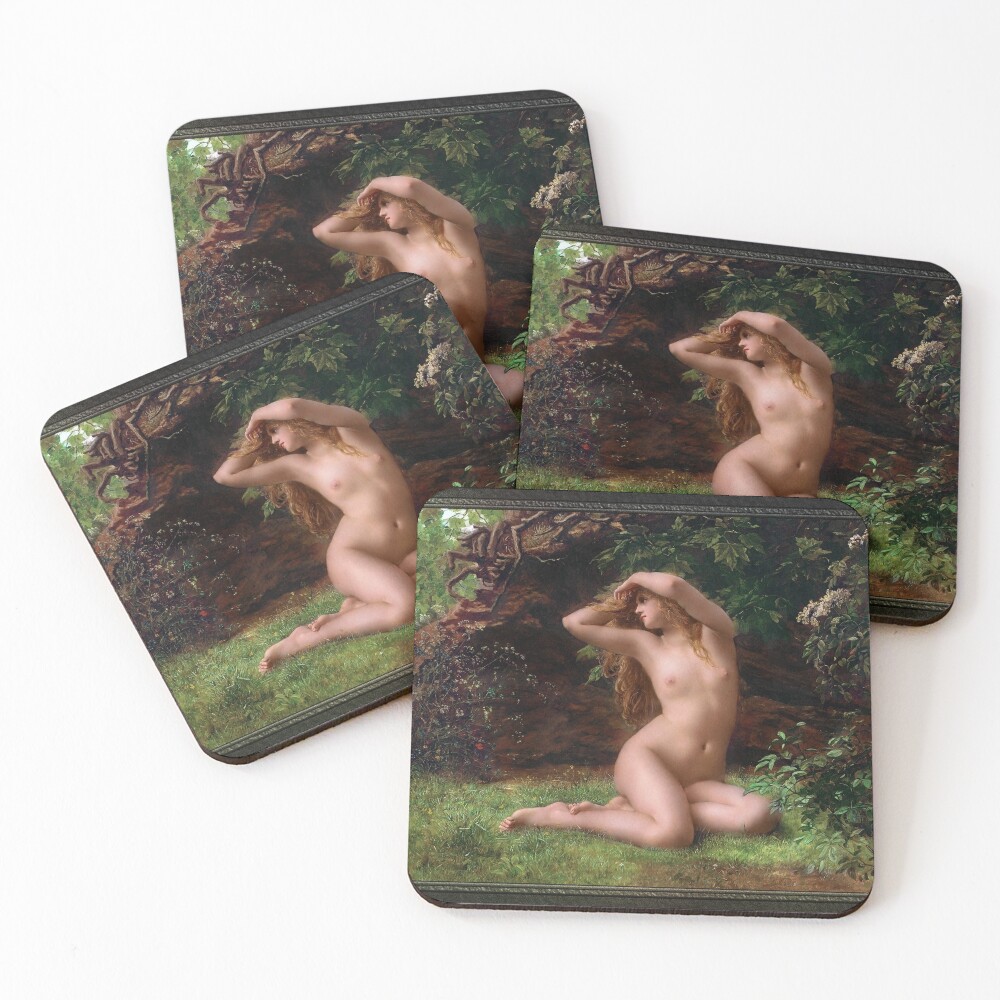
Valentine Cameron Prinsep’s “The First Awakening of Eve,” painted circa 1870, is a captivating work within the Pre-Raphaelite tradition, exploring themes of nascent consciousness and the transition from primal existence to awareness. Prinsep, a British artist known for his depictions of biblical and classical subjects, imbues this scene with a delicate realism and an evocative atmosphere that invites contemplation. The painting resides within a gilded frame, which enhances its overall aesthetic appeal.

Table of Contents
Compositional Elements & Setting
The artwork’s composition is carefully structured to draw the viewer’s eye towards Eve, who occupies the central position. She kneels upon a bed of lush green grass, her posture suggesting both vulnerability and burgeoning strength. The setting is an idyllic garden, overflowing with dense foliage – various shades of green dominate, punctuated by touches of white blossoms and darker browns representing rock formations and shadowed areas.
A rocky outcrop rises in the background, partially obscured by trees, creating depth and a sense of enclosure. A sculpted figure, seemingly depicting a lion or similar feline creature, is subtly integrated into the background foliage on the left side of the canvas; its presence adds an element of mystery and foreshadowing without being overtly dominant. The overall effect is one of secluded beauty, a private moment unfolding within a paradise-like environment.
Eve’s Figure & Expression
Eve herself is rendered with remarkable detail. Her skin possesses a warm, almost translucent quality, reflecting the soft light that filters through the leaves above. Her hair, a cascade of vibrant red-gold curls, frames her face and spills down her shoulders. She raises one hand to her head, gently pushing back strands of hair, while the other rests on her knee; this gesture conveys a sense of awakening and self-discovery.
Her gaze is directed slightly upwards and outwards, suggesting an emerging awareness of her surroundings and perhaps, a nascent understanding of her own existence. Her expression isn’t one of surprise or fear, but rather a quiet contemplation – a moment of gentle realization. The artist avoids any overt sensuality; instead, he focuses on portraying the purity and innocence of this initial awakening.
Light & Color Palette
Prinsep masterfully utilizes light to enhance the painting’s emotional impact. Sunlight streams through the canopy above, dappling Eve’s skin with highlights and casting soft shadows that define her form. The color palette is predominantly verdant, reflecting the abundance of nature surrounding her. Warm tones – golds, yellows, and reds – are used to depict Eve’s hair and skin, creating a striking contrast against the cooler greens of the foliage. Subtle touches of white and pink in the blossoms add further visual interest. The artist’s use of chiaroscuro—the interplay of light and shadow—creates depth and drama, drawing attention to Eve while subtly integrating her into the natural environment.
Artistic Influences & Technique
“The First Awakening of Eve” clearly demonstrates Prinsep’s engagement with the Pre-Raphaelite Brotherhood’s ideals. Like his contemporaries, he prioritized meticulous detail, vibrant color, and a return to medieval artistic principles. The painting exhibits a remarkable attention to botanical accuracy; each leaf and flower is rendered with precision.
Prinsep’s technique involves layering thin glazes of paint to achieve luminous effects and subtle gradations of tone. This approach contributes to the overall sense of realism and allows for a delicate rendering of light and shadow. The work also shows an influence from classical sculpture, particularly in the idealized form of Eve’s figure.
Symbolism & Interpretation
Beyond its aesthetic beauty, “The First Awakening of Eve” is rich with symbolic meaning. Eve’s kneeling posture can be interpreted as a gesture of humility or reverence. Her upward gaze suggests a yearning for knowledge and understanding. The garden setting represents the biblical Garden of Eden, symbolizing innocence and paradise lost.
The presence of the feline sculpture in the background may allude to temptation or the potential for danger lurking within this newfound awareness. Ultimately, the painting captures a pivotal moment – the transition from unconsciousness to consciousness, from primal existence to self-awareness. It is not merely an illustration of a biblical narrative but rather a meditation on the human condition and the complexities of awakening.
Legacy & Significance
Valentine Cameron Prinsep’s “The First Awakening of Eve” remains a significant work within the Pre-Raphaelite canon. It exemplifies the movement’s commitment to beauty, detail, and symbolic meaning. The painting has been exhibited in numerous museums and galleries around the world, captivating audiences with its evocative imagery and profound themes. It stands as a testament to Prinsep’s skill as an artist and his ability to capture the essence of human experience within a classical framework.
Artist Bio From Wikipedia.org
Cameron was born in Calcutta on February 14, 1838 in India, and was the second son of Henry Thoby Prinsep, who was a civil servant of the British Raj, and his wife Sarah Monckton Pattle, daughter of James Pattle.
His mother was the sister of the British Photographer Julia Margaret Cameron (1815 – 1879) and Maria Jackson (née Pattle), who was the grandmother of British Author Virginia Woolf (1882 – 1941) and British Painter Vanessa Bell (1879 – 1861).
His father Henry, was a friend of the British Painter George Frederic Watts (1817 – 1904), who was a teacher to Henry’s oldest son and Cameron from 186 to 1857 traveled with Watts to visit British Archaeologist Sir Charles Thomas Newton (1816 – 1894) at the excavation site Halicarnassus in Turkey.
He then went to the atelier of Charles Gleyre’s (1806 – 1874) in Paris; becoming his student along with James Abbott McNeill Whistler (1834 – 1903), Edward Poynter (1836 – 1919), and George du Maurier (1834 – 1896).
He first exhibited his artwork in 1862 t the Royal Academy of Arts, with his piece Banca Capella; and from that point forward exhibited his work annually until his death in 1904.
The First Awakening of Eve is a retouched digital art old masters reproduction of a public domain image that is available for sale as a rolled canvas print.