

Immaculate Conception of Soult c1678
The “Immaculate Conception of Soult,” painted in 1678 by Spanish artist Bartolomé Esteban Murillo (1617 – 1682), is a sublime example of Baroque religious art. This masterpiece, famed for its ethereal depiction of the Virgin Mary, represents one of Murillo’s most celebrated works, capturing the moment of the Virgin’s Immaculate Conception, an event central to Catholic doctrine, which posits that Mary was conceived without original sin. This dramatic painting resonates with viewers through its masterful use of light, soft color palette, and heavenly composition. Murillo’s delicate brushstrokes and divine portrayal of Mary amidst cherubic figures exemplify the artist’s exceptional skill in rendering religious themes with tenderness and devotion.
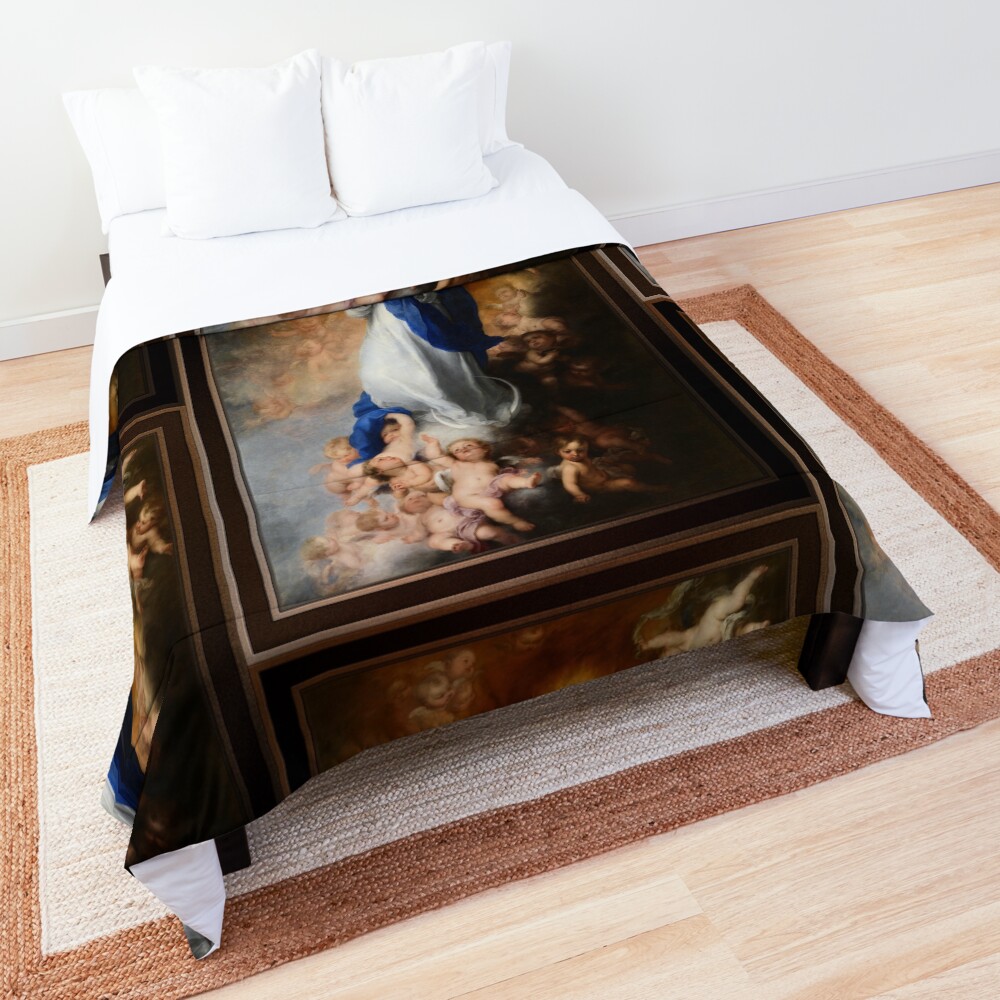
Table of Contents
Main Subject: The Virgin Mary
At the center of the painting stands the Virgin Mary, clothed in a flowing white robe accented by a rich, radiant blue mantle that signifies her purity and sanctity. The blue, a color often associated with divine grace in Christian art, contrasts beautifully against the warm, golden backdrop, which symbolizes the glory and divine light surrounding her. Mary’s head is slightly tilted upward, her hands are folded in a prayerful gesture, and her expression is one of serene reverence and heavenly calm. The halo around her head glows with a soft, golden light, marking her as an extraordinary, sacred figure.
Her youthful face radiates an innocence and purity that transcends earthly concerns, a hallmark of the Immaculate Conception. Murillo’s treatment of her skin is exceptionally tender, with soft tonal gradations that give the figure a lifelike appearance. This delicacy of form and the refinement of her features create an ethereal, almost otherworldly aura that emphasizes her holiness. The heavenly light that surrounds her seems to come from within, as if she is the very embodiment of purity.
The Angelic Figures: Cherubs and Heavenly Hosts
Surrounding the Virgin are a host of angelic cherubs and young angels, each one portrayed with Murillo’s characteristic softness and lightness. The angels appear to be floating or descending around Mary, their small forms clustered near her feet and further in the background, creating an impression of divine harmony. Their cherubic faces are full of innocence and joy, with their arms raised as if adoring the Virgin in reverence. The angels are lightly draped in pastel-colored robes, their limbs and faces softly illuminated against the dark background, creating a contrast that draws attention to the figures of the Virgin Mary and the surrounding celestial light.
The cherubs at Mary’s feet appear to be adoring her, while others ascend toward the sky, perhaps symbolizing their role as messengers of God. The way the angels’ limbs intertwine and their soft, ethereal forms are rendered gives the composition a sense of fluidity and lightness. These heavenly figures create a sense of divine presence and reinforce the centrality of Mary as the object of worship and reverence.
Composition and Use of Light
Murillo’s composition is arranged in such a way that the viewer’s attention is drawn immediately to the central figure of the Virgin Mary. The background of the painting is dominated by swirling clouds, golden hues, and soft bursts of light, which seem to radiate from the Virgin herself. The artist’s masterful use of light serves not only to elevate the central figure but also to give a sense of the celestial and divine realm surrounding her. The soft, almost diffused light that bathes the Virgin’s face and body further emphasizes her purity and sanctity.
The composition is built on a diagonal axis, leading the viewer’s eye from the bottom left, where the cherubs are gathered, up to the Virgin in the center, and then upwards toward the distant heavenly host. This movement of figures conveys a sense of upward ascension, symbolizing the spiritual elevation of the Virgin Mary. The swirling clouds and the ethereal quality of the painting create an illusion of infinite space, placing the viewer in the midst of a heavenly realm.
Mood and Emotional Impact
The mood of the painting is one of serenity, reverence, and divine grace. Murillo’s careful handling of light, the soft and glowing color palette, and the expression of calm devotion on Mary’s face all contribute to the overall feeling of peace and spiritual transcendence. There is a profound sense of calm that emanates from the Virgin Mary, offering solace to the viewer while evoking a sense of divine awe. The peaceful expressions on the angels’ faces and the gentle poses of the cherubs further amplify this tranquil mood, enhancing the emotional impact of the piece.
The use of light and the heavenly imagery also evoke a sense of divine intervention and the sacred nature of the Virgin’s conception. The painting embodies the reverence with which the Catholic faith views Mary, as the Immaculate Conception signifies her exceptional purity and grace, even from the moment of her conception. The overall atmosphere is one of divine celebration, elevating the viewer’s spiritual consciousness.
Style and Artistic Technique
As is characteristic of the Baroque period, Murillo’s “Immaculate Conception of Soult” demonstrates a sophisticated use of chiaroscuro, the contrast between light and dark, to heighten the dramatic impact of the painting. The soft transitions of light on Mary’s face and the careful blending of tones give the painting a naturalistic quality while maintaining an idealized sense of beauty. Murillo’s skill in rendering textures is also evident, particularly in the delicate fabrics of the Virgin’s robe and the softness of the angels’ skin.
The painter’s brushwork is gentle and fluid, which enhances the overall softness of the image. The figures are rendered in a soft, almost dreamlike manner, contributing to the ethereal quality of the work. The glowing hues of gold and blue, combined with the subtle use of light, give the composition a radiant, heavenly appearance that reflects the sacred nature of the subject.
Conclusion
Bartolomé Esteban Murillo’s “Immaculate Conception of Soult” is a striking representation of the Virgin Mary, imbued with both religious significance and artistic excellence. Through his masterful use of light, delicate brushwork, and serene composition, Murillo captures the divine purity and sanctity of the Virgin, offering the viewer a glimpse into the celestial realm. The painting serves as both an artistic triumph and a profound spiritual statement, inviting reflection on the purity and grace that the Catholic faith attributes to the Virgin Mary.
This is a retouched digital art old masters reproduction of a public domain image.
Artist Bio Derived From Wikipedia.org
Bartolomé was the son of Spanish parents Gaspar Esteban a barber nad surgeon and María Pérez, and may have been born in either Seville of in pilas Spain, a smaller Andalusian town; and was the youngest son of a family of fourteen.
When Bartolomé was 10 years old he lost one of his parents, and then a year later in 1628 at the age of 11 he lost his other parent; thus becoming a ward of his sister’s husband Juan Agustín Lagares.
Bartolomé began his artistic studies under Baroque Spanish Painter Juan del Castillo (1590 – 1657); who was a relative of his mothers and his uncle on his mother side of the family Antonio Pérez, was also a painter.
If you are wondering where Bartolomé last name comes from, it is from his maternal grandmother, Elvira Murillo; he rarely used is fathers surname.
At the age of 26, in 1642 he moved to Madrid Spain, becoming familiar with the works of Spanish Painter Diego Rodríguez de Silva y Velázquez (1599 – 1660); and the works of Venetian and Flemish masters that were in the royal collection; which is suggested by the rich colors and soft modeled forms of his later works.
Bartolomé was an artist that was in great demand throughout his career and he had many pupils and followers; as such, much of his work was imitated by others, which insured that his reputation in Spain and fame throughout Europe, made his artwork more widely known than any other Spanish artist.