

Juno Asking Aeolus To Release The Winds
Juno Asking Aeolus To Release The Winds c1769 by French Painter Francois Boucher (1703 – 1770), who was also an accomplished draughtsman and etcher. He worked in the Rococo Style and is known for his idyllic classical themes, pastoral scenes and decorative allegories.
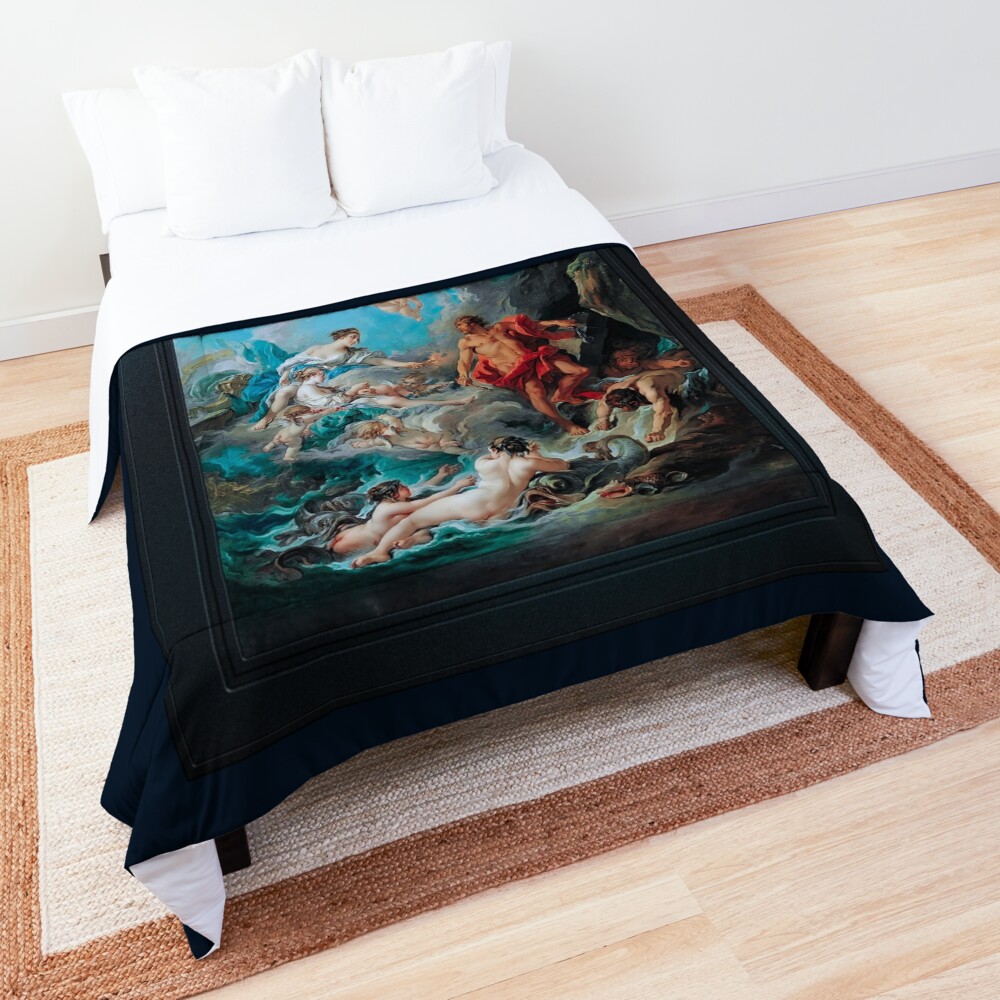
This is a depiction of the Greek-Roman Mythological tale of Juno (Chief Goddess akin to the Greek Hera) visiting Aeolus (King of the mythical, floating island of Aiolia or Aeolia), who is the keeper of the winds and urging him to release these mythological creatures so that their fury and might, may provoke a violent storm at sea, which would result in the destruction of the Aeneas’s Fleet.
Things don’t turn out as Juno expects, even though she has offered Aeolus her most beautiful nymph Deiopea in marriage; and aiming her torch strait at his heart, the love struck Aeolus does as she ask.
Then Cupid unsheathes an arrow to target the compliant nymph Deiopea, that has her wrist bound with pearls; but the power God of the Sea Neptune interferes and prevails over the winds that were released from the cavernous island interior, by rendering the waters of the sea into a calm state.
To complete the scene we find cherubs flying in the air and some floating on a cloud above the water and two other sea nymphs in the water surround by very large gulping fish.
Juno Asking Aeolus To Release The Winds is a remastered digital art old masters reproduction of a public domain image that is available as a canvas print online.
Info Below Derived From Wikipedia.org
A native of Paris, Francois Boucher was the son of a lesser known painter Nicolas Boucher, who gave him his first artistic training. At the age of seventeen, a painting by Boucher was admired by the painter François Lemoyne. Lemoyne later appointed Boucher as his apprentice, but after only three months, he went to work for the engraver Jean-François Cars.

In 1720, he won the elite Grand Prix de Rome for painting, but did not take up the consequential opportunity to study in Italy until five years later, due to financial problems at the Académie royale de peinture et de sculpture.[1] On his return from studying in Italy he was admitted to the refounded Académie de peinture et de sculpture on 24 November 1731. His morceau de réception (reception piece) was his Rinaldo and Armida of 1734.
Boucher married Marie-Jeanne Buzeau in 1733. The couple had three children together. Boucher became a faculty member in 1734 and his career accelerated from this point as he was promoted Professor then Rector of the Academy, becoming inspector at the Royal Gobelins Manufactory and finally Premier Peintre du Roi (First Painter of the King) in 1765. Portrait of Marie-Louise O’Murphy c. 1752
Boucher died on 30 May 1770 in his native Paris. His name, along with that of his patron Madame de Pompadour, had become synonymous with the French Rococo style, leading the Goncourt brothers to write: “Boucher is one of those men who represent the taste of a century, who express, personify and embody it.”
Boucher is famous for saying that nature is “trop verte et mal éclairée” (too green and badly lit).
Boucher was associated with the gemstone engraver Jacques Guay, whom he taught to draw. He also mentored the Moravian-Austrian painter Martin Ferdinand Quadal as well as the neoclassical painter Jacques-Louis David in 1767.[4] Later, Boucher made a series of drawings of works by Guay which Madame de Pompadour then engraved and distributed as a handsomely bound volume to favored courtiers