

L’Aurore: A Dawn of Classical Beauty by Adolphe Alexandre Lesrel
Adolphe Alexandre Lesrel’s “L’Aurore,” painted around 1868, is a striking example of French academic nude painting during the mid-19th century. The artwork embodies the Neoclassical and Romantic sensibilities prevalent at the time, showcasing a blend of idealized form and dramatic composition. Measuring approximately 92 x 50 cm (36.2 x 19.7 in), this large-scale canvas commands attention with its vibrant colors and dynamic arrangement. It currently resides within a private collection.
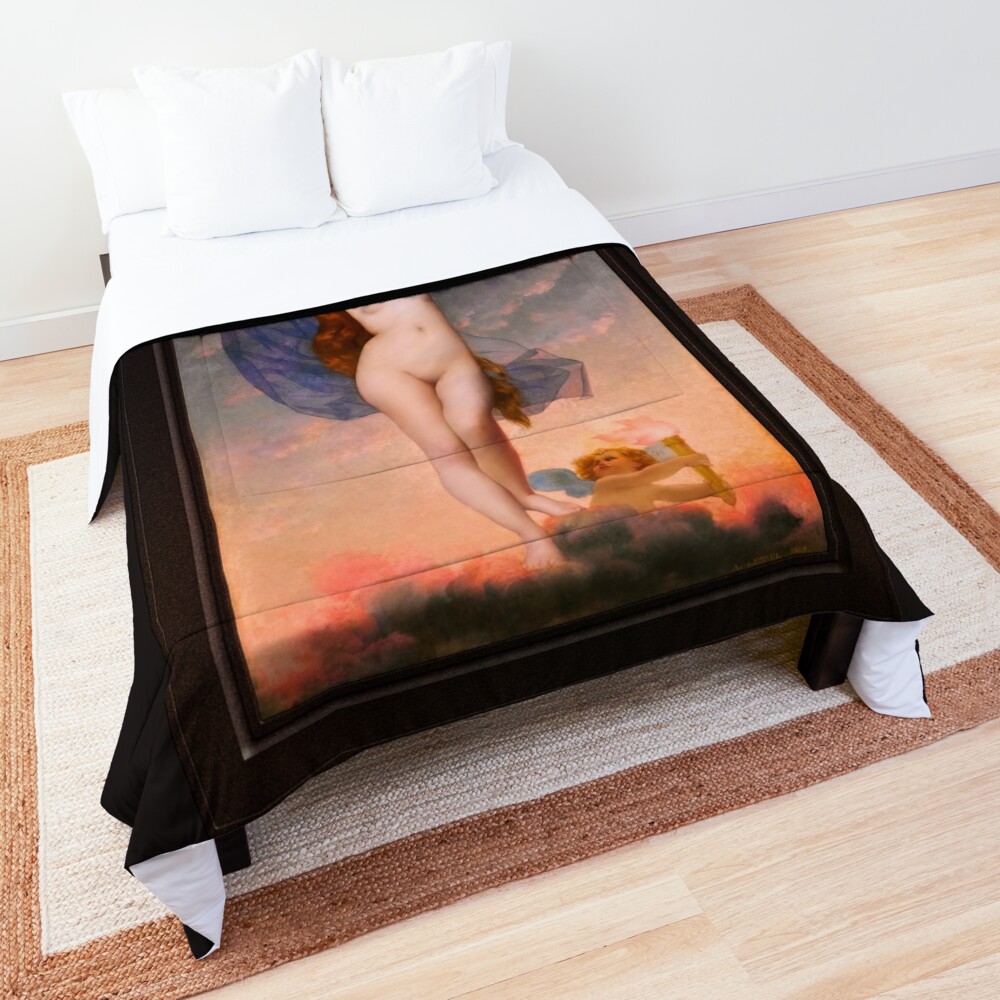
Table of Contents
Compositional Elements & Narrative
The painting depicts the mythological figure of Aurora, the Roman goddess of dawn, as she rises from a swirling cloudscape to herald the arrival of daylight. Lesrel’s composition is vertically oriented, emphasizing Aurora’s ascent and drawing the viewer’s eye upwards towards the celestial sphere. The lower portion of the canvas is dominated by turbulent clouds rendered in shades of orange, pink, and grey, suggesting the fading remnants of night. These clouds serve as a dramatic base for Aurora’s figure, which occupies the central space.
To the right, partially obscured by the swirling mists, appears a cherubic figure holding aloft a torch or lamp. This detail reinforces the theme of dawn and the transition from darkness to light. The crescent moon hangs in the upper left corner, further emphasizing the passage of time and the cyclical nature of day and night.
Aurora: Form & Expression
Aurora herself is depicted as a nude female figure with flowing auburn hair cascading down her shoulders. Her pose is dynamic; she raises one arm towards the sky while extending the other to hold a translucent blue drapery that billows around her, seemingly caught in an unseen breeze. The drapery adds a sense of movement and ethereal quality to the composition.
Lesrel’s rendering of Aurora’s anatomy demonstrates a mastery of classical form. Her body is idealized, exhibiting smooth contours and graceful proportions characteristic of academic art. However, unlike the rigid formality often associated with Neoclassicism, Lesrel infuses his depiction with a Romantic sensibility through her expressive face. Her gaze is directed upwards, conveying a sense of hope and anticipation as she brings forth the new day. A laurel wreath adorns her head, a traditional symbol of victory and honor.
Color Palette & Technique
The color palette in “L’Aurore” is rich and vibrant. The warm tones of orange and pink in the clouds contrast beautifully with the cool blues of Aurora’s drapery and the pale complexion of her skin. Lesrel employs a technique known as chiaroscuro, using dramatic contrasts between light and shadow to create depth and volume. Light seems to emanate from an unseen source, illuminating Aurora’s form while leaving portions of the clouds in deep shadow.
The brushwork is visible yet controlled, demonstrating Lesrel’s skill in blending realism with a painterly aesthetic. The overall effect is one of luminous beauty and dramatic intensity. The artist skillfully uses glazing techniques to achieve subtle gradations of color and create a sense of atmospheric perspective.
Context & Artistic Influences
Lesrel was a prominent figure within the French art world, known for his history paintings and allegorical works. “L’Aurore” reflects the artistic trends of its time, drawing inspiration from classical mythology and the Romantic movement’s emphasis on emotion and drama. The painting can be seen as part of a broader trend in 19th-century art that sought to elevate mythological subjects to the level of historical importance.
The influence of artists like Jean-Auguste-Dominique Ingres, with his focus on anatomical accuracy and idealized forms, is evident in Lesrel’s depiction of Aurora. However, Lesrel also incorporates elements of Romanticism, particularly in the dramatic lighting and expressive rendering of the figure’s emotions. The painting showcases a synthesis of these influences, resulting in a work that is both technically accomplished and emotionally engaging.
Legacy & Significance
“L’Aurore” remains an important example of French academic art from the mid-19th century. It demonstrates Lesrel’s skill as a painter and his ability to synthesize classical and Romantic artistic traditions. The painting continues to captivate viewers with its beauty, drama, and evocative portrayal of the dawn. Its enduring appeal lies in its timeless depiction of renewal, hope, and the cyclical nature of time.
This is a remastered digital art old masters reproduction of a public domain image that is available as a rolled canvas print online.


