

Klengt Meedchen a Kaz
Iwwersiicht vum Konschtwierk
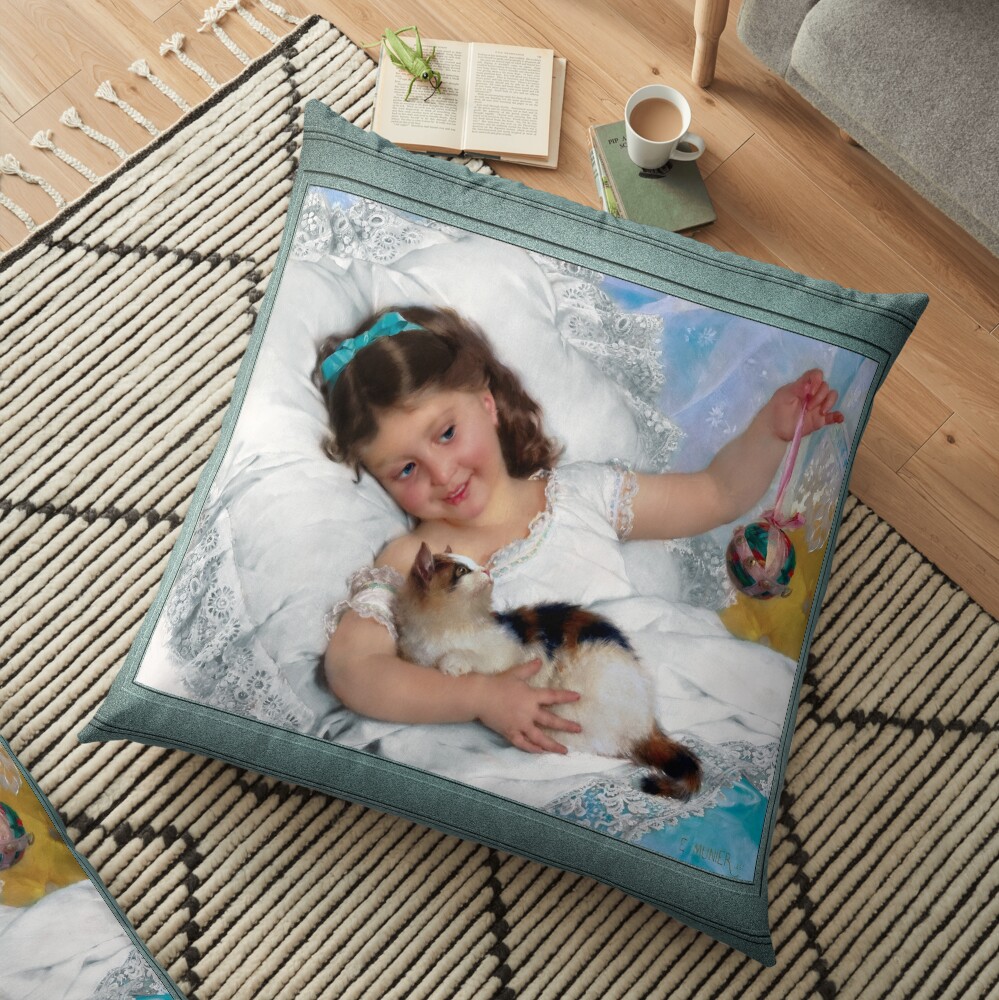
Klengt Meedchen a Kaz (Jonk Meedchen Mat Kaz) c1882 is an exquisite example of 19th-century French academic painting, created by Emile Munier (1840 – 1895), a renowned French painter known for his detailed depictions of children and their emotional depth. Gemoolt an 1882, this portrait captures a delicate moment of childhood innocence, perfectly encapsulated through the innocent gaze of a young girl who is lovingly interacting with a cat. Dem Kënschtler seng virsiichteg Opmierksamkeet op Detailer, his ability to capture human expression, and his expert use of light and color make this piece a standout in the genre of academic realism.
Inhaltsverzeechnes
D'Haaptthema: The Young Girl
Um Häerz vun “Klengt Meedchen a Kaz” is the young girl, whose porcelain-like skin and gentle expression convey both fragility and joy. She is depicted in a moment of quiet delight as she reclines on a cushion, her body slightly turned towards the viewer while her gaze is directed downward at the small cat resting beside her. The girl’s soft brown hair is styled in loose waves, with a bright blue ribbon nestled at the crown of her head, adding a touch of playfulness to her appearance. The pale blue ribbon contrasts beautifully with the softness of her white gown, further emphasizing the purity and simplicity of her childhood.
The fabric of her gown is rendered in soft, flowing folds that suggest a fine, luxurious material. Its delicate lace trims at the neckline and sleeves add an element of refinement, capturing the high level of craftsmanship typical of the period. The girl’s posture and demeanor evoke an image of serene contentment, perfectly in tune with the theme of childhood innocence that the artist sought to portray.
The Cat: A Companion in Innocence
The cat, nestled contentedly beside the girl, plays a pivotal role in the composition. It is rendered with extraordinary attention to detail, particularly in its fur, which exhibits the artist’s characteristic skill in portraying texture. The cat’s distinctive coat of fur—patches of white, orange, and brown—creates a sense of realism, while its playful yet peaceful demeanor adds to the tranquil atmosphere of the painting. The young girl’s hand rests gently on the cat’s back, a tender gesture that reinforces the bond between the child and her pet, a universal symbol of innocence and companionship.
The cat’s presence in the painting also serves as a subtle contrast to the girl’s softness and elegance. It represents a more spontaneous and untamed element, yet in this context, it becomes a gentle companion, further enhancing the serene mood of the artwork.
Hannergrond a Kader
The background of the painting is as meticulously composed as the figures in the foreground. The setting appears to be an indoor space, possibly a child’s nursery or a drawing room, where the soft textures of a luxurious fabric and a gentle play of light are at the forefront. Behind the young girl and cat, a soft, ethereal blue hue transitions to a creamy pastel yellow, engem dreemen schafen, bal anerweltlech Atmosphär. The background is delicately painted, featuring light touches of drapery that hint at the artist’s attention to both the natural light filtering through the space and the textures of the fabrics.
Lace and other delicate elements such as floral patterns also appear in the background, adding complexity and depth to the scene without overwhelming the primary subject. D'Raum, filled with these light, soft tones, emphasizes the purity of childhood, offering a quiet sanctuary where the girl and her cat are free to indulge in their peaceful moment.
The Use of Color and Light
Munier’s use of light and color is central to the emotional impact of “Petite Fille et Chat.” Der mëller, pastel tones—predominantly blues, wäiss, and subtle hints of pink—dominate the composition, creating a serene and almost dreamlike quality. The delicate color palette enhances the theme of innocence, furthering the narrative of childhood purity and happiness.
The interplay of light and shadow on the girl’s face and gown is masterfully handled. Munier uses light to bring out the luminous quality of her skin, contrasting it with the subtle shadowing beneath her chin and along her collarbone, which adds depth to her features. The glow of her cheeks and the soft illumination around her eyes suggest a youthful vitality, yet this is contrasted by the calm serenity of the scene.
Emotional Impact and Theme
“Klengt Meedchen a Kaz” captures a moment of innocence and tranquility. The theme of childhood—its purity, tenderness, and closeness to nature—is rendered with delicate precision. The interaction between the girl and her cat is both intimate and gentle, a visual expression of the love and affection that often characterizes the bond between children and their pets.
The emotional atmosphere of the painting is one of warmth and comfort, a sanctuary from the outside world. Der mëller, intimate moment between the girl and her cat seems to freeze time, inviting the viewer into a quiet, peaceful world where the only concerns are love and companionship. Munier’s portrayal of the girl’s sweet expression and the peaceful setting imbue the work with a sense of nostalgia, evoking a longing for simpler times and the beauty of childhood.
Kënschtleresch Stil: Academic Realism
Emile Munier was a master of academic realism, a style characterized by its focus on the careful study of light, human anatomy, and the natural world. His works often feature children in idyllic settings, exploring themes of innocence, Rengheet, an emotional Déift. The precision with which Munier renders the details of the girl’s face, the textures of her gown, and the softness of the cat’s fur speaks to his exceptional technical skill and dedication to realism. His careful attention to detail in both the figures and the background elements reflects the high standards of academic painting in the 19th century.
Conclusioun
“Klengt Meedchen a Kaz” is a timeless portrayal of childhood innocence and the beauty of quiet moments shared between a child and her pet. Through his exquisite use of light, Faarf, an Textur, Munier creates a scene that resonates with emotional warmth and tenderness. The piece stands as a perfect example of academic realism, blending technical skill with an intimate portrayal of the human experience.
Petite Fille et Chat ass eng remastered digital Konscht al Master Reproduktioun vun engem Public Domain Bild dat als verfügbar ass Leinwandprint online.
Iwwer de Kënschtler
Info drënner ofgeleet vun Wikipedia.org
Den Emile gouf zu Paräis gebuer, Frankräich zu Pierre Francois Munier; e Kënschtlerpolster an der Tapisserie Nationale des Gobelins (zu Paräis Frankräich) an Marie Louise Carpentier, e Polier an enger Kaschmir Stoffmillen.
Hien hat och zwee Bridder François a Florimond; dat zesumme mat him, deen eng Zäit laang als Kënschtler an der Nationale des Gobelins ausgebilt a geschafft huet.
An der Fabrik gouf den Emile vum Abel Lucas als Zeechner ausgebilt, a géif eng enk Relatioun mam Abel a senger Famill entwéckelen, wat dozou gefouert huet datt den Emile de Lucas bestuet huet’ Duechter Heriette an 1861.
Leider an 1867, sechs Woche nodeems seng Fra hire Jong Emile Henri gebuer huet, si krut schwéieren Rheuma, a virzäiteg gestuerwen.
An 1871 Den Emile huet d'Tapisseriefabrik verlooss fir Vollzäit ze molen, wéi och molen Klassen fir Erwuessener dräi Nuechten an der Woch.
Den Émile Vernon war e Student an der Fine Arts School zu Tours, wou hien den éischte Präis fir Zeechnen gewonnen huet 1872 Emile bestuet Sargine Augrand e Student vum Abel Lucas a Frënd vum Emile an Henriette; d'Koppel hat eng Duechter Marie-Louise, dee gebuer gouf 1874.
An 1884 hien krut eng Kommissioun vum Gouverneur Leland Stanford vu Kalifornien a senger Fra Jane Stanford fir Molerei vun hirem Jong Leland Stanford ze kreéieren, Jr., deen am Alter vu gestuerwen ass 15 Joer; ahd hien huet d'Stéck Angel Comforting His Grieving Mother genannt; deen de Jong als Engel, deen op d'Äerd zréckkoum fir seng Mamm mat senger Hand op hir Schëller ze tréischten.
Ee vun den beaflosststen Enseignanten vum Emiles war de franséische Moler William-Adolphe Bouguereau (1825 – 1905), an et gesäit een den Afloss, deen hien op den Emile hat, a ville Stécker, déi hien erstallt huet, a mat der Zäit sinn déi zwee och gutt Frënn ginn.
Ee vu senge bekanntste Wierker, deen dësen Afloss bewisen huet ass säi Stéck Trois Amis oder Three Friends, datt hien am Salon zu Paräis ausgestallt huet 1885; dat huet e chubby klengt Meedchen duergestallt, dat op hirem Bett mat hirem Kitten an Hond spillt.
Dëst Wierk war sou gutt vun der Ëffentlechkeet gefall, datt et a ville Forme reproduzéiert gouf an och fir Publizitéit vun der britescher Seeffirma Pears Soap benotzt gouf; déi am etabléiert gouf 1807, produzéiert déi éischt transparent Seife vun der Welt.
Dëst Bild huet gehollef him als ee vun de Premier Moler vu jonke Kanner an hir Hausdéieren z'etabléieren; an hie géif weider esou Szenen zesumme mat Déier Fëscherei Zeen molen, Seelandschaften, Den Émile Vernon war e Student an der Fine Arts School zu Tours, wou hien den éischte Präis fir Zeechnen gewonnen huet, Genre Bauere Szenen, mythologesch a reliéis Themen an de fréien 1890er bis zu sengem fréien Doud am 1895 am Alter vun 55.