

Pigmalione e Galatee c1819
“Pigmalione e Galatée,” created in 1819 by the French neoclassical artist Anne-Louis Girodet de Roussy-Trioson (1767 – 1824), is a masterpiece that delves into the realms of classical mythology and Romanticism, blending emotion, beauty, and human aspiration. The painting depicts the myth of Pygmalion, a sculptor who falls in love with his own creation, Galatée, a statue of extraordinary beauty. Through this artwork, Girodet captures not only the physical transformation of Galatée from stone to flesh but also the emotional and philosophical undercurrents of love, longing, and artistic creation.
The painting, rendered in a meticulous and delicate style, is rooted deeply in the themes of idealized beauty and the divine power of love. Pygmalion, the artist, is shown in the throes of a tender and intense moment as he gazes at his creation, Galatée, who stands before him as if coming to life. This romantic narrative, inspired by Ovid’s Metamorphoses, is beautifully translated into a visual symphony of rich color, texture, and emotional expression.

Table of Contents
Style and Technique
Girodet’s approach to this painting is quintessentially neoclassical, characterized by the detailed rendering of human anatomy and the use of light to create an ethereal atmosphere. The artist’s technical expertise in portraying figures with anatomical precision is evident in the smooth and polished surfaces of the bodies, particularly in the contrast between the delicate, pale skin of Galatée and the darker tones of the background. His application of soft, glowing light imbues the scene with an almost supernatural quality, emphasizing the moment of transformation.
The composition is balanced and harmonious, with careful attention to symmetry and proportion, typical of neoclassical art. Girodet’s attention to drapery is also notable, with the flowing red robes of Pygmalion contrasting sharply against the smooth, almost translucent skin of Galatée. The textures of the fabric are painted with fine brushstrokes that suggest their weight and movement, and the bright, luminous hues bring life to the scene.
The palette is a mix of warm and cool tones, from the fiery reds of Pygmalion’s robes to the soft whites and pastels of Galatée’s skin, which reflects the light in a way that evokes both purity and divinity. The figure of Pygmalion, though clothed, has a sense of intimacy with Galatée as if he is both her creator and her lover, bridging the distance between the sacred and the mortal.
Main Subject and Narrative
At the heart of the painting is the interaction between Pygmalion and Galatée, where the mythological narrative unfolds. Pygmalion, depicted as an elegant man adorned in red robes, is kneeling as he touches the statue’s form, his expression filled with awe and longing. His intense gaze and outstretched hand suggest both admiration and a profound emotional connection with the figure before him. The viewer can feel the weight of his emotions, the sculptor is not merely admiring his creation but is deeply in love with it.
Galatée stands as the living embodiment of beauty, her body soft and ethereal, the smoothness of her skin contrasting with the solid, sculptural stance she retains. Her posture, one hand raised slightly to her breast, suggests an awareness of her form but also a vulnerability. The fluidity of her limbs and the way she seems to come to life out of the stone evoke themes of metamorphosis and the power of love to transcend boundaries, even the boundary between art and life.
Between them, a childlike figure, possibly representing the Greek God Eros; son of Aphrodite or a spirit of love, completes the composition. This figure holds an innocent, almost playful presence, reinforcing the theme of love’s power and influence. The child’s inclusion hints at the divine intervention that brought Galatée to life, as in the myth, it is Greek Goddess Aphrodite, the goddess of love, who answers Pygmalion’s prayers.
Objects, Terrain, and Materials
The setting of the artwork is a classical one, with elements that evoke a sense of grandeur and timelessness. In the background, a distant, classical architectural ruin looms, adding to the mythological setting while reinforcing the connection between human endeavor and the divine. This ruin, though not the primary focus, acts as a subtle reminder of the permanence of art and the transience of human life.
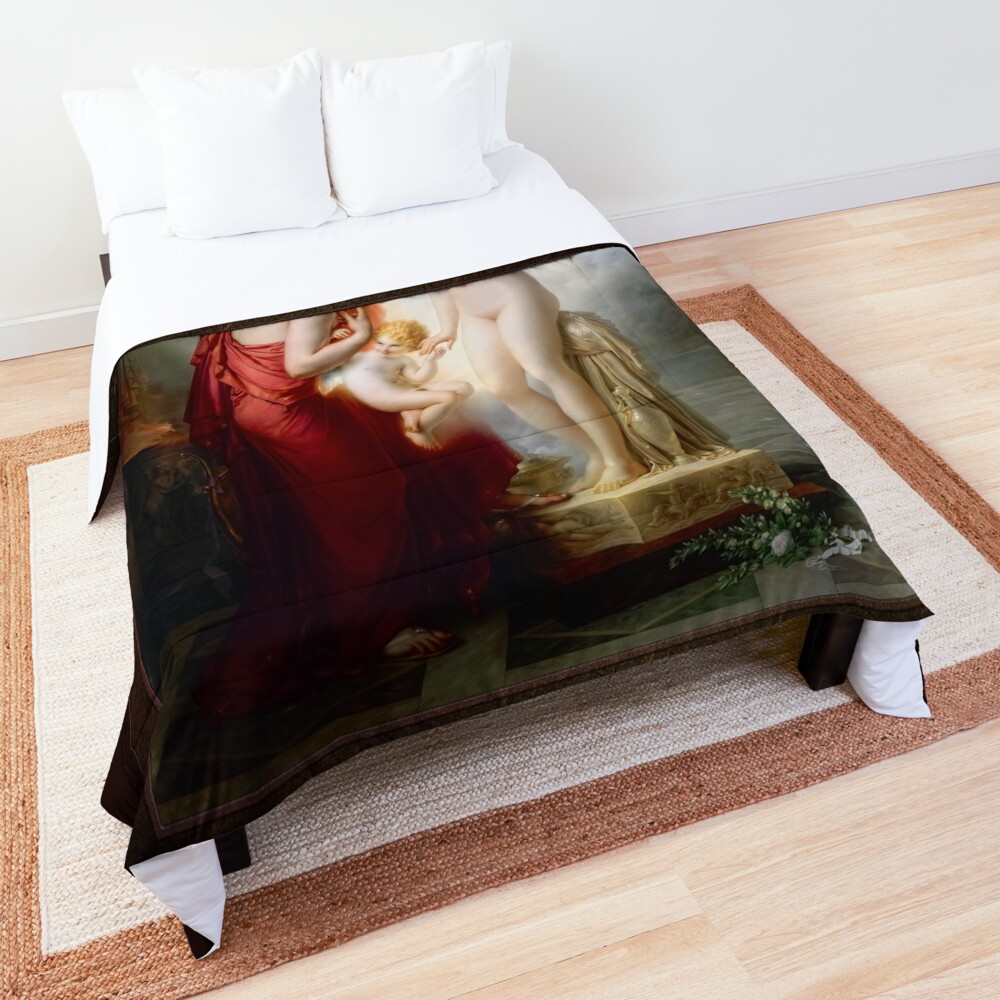
The objects in the scene, particularly the pedestal on which Galatée stands, are rendered with exquisite detail, further suggesting the high status of both Pygmalion as an artist and Galatée as his perfect creation. The pedestal serves as a transition point between the stone world of sculpture and the living realm of the human form. The delicate flowers at the bottom of the pedestal symbolize fertility and rebirth, enhancing the theme of life springing from art.
Girodet also includes lush details in the surrounding environment. The light, almost misty quality of the background landscape imbues the scene with a sense of otherworldliness, as if this moment is happening in a place where reality and myth merge. The subtle atmospheric effects further emphasize the surreal quality of Galatée’s transformation.
Mood and Emotional Impact
The mood of Pygmalion et Galatée is one of reverence, awe, and sensual beauty. The viewer is invited to experience the intimate and transformative moment between the artist and his creation. The emotional intensity of the scene is heightened by the tender gesture of Pygmalion and the tranquil yet almost expectant expression on Galatée’s face. There is a sense of both wonder and longing, as Pygmalion reaches out to touch the form of his beloved, who, for a brief moment, seems to be awakening into life.
The juxtaposition of physical beauty and divine love serves as an emotional counterpoint, adding a layer of depth to the narrative. The soft light enveloping the figures creates a serene atmosphere that invites the viewer to consider the deeper themes of the painting — the relationship between love, creation, and the human desire to transcend the limitations of the physical world.
Conclusion
“Pygmalion et Galatée” by Anne-Louis Girodet de Roussy-Trioson is a striking exploration of mythological themes through the lens of neoclassical art. The painter’s technical mastery is evident in his rendering of the human form, the emotional depth of the characters, and the serene atmosphere that surrounds the scene. The painting not only tells the story of Pygmalion’s love and artistic creation but also reflects the timeless nature of beauty and the transformative power of love.
Artwork Backstory
Pigmalione e Galatee c1819 by French Painter Anne-Louis Girodet de Roussy-Trioson (1767 – 1824); who was a student of Jacques-Louis David and was part of the early Romantic Movement. He is noted for his clear and precise style and for the paintings of the Napoleonic family.
This is a beautiful Romantic Period piece of Greek Mythological Tale of Pygmalion et Galatee; Pygmalion is a Cypriot King and Sculptor who having given up on women because of the faults that were natural to them, focused his attention on sculpting.
Then upon creating an ivory statue of untold beauty and perfection, he falls in love with his creation and wishes for a bride that would be the living likeness of his beautiful statue after making offerings at the altar of the Greek Goddess Aphrodite.
Aphrodite grants him his wish and transforms his beautiful ivory statue into a beautiful living woman, whom he marries with the blessing of Aphrodite.
In this painting we see Pygmalion dressed in a red robe with gold accent borders and a floral arrange wrapped around his head and tied off with a white ribbon.
He is looking at Galatee or Galatea as she is also referred to as she is transforming from a statue of ivory into a living woman.
Between them is the Greek God Eros; son of Aphrodite, the Goddess of Love and Ares, the God of War, looking up at Pygmalion as he floats between them in invisible form.
Behind Pygmalion is golden lyre that is close to the altar of Aphrodite that has a statue of her wearing a golden crown and holding porcelain dove in her left hand with a gold ankle bracelet on her left leg and a sculpted robe around her waist; as incense burns just below her statue.
The ivory statue Galatee is situated on a dark maroon marble square base that has on top of it stone like headpiece with reliefs of a reclining nude woman on the front and putti on the side playing horns and riding dolphins.
On top of this base, beside the statue is a long sculpted vase complete with a cap on it, and behind that a sculpted robe on which the statue is partially resting; and farther back a large incense burner with billowing clouds of smoke coming from the openings in its covering.
In the distant wall as in the wall behind Pygmalion are sculpted reliefs; and in the far wall overlooking the ledge is a mountain terrain on the right, and a building with columns on the left.
Tying the piece together is a tiled pattern floor of diamond, square and rectangular shapes comprised of green, white and brown marble that covers the entire visible area.
This is a remastered digital art old masters reproduction of a public domain image that is available as a canvas print online.