

The Lady with the Veil
“The Lady with the Veil (the Artist’s Wife)” is a captivating portrait created by Swedish painter Alexander Roslin in 1768. Roslin, who was born in 1718 and died in 1793, was renowned for his skill in portraiture, and this work stands as a testament to his mastery. The subject of the painting is none other than the artist’s own wife, Marie Suzanne, who was often depicted by Roslin in several of his works. In this particular portrait, the artist captures his wife with an alluring and serene expression, her face partially veiled, adding an air of mystery and grace to the composition.
The painting’s subtle yet sophisticated tone is enhanced by Roslin’s delicate brushwork and the soft, almost ethereal quality he imparts to his subjects. The mood is one of quiet elegance and restrained sensuality, drawing the viewer into an intimate moment with the woman behind the veil. The composition is meticulously planned, with a focus on the textures of fabric, the play of light and shadow, and the precise rendering of the subject’s features. It is a classic example of the Rococo style, which was prominent in Europe during the 18th century. Roslin’s use of color, light, and shadow exemplifies the Rococo’s emphasis on elegance, romance, and decorative detail.
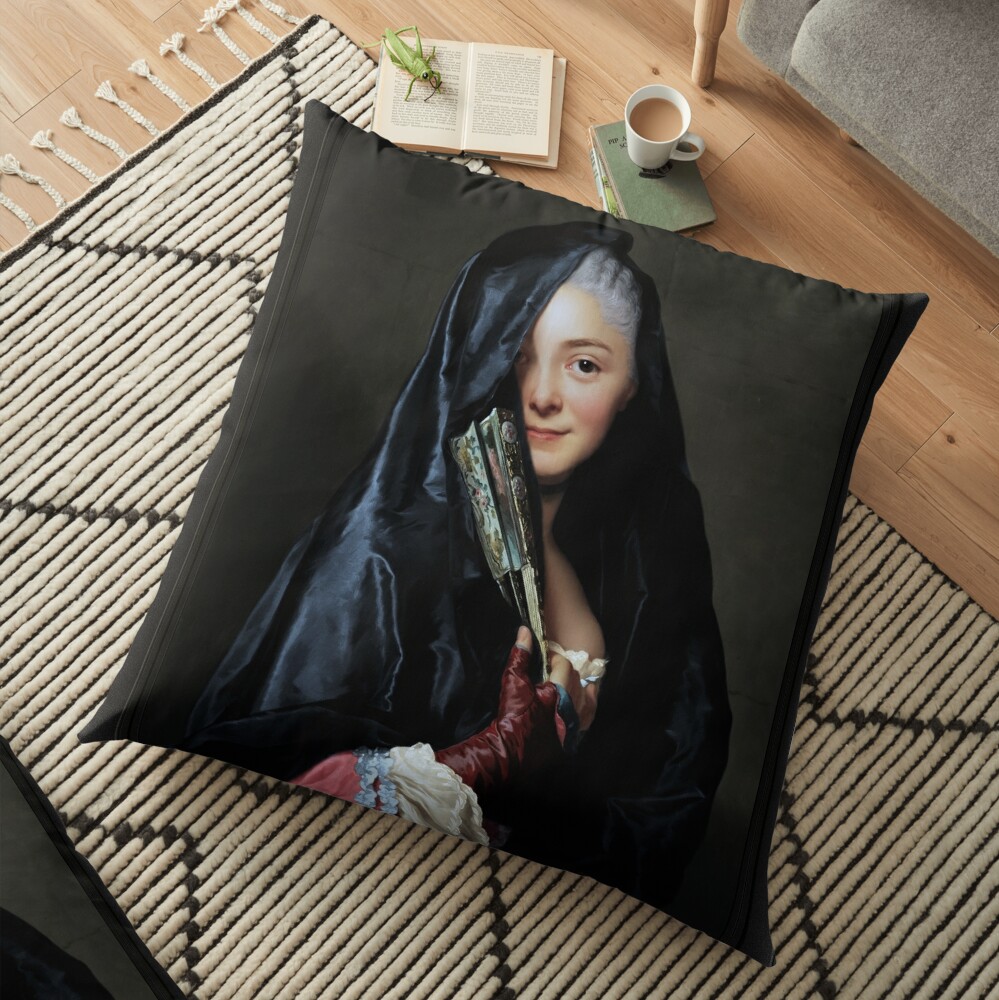
Table of Contents
The Main Subject: The Artist’s Wife
At the heart of the painting stands the artist’s wife, who exudes an aura of calm and sophistication. Her gaze is direct and engaging, yet there is a soft mystery to her expression, partly due to the veil that covers her head. The veil is a significant element in the composition, as it creates an element of intrigue and lends an air of modesty and delicacy to the subject, while still allowing for a glimpse of her refined beauty. The artist has chosen to depict her not in an overtly dramatic pose, but rather in a natural, serene manner that suggests a quiet moment of reflection or contemplation.
Her attire is another striking aspect of the painting. She wears a luxurious gown, typical of the Rococo period, in which delicate fabrics such as silk and lace are used to create a sense of refinement and aristocratic elegance. The gown is adorned with rich folds and intricate details that showcase Roslin’s attention to fabric texture. The contrast between the flowing silk of the gown and the more rigid, structured nature of the veil enhances the visual depth of the painting, adding layers of texture and dimension to the composition.
Objects: The Fan and Accessories
One of the most notable objects in the painting is the fan held by the subject. The fan is not only a fashionable accessory, but it also serves as a symbolic gesture of grace and refinement. Its position in the composition, near the subject’s face, subtly directs the viewer’s attention toward her face and adds to the overall sense of elegance. The fan’s intricate design, with its delicate patterns and textures, contrasts beautifully with the smooth sheen of the veil and the soft folds of the gown.
Another important detail is the gloved hand of the subject, which adds a touch of formal propriety and underscores the aristocratic nature of the painting. The gloves are richly textured, their deep red hue contrasting with the white lace trim of the gown. This attention to detail in both the clothing and accessories speaks to Roslin’s technical skill and his ability to render the material world with accuracy and beauty.
Terrain and Background
The background of the painting is kept simple and unobtrusive, with a muted, almost abstract color palette that ensures the viewer’s focus remains on the subject. The use of shadow and light in the backdrop is masterful, enhancing the depth of the portrait while keeping the overall composition elegant and restrained. The subtle darkness of the background also serves to highlight the subject’s face, creating a striking contrast between her illuminated features and the shadowy surroundings.
The lack of any overtly defined setting contributes to the intimacy of the portrait. By omitting detailed backgrounds or landscapes, Roslin places the emphasis solely on the figure and her attire, allowing her persona to take center stage. This approach was characteristic of many portrait artists of the time, as it emphasized the dignity and elegance of the sitter over their surroundings.
Style and Technique
As with many of Roslin’s works, “The Lady with the Veil” exemplifies the Rococo style, which is known for its lightness, elegance, and elaborate detail. The use of soft, pastel colors and the fluid, graceful rendering of fabrics and textures is a hallmark of this style. The painting is filled with refined, delicate details, from the intricate lace trim of the gown to the subtle shading on the subject’s face, which conveys a sense of realism and three-dimensionality. Roslin’s mastery of light is evident in the way the soft light falls on the subject’s face, accentuating the softness of her features while also adding depth to the folds of her gown.
The artist’s brushwork is delicate yet assured, capturing both the textures of the materials and the inner calm of the subject. The veil itself is rendered with remarkable skill, the fabric appearing almost weightless, yet conveying a sense of richness and texture. This level of technical proficiency is one of the reasons why Roslin is considered one of the preeminent portrait painters of the 18th century.
Theme and Mood
The overall theme of the portrait revolves around aristocratic grace and refinement, as well as the intimate relationship between the artist and his wife. The mood is one of quiet elegance, with an undercurrent of mystery. The veil, combined with the soft lighting and the elegant pose, suggests a hidden depth to the subject’s character, inviting the viewer to reflect on the identity and personality of the woman behind the portrait. This air of mystery is complemented by the subdued, almost introspective expression on her face, which draws the viewer into a private moment with the subject.
The portrait also speaks to the Rococo fascination with beauty, luxury, and the refinement of the aristocracy. By focusing on the details of the subject’s attire and accessories, Roslin not only portrays his wife but also captures the essence of the high-society world in which she moved.
Conclusion
“The Lady with the Veil” is a masterpiece of 18th-century portraiture that encapsulates the elegance, grace, and technical precision of the Rococo period. Through his portrayal of his wife, Alexander Roslin creates a work that is both intimate and refined, drawing the viewer into a world of aristocratic beauty and quiet sophistication. The attention to detail, the play of light and shadow, and the careful rendering of fabric and texture all contribute to the timeless quality of this work. It is a portrait that invites contemplation and appreciation of both the subject and the artist’s exceptional skill.
The Lady with the Veil is a remastered digital art old masters reproduction of a public domain image that is available as a canvas print online.
Artist Bio
Alexander was born to the naval physician Hans Roslin and his wife Catherine Wertmüller on July 15, 1718; and showing an early talent for drawing and painting he was sent to Karlskrona, Sweden to be trained in drawing under the Admiralty Captain Lars Ehrenbill (1697–1747), so that he could become a naval draughtsman.
It was during this time that he also began painting miniatures and would later move to Stockholm, Sweden; which at the time had become an intellectual and artistic center [due to the efforts of Queen Christina (1626 – 1689 ruled from 1644 – 1654), who had established ties with Paris, France], and at the age of sixteen became apprenticed to the Swedish court painter Georg Engelhard Schröder (1684 – 1750); remaining there studying painting until 1941, moving to Gothenburg, and then Scania the following year, where he stayed for the next four years.
Thin in 1745 Alexander left Sweden for Bayreuth, Germany upon receiving an invitation to work for Frederick, Margrave of Brandenburg-Kulmbach (1711 – 1763) of the House of Hohenzollern and eldest son of Georg Frederick Karl (1688 – 1735).
Two years later he moved to Italy to study the works of the great masters; then later that year moved to Paris, France where is he would settle and remain for the rest of his life.
In 1759 at the age of 41 he married the pastel painter Marie-Suzanne Giroust (1734 – 1772) with whom had six children (three sons and three daughters); and would paint a portrait of his wife in 1768 with her dressed in Bolognese fashion in a piece called Lady with Veil; he also painted a double portrait of him and his wife, she is depicted working in pastels on a portrait of Henrik Wilhelm Peill (1730 – 1797), while he points to a gold box he received from Peill as a present.
While living in Paris, Alexander became a protégé of French Painter François Boucher (1703 – 1770), which quickly made his artwork fashionable in France, and help lead to him being selected as a member of the French Art Academy, to which his wife also belonged; soon becoming one of the foremost portraitists of his time, valued mostly for practiced rendering of luxurious fabrics and gentle complexions.
Though Alexander was a foreigner he was award in 1765, a state pension and a free apartment in the Louuvre; and in the following year was awarded the Royal Order of Vasa by Sweden, after which he was called Roslin le Chevalier or Roslin the knight.