

Vénus désarmant Cupidon
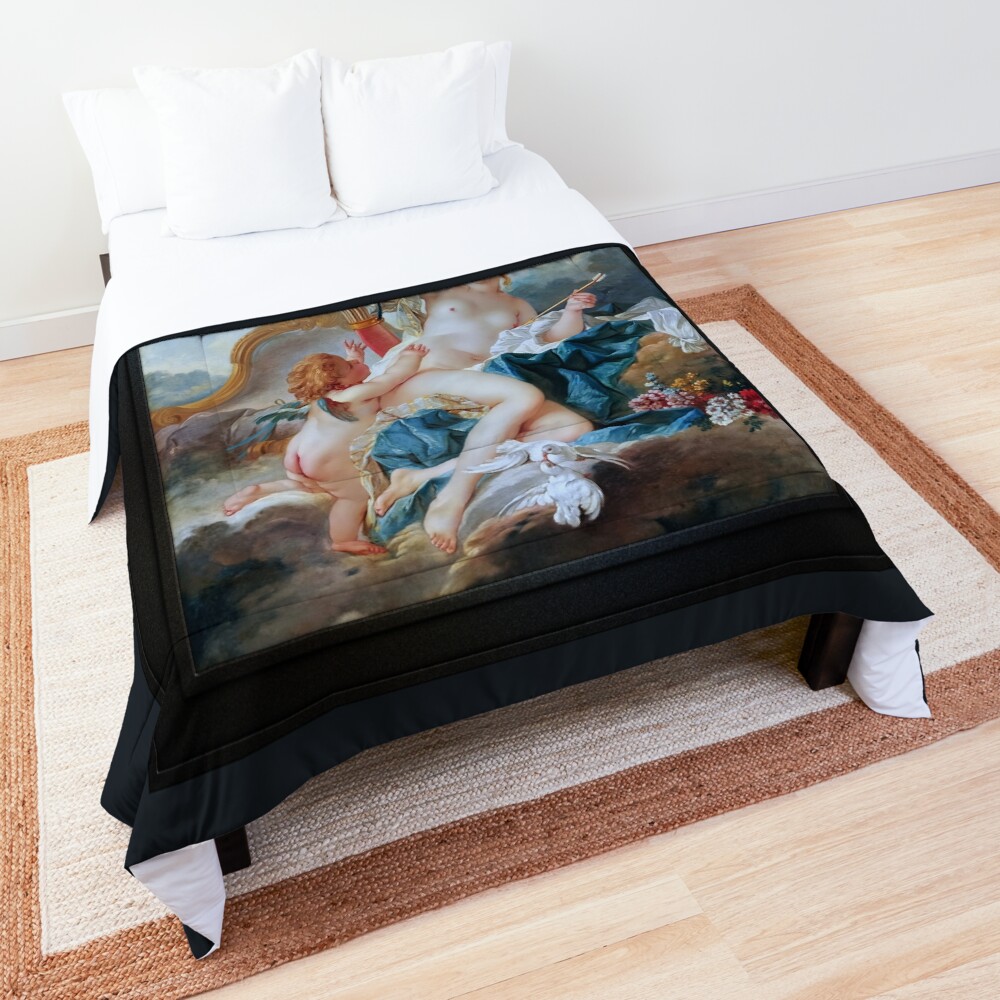
“Vénus désarmant Cupidon” (Venus Disarming Cupid), stworzony w 1751 by the celebrated Rococo artist Francois Boucher (1703 – 1770), is a quintessential example of the playful, sensual themes typical of the Rococo style. The painting features Venus, Rzymska bogini miłości, and Cupid, Jej psotny syn, in a tender and intimate moment. This work emanates an air of softness, czar, and light-heartedness, presenting a scene rich in symbolic meaning and lush visual details.
Spis treści
Główny temat: Wenus i Kupidyn
In this masterful composition, Venus is the central figure, depicted in a relaxed, reclining position on an ornate couch draped in luxurious fabrics. She is the epitome of grace and beauty, with her delicate features framed by soft curls and a serene expression. Wenus’ pose suggests both authority and gentleness, her body slightly turned towards Cupid as she lovingly and effortlessly disarms him. She holds the quiver of arrows, podczas gdy Cupid, depicted as a playful, cherubic child, attempts to pull away, symbolizing the restrained power of love.
Amorek, a symbol of unrestrained desire and the unpredictable force of love, is shown in a vulnerable moment, trying to escape from Venus’s grasp. His youthful form is soft and round, his small wings spread wide as he pushes against Venus’s tender hold. The playful struggle between mother and son represents the balance between the power of love, both as an uncontrollable force (Amorek) and as something that can be tempered or moderated by wisdom and restraint (Wenus).
Przedmioty i symbolika
In this Rococo masterpiece, objects within the scene are not merely decorative but carry profound symbolic weight. Venus’s quiver, from which she removes Cupid’s arrows, represents the tools of love and desire. The delicate arrows, typically seen as symbols of love’s unpredictability, are now disarmed and under Venus’s control, reinforcing her dominance over Cupid and, by extension, the power of love itself. The golden bow lying on the ground further emphasizes the shift from action to pause, and perhaps the temperance that Venus, Jako bogini miłości, represents.
The presence of doves at Venus’s feet adds another layer of meaning. In classical mythology, doves are often associated with love, czystość, and harmony, making them fitting companions to Venus, the goddess who embodies these ideals. The flowers scattered at the lower right of the painting, including roses and other vibrant blooms, mirror the themes of beauty, Miłość, i płodność, reinforcing the sensuous atmosphere of the work.
Teren i materiały
The landscape within “Vénus désarmant Cupidon” is soft and atmospheric, filled with light clouds and a faint suggestion of a distant horizon. This background is not meant to be a focal point but rather provides a gentle, dream-like setting that complements the figures of Venus and Cupid. The terrain is open, unconfined, with no sharp boundaries, allowing the figures to appear as if floating in an idealized, serene world where love is the prevailing force.
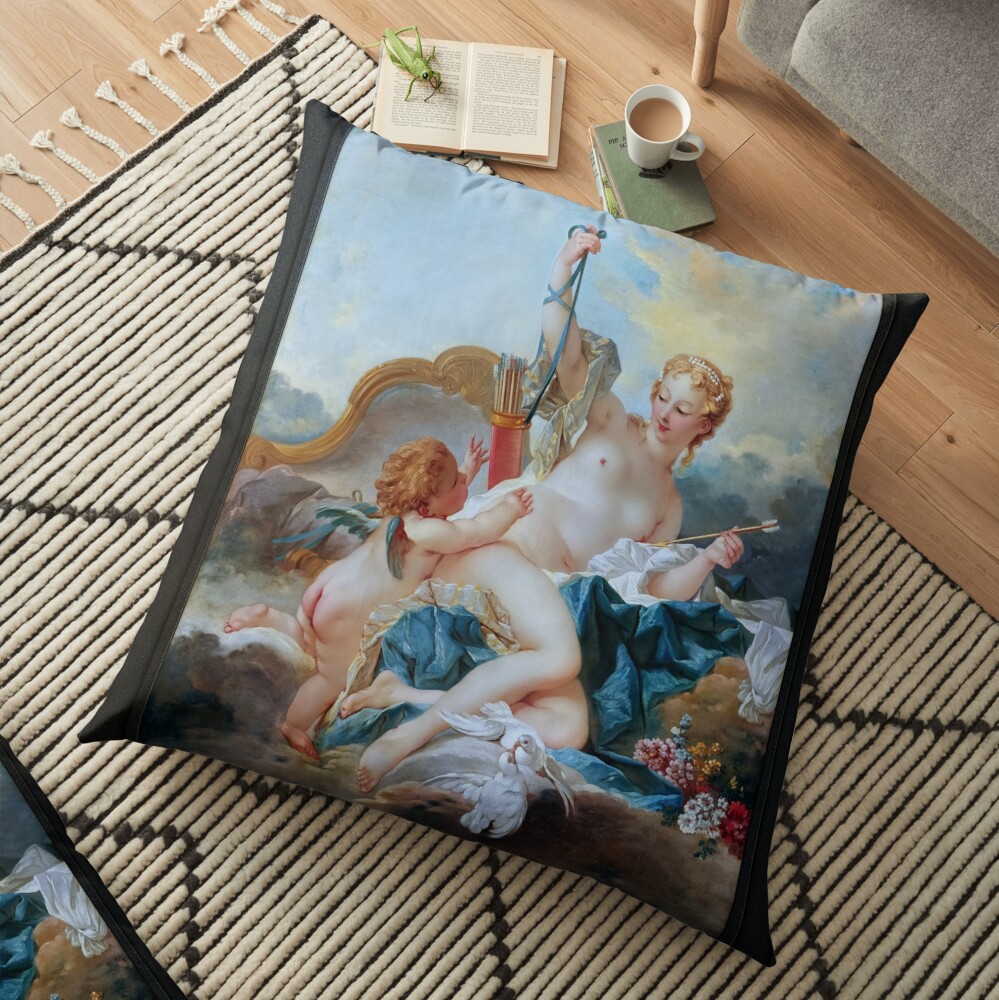
The materials depicted within the painting, rich fabrics, soft drapery, and the delicate textures of skin and hair—are rendered with incredible finesse, showcasing Boucher’s mastery of texture and detail. The smoothness of the skin contrasts beautifully with the lushness of the fabric surrounding the figures, emphasizing the ethereal quality of the scene. Venus’s gown, a flowing fabric of soft blues and whites, is meticulously painted to reflect light, enhancing the sense of movement and grace in her posture.
Styl, Temat, i Nastrój
François Bouchera “Vénus désarmant Cupidon” Pokazuje styl Rococo, characterized by its light, zwiewne kompozycje, playful themes, and emphasis on beauty and sensuality. The soft color palette of pastel blues, róże, and whites gives the piece a delicate, almost otherworldly quality, aligning with the Rococo emphasis on grace, elegancja, and charm.
The rounded, soft forms of the figures, along with their fluid poses, are indicative of the Rococo’s rejection of the hard lines and dramatic compositions of earlier Baroque works. Boucher’s signature use of light and shadow, coupled with the intricate detail of Venus’s drapery and Cupid’s cherubic features, makes the painting appear almost alive.
The mood of the painting is one of playful affection. The interaction between Venus and Cupid suggests not only the tender love of a mother for her son but also the nurturing, controlling aspect of love itself. Venus is not merely disarming Cupid; she is showing him that love can be both powerful and restrained. This juxtaposition between control and innocence, strength and tenderness, infuses the painting with a timeless charm.
Wniosek
“Vénus désarmant Cupidon” stands as a remarkable example of François Boucher’s ability to merge delicate beauty with allegorical depth. Through his mastery of Rococo style, Boucher captures the nuances of love in both its playful and powerful forms. Wenus, as the dominant yet nurturing figure, and Cupid, as the symbol of love’s unpredictable force, together create a timeless narrative of affection, control, and the eternal dance between the two.
Vénus désarmant Cupidon is a remastered digital art old masters reproduction of a public domain image that is available as a druk na płótnie online.
Informacje poniżej pochodzą z Wikipedia.org
Pochodzący z Paryża, Boucher był synem mniej znanego malarza Nicolasa Bouchera, który dał mu pierwszy trening artystyczny. W wieku siedemnastu lat, obraz Bouchera podziwiał malarz François Lemoyne. Lemoyne mianował później Bouchera swoim uczniem, ale już po trzech miesiącach, poszedł do pracy dla grawera Jean-François Cars.
W 1720, zdobył elitarne Grand Prix de Rome za malarstwo, ale dopiero pięć lat później skorzystał z wynikającej z tego możliwości studiowania we Włoszech, z powodu problemów finansowych w Królewskiej Akademii Malarstwa i Rzeźby.[1] Po powrocie ze studiów we Włoszech został przyjęty do zrefundowanej Académie de peinture et de sculpture na 24 listopad 1731. Jego kawałek recepcji (kawałek recepcji) był jego Rinaldo i Armida z 1734.
Boucher poślubił Marie-Jeanne Buzeau w 1733. Para miała razem troje dzieci. Boucher został członkiem wydziału w 1734 i od tego momentu jego kariera nabrała tempa, gdy został mianowany profesorem, a następnie rektorem Akademii, zostaje inspektorem w Królewskiej Manufakturze Gobelinów i wreszcie premierem Peintre du Roi (Pierwszy malarz króla) w 1765. Portret Marie-Louise O'Murphy c. 1752
Boucher zmarł dnia 30 Móc 1770 w rodzinnym Paryżu. Jego imię, wraz z tym jego patronki Madame de Pompadour, stał się synonimem francuskiego stylu rokoko, prowadząc braci Goncourt do pisania: “Boucher jest jednym z tych mężczyzn, którzy reprezentują smak stulecia, kto wyraża?, personifikować i ucieleśniać go.”
Boucher słynie z tego, że mówi, że natura jest “zbyt zielony i słabo oświetlony” (zbyt zielony i źle oświetlony).
Boucher był związany z grawerem kamieni szlachetnych Jacques Guay, kogo nauczył rysować. Był również mentorem dla morawsko-austriackiego malarza Martina Ferdinanda Quadala oraz neoklasycznego malarza Jacquesa-Louisa Davida w 1767.[4] Później, Boucher wykonał serię rysunków dzieł Guay, które Madame de Pompadour następnie wygrawerowała i rozprowadziła jako ładnie oprawiony tom wśród uprzywilejowanych dworzan