

A Boyarina Beauty
A Boyarina Beauty by Russian Painter Konstantin Makovsky (1839 – 1915); erikoistunut venäläisiin historiallisiin maalauksiin, jotka näyttävät idealisoidun näkemyksen venäläisestä elämästä menneinä vuosisatoina.
This exquisite portrait of a beautiful young Boyarina, shows a young girl from a noble Russian family dressed in the attire that a young lady would have worn in the19th century.

The young lady is wearing a large gold kokoshnik on her head and a venchik over her hair, with a matching rope choker around her neck that has a gold Christian Cross hanging from its end.
Resting on her shoulders is thick red woolen shoulder plate withe floral embroidery, which itself rest on an indoor white-yellow heavy woolen coat with colorful floral designs.
Beneath her coat is a heavy floor length red dress that has three gold buttons on the front; and on both of her wrist she has very large and wide cuff like decorated silver bracelets.
The young lady is seated on a wooden bench, by a wooden table that is situated by a window that she is looking out of; as she has moved the curtain covering it to the side with her right hand which she has her elbow placed.
On the table is a flower pot with a growing green plant, a decorative wooden box and a piece of decorative cloth and jewelry that is leaning over the table.
On the decorative bench she is seated on is a class vase that has four types of flowers composed of violet flowers, blue flowers, green flowers and yellow flowers.
Behind and above her is a decorative wooden panel ledge that has a small burning candle on it that is in front of what appears to be some sort of metal frame; while in front of her is a spinning wheel that she was using to spin yarn.
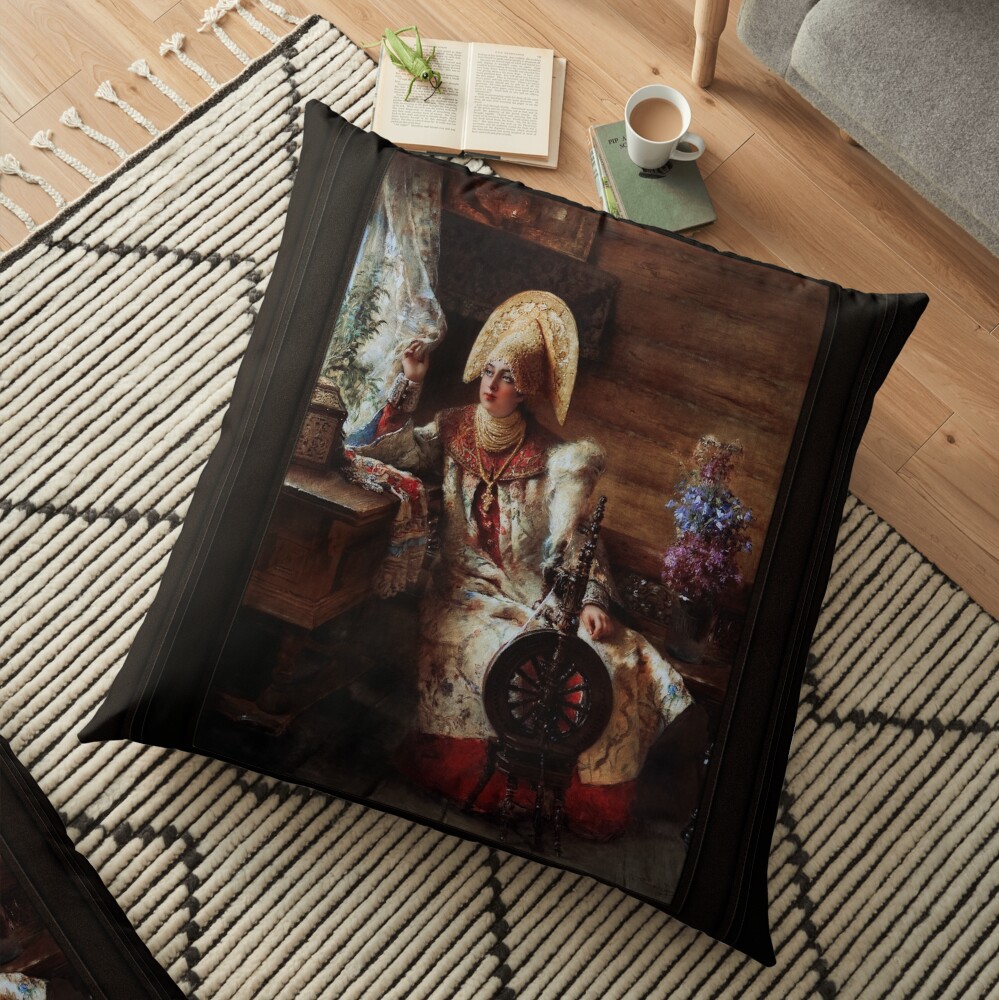
A Boyarina Beauty is a remastered digital art old masters reproduction of a public domain image that is available as a canvas print online.
Alla olevat tiedot ovat peräisin Wikipedia.org
Konstantin Makovsky oli vaikutusvaltainen venäläinen taidemaalari, sidoksissa “Peredvizhniki (Vaeltajat)”. Monet hänen historiallisista maalauksistaan, kuten Beeath the Crown (1889) tunnetaan myös nimellä The Russian Bride's Attire ja Before the Wedding, osoitti idealisoidun näkemyksen Venäjän aikaisempien vuosisatojen elämästä. Häntä pidetään usein akateemisen taiteen edustajana.
Konstantin Makovsky syntyi Moskovassa. Hänen isänsä oli venäläinen taidehahmo ja amatöörimaalari, Jegor Ivanovich Makovsky. Hänen äitinsä oli säveltäjä, ja hän toivoi, että hänen poikansa jonain päivänä seuraisi hänen jalanjälkiä. Hänen nuoremmat veljensä Vladimir ja Nikolay sekä hänen sisarensa Alexandra ryhtyivät myös maalareiksi.
Sisään 1851 Makovsky tuli Moskovan maalauskouluun, Veistos ja arkkitehtuuri, jossa hänestä tuli paras opiskelija, saada helposti kaikki saatavilla olevat palkinnot. Hänen opettajansa olivat Karl Bryullov ja Vasily Tropinin. Makovskin taipumukset romantiikkaan ja koristeellisuuteen selittyvät Bryullovin vaikutuksella.

Although art was his passion, he also considered what his mother had wanted him to do. He set off to look for composers he could refer to, and first went to France. Before, he had always been a classical music lover, and listened to many pieces. He often wished he could change the tune, or style of some of them to make them more enjoyable. Later in his life it came true.
Sisään 1858 Makovsky tuli Pietarin keisarilliseen taideakatemiaan. Alkaen 1860 hän osallistui Akatemian näyttelyihin maalauksilla, kuten Curing of the Blind (1860) ja Agents of the False Dmitry tappavat Boris Godunovin pojan (1862). Sisään 1863 Makovsky ja 13 muuta opiskelijaa protestoivat Akatemian asettamia aiheita skandinaaviseen mytologiaan kilpailussa Large Gold Medal of Academiasta.; kaikki lähtivät akatemiasta ilman virallista tutkintotodistusta.
Makovsky became a member of a co-operative (artel) of artists led by Ivan Kramskoi, typically producing Wanderers paintings on everyday life (Widow 1865, Herring-seller 1867, etc.). Alkaen 1870 he was a founding member of the Society for Traveling Art Exhibitions and continued to work on paintings devoted to everyday life. He exhibited his works at both the Academia exhibitions and the Traveling Art Exhibitions of the Wanderers.
A significant change in his style occurred after traveling to Egypt and Serbia in the mid-1870s. His interests changed from social and psychological problems to the artistic problems of colors and shape.
In the 1880s he became a fashionable author of portraits and historical paintings. At the World’s Fair of 1889 in Paris he received the Large Gold Medal for his paintings Death of Ivan the Terrible, The Judgement of Paris, and Demon and Tamara. He was one of the most highly appreciated and highly paid Russian artists of the time. Many democratic critics considered him as a renegade of the Wanderers’ ideals, producing (like Henryk Siemiradzki) striking but shallow works, while others see him as a forerunner of Russian Impressionism.
Makovsky tapettiin vuonna 1915 kun hänen hevoskärrynsä törmäsi sähköraitiovaunuun Pietarissa.