

A Capriccio of the Roman Forum c1741
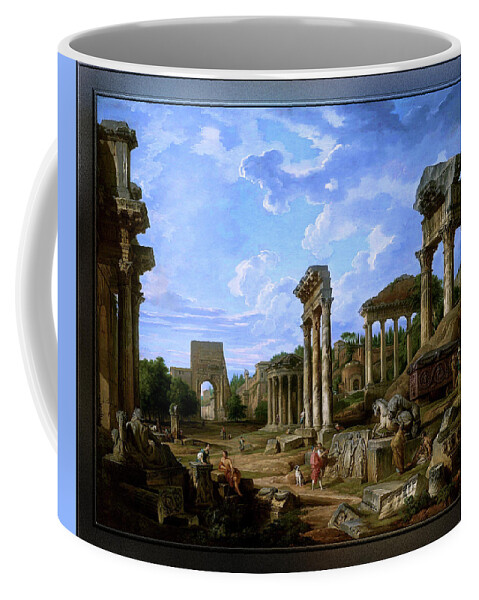
“Capriccio z Fora Romana” is a remarkable painting created in 1741 by the esteemed Italian artist Giovanni Paolo Pannini (1691 – 1765). Known for his mastery in architectural and landscape painting, Pannini’s work encapsulates both the grandeur and the melancholy of the past, blending historical elements with a vibrant imaginative approach. This particular piece, A “capriccio,” serves as an artistic interpretation of the Roman Forum, evoking a sense of classical antiquity while also showcasing Pannini’s characteristic style of combining real and imaginary elements in a cohesive yet fantastical composition.
Obsah
Theme and Style
Téma “Capriccio z Fora Romana” revolves around the notion of historical ruin and nostalgia for a bygone civilization. It evokes the spirit of the Grand Tour, a traditional journey undertaken by young European aristocrats to explore the cultural and architectural heritage of ancient Rome. Pannini, well-versed in the visual language of Rome’s architectural splendor, captures the Roman Forum in a dramatic, almost theatrical manner. His painting fuses the past and present, incorporating elements of historical accuracy alongside a certain level of artistic license. This capriccio, which was popular during the 18th century, often included anachronisms and artistic embellishments, creating a romanticized version of architectural ruins.
The style of the painting aligns with the Rococo period, marked by a lighter, more decorative approach compared to the baroque. Although Pannini’s work possesses the detailed realism typical of the baroque, there is an underlying grace and fluidity to his composition, indicative of the Rococo influence. The grandiose ruins of the Roman Forum are presented with a sense of elegance and poetic beauty, underlined by the calmness of the sky and the serenity of the figures within the scene.
Hlavní předmět a složení
At the center of this work is the Roman Forum itself, the once vibrant heart of ancient Roman life, now reduced to crumbling ruins. Pannini captures the architectural elements in extraordinary detail, showcasing a variety of columns, oblouky, and statues that were iconic to the Roman Empire. These structures are depicted with a sense of scale and perspective that invites the viewer to explore the scene from multiple angles, enhancing the immersive quality of the painting.
The foreground is rich with artifacts, such as broken columns and stone blocks, as well as classical sculptures. These elements, although fragmented and damaged, convey the idea of a civilization that has left behind a lasting cultural legacy. Several figures, dressed in 18th-century clothing, populate the scene, contrasting the ruins with contemporary life. Tyto postavy, likely tourists or scholars, are portrayed in various poses, some deep in conversation, while others gaze at the ruins in awe. This interaction between modern people and ancient architecture serves to emphasize the idea of continuity and the passage of time.
Doleva, a majestic arch stands in partial ruin, with fragments scattered around its base, suggesting the ravages of time and the erosion of history. The arch is likely a representation of one of the famous Roman triumphal arches, evoking the grandeur of the Roman Empire’s military victories. Na pravé straně, more ruins emerge from the landscape, with large stone blocks and the remnants of statuary. The figures that inhabit the space are placed thoughtfully, vede oko diváka přes scénu, guiding them from one architectural fragment to the next.
Terén a materiály
The terrain depicted in the painting is characteristic of the Roman Forum, with its uneven surfaces, rocky ground, and broken columns. Pannini’s treatment of the earth beneath the ruins is both realistic and detailed, with patches of grass and trees emerging from between the stone fragments. The sky above is expansive and luminous, painted with soft, diffused light that contrasts with the darker, shadowed areas of the ruins below. This treatment of light and shadow enhances the dramatic effect of the scene, creating a sense of timelessness that envelops the viewer.
Pannini’s use of oil paints allows for a nuanced rendering of textures and surfaces. The stone appears solid and tangible, with the varying tones of grey, beige, and ochre capturing the natural decay of time. The sky is rendered with delicate brushstrokes, with soft clouds drifting above, providing a serene contrast to the monumental structures below. The figures are painted with an acute attention to detail, their clothing rendered in a way that suggests the materiality of the fabrics, further drawing the viewer into the scene. The overall composition conveys a sense of both grandeur and desolation, creating an emotional connection with the viewer that transcends mere architectural representation.
Nálada a atmosféra
Nálada “Capriccio z Fora Romana” is one of reflection and nostalgia. There is a sense of awe that permeates the work, evoked both by the monumental scale of the ruins and by the presence of the figures, who seem to be lost in thought as they engage with the past. The ancient ruins speak of lost civilizations, their grandeur now reduced to fragments and memories. Ještě, there is also a quiet reverence in the scene, a celebration of the enduring legacy of the Roman Empire.
nebe, with its soft hues of blue and white, adds to the overall tranquility of the scene, enhancing the feeling of peace that accompanies the ruins. Despite the crumbling nature of the structures, there is a beauty in their decay, as if they have reached a timeless equilibrium with nature. This interplay between the enduring strength of the Roman Empire and the inevitable passage of time imbues the painting with a melancholic yet serene atmosphere.
Závěr
Giovanni Paolo Pannini’s “Capriccio z Fora Romana” is a masterful work that captures the beauty and fragility of ancient Rome. Through his meticulous rendering of architectural details, the juxtaposition of modern figures and ancient ruins, and the evocative atmosphere, Pannini creates a scene that is both a tribute to the past and a reflection on the passage of time. The painting serves as a visual meditation on the relationship between history, memory, and the physical remnants of a once-great civilization.
This is a retouched digital art reproduction of a public domain image that is available online on a many home decor products.
Umělec bio Wikipedia.org
Giovanni Paolo Panini nebo Giovanni Paolo Pannini byl malíř a architekt, který působil v Římě a je známý především jako jeden z vedutistů. (“zobrazit malíře”).
Jako malíř, Pannini je nejlépe známý pro své výhledy na Řím, ve kterém se zvláště zajímal o městské starožitnosti.
Mezi jeho nejznámější díla patří jeho pohled na interiér Pantheonu (jménem Francesca Algarottiho 1712 – 1764 – Benátský Polymath), a jeho vedutové obrazy obrazových galerií obsahující pohledy na Řím.
Většina jeho děl, zvláště ty zříceniny, mají fantazijní a neskutečné zdobení charakteristické pro capriccio témata. V tomto připomínají capricci italského malíře a tiskaře Marca Ricciho (1676 – 1730).
Panini také maloval portréty, včetně jednoho z papeže Benedikta XIV (narozený Prospero Lorenzo Lambertini 1675 – 1758 – Hlava katolické církve z 1740 – 1758).
V Římě, Panini si vysloužil jméno jako dekorátor paláců. Některá jeho díla zahrnovala Villa Patrizi c1719 / 25, Palazzo de Carolis c1720, a Seminario Romano c1721 / 22).
v 1719, Panini byl přijat do Kongregace Virtuosi al Pantheon. Učil v Římě na Accademia di San Luca a Académie de France, kde údajně ovlivnil Jean-Honoré Fragonard. v 1754, sloužil jako princ (ředitel) Accademia di San Luca.