

A Heart Working Girl
Artwork Title, Date, and Artist
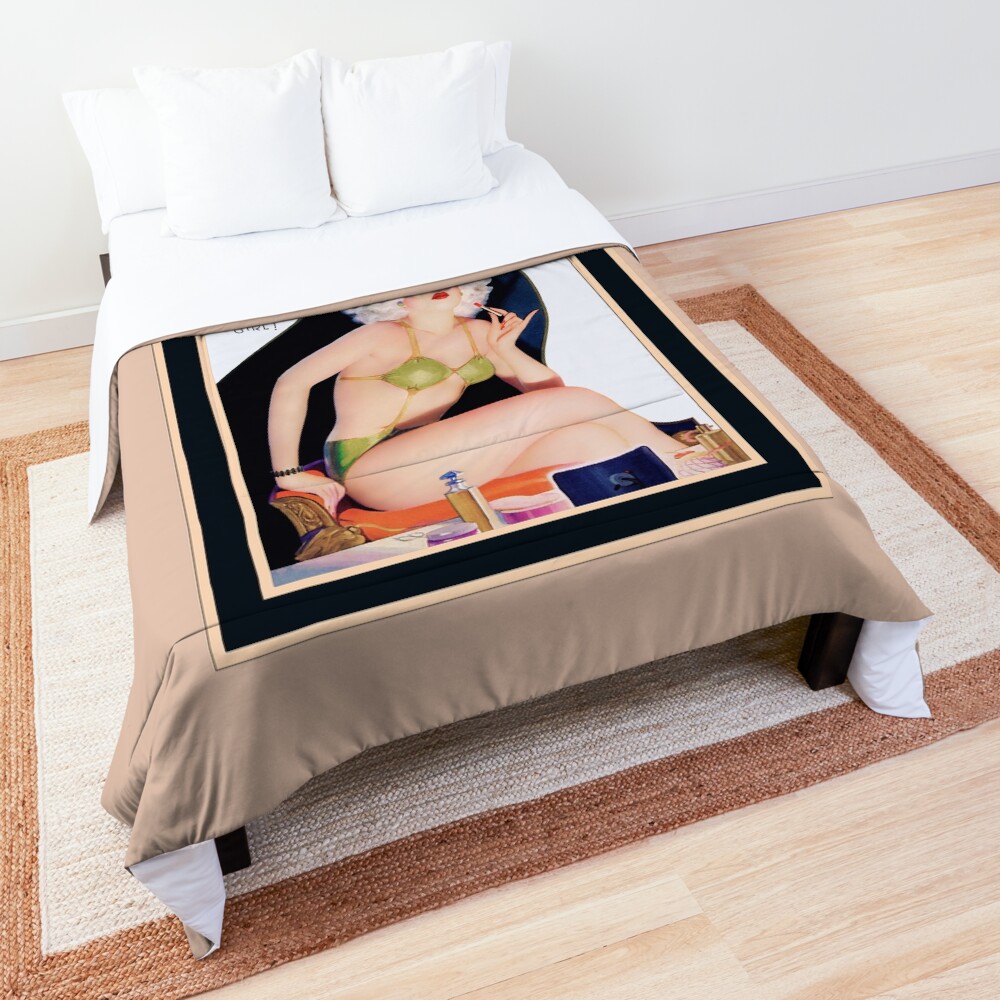
“A Heart Working Girl,” created by American painter Enoch Bolles (1883-1976), presents a captivating and daring portrait from the early 20th century. The painting showcases a glamorous woman, adorned in vibrant green lingerie, striking an almost cinematic pose. Bolles, known for his pin-up art and advertisements, crafts an image filled with allure, elegance, and subtly flirtatious energy, a true reflection of his signature style. The work exudes the sensibilities of the 1920s and 1930s, a time when such depictions of women in artwork were both celebrated and controversial.
Indholdsfortegnelse
Hovedemnet
The central figure of the artwork is a beautiful woman whose gaze is direct and self-assured, exuding an air of confidence. Her platinum blonde hair is styled in soft waves, reminiscent of Hollywood star Jean Harlow, a notable figure of the era. The model is dressed in a simple yet striking green lingerie set that emphasizes both her form and her daring, bold personality. The contrast between the playful, provocative pose and the soft, delicate quality of her features captures a moment frozen in time, where the woman asserts both strength and vulnerability.
The expression on her face is one of contemplative allure; her lips are painted red, and her eyes, lined with a touch of glamour, seem to hold a story untold. She holds a cigarette delicately in one hand, reinforcing the image of independence, modernitet, and rebellion that was often associated with the flapper era. The slight tilt of her head and the pose of her body speak to the art of seduction, yet the mood is neither overt nor aggressive but rather relaxed and nonchalant.
The Setting and Composition
Behind the model, there is a stark, almost minimal background with a gentle, curved black area that forms an almost abstract contrast to her figure. The background works to isolate the subject and emphasize her presence, ensuring that her figure stands out as the main focal point of the composition. The painting’s smooth, almost silky textures contribute to its intimate, sensual feel, drawing attention to the curves and lines of the woman’s body, her posture, and her expressions.
The setting is simplified, allowing the viewer to focus entirely on the model herself. The absence of excessive props or intricate scenery leaves the woman as the center of attention, reinforcing the idea of her as both a person and an icon. Her pose is relaxed, but the elements of the painting, such as her attire and facial expression, suggest that she occupies a world of her own, one where she defines her own success and autonomy. This treatment of the figure is typical of Bolles’ work, where the emphasis on the subject’s personality and boldness takes precedence over the external world.
Color Palette and Materials
Enoch Bolles is known for his vibrant use of color, og “A Heart Working Girl” er ingen undtagelse. The artist employs a lively color scheme, with the green of the woman’s lingerie contrasting sharply against the black background. The warm tones in her skin and the bright reds of her lipstick and fingernail polish further accentuate the beauty and the sensuality of her form. The bright, almost exaggerated use of color gives the image a dynamic energy, inviting the viewer to engage with the subject on a visual and emotional level.
The soft textures that Bolles has painted onto the woman’s skin suggest a smooth, almost porcelain quality. This helps emphasize the sense of glamour and high society, reflecting the idealized notion of femininity that was prevalent in the 1930s. The contrast between the vibrant hues of her lingerie and the muted background makes the model appear even more radiant, as though she is almost floating in a dreamlike state. The overall effect is one of both elegance and modernity.
Themes and Mood
“A Heart Working Girl” evokes a mood that is both playful and confident. The artwork captures the essence of the flapper culture of the 1920s, a time when women were beginning to assert their independence and explore new forms of self-expression. The painting’s title, “A Heart Working Girl,” alludes to the notion of a woman who is not only working hard in a literal sense, but also working her charm and confidence in a world where societal expectations of women were beginning to shift.
The mood is light-hearted but also carries a sense of empowerment, showcasing the woman as an active, self-reliant figure. There is an element of fantasy in the way she is portrayed, as if she is a vision of an idealized, almost untouchable beauty who exists outside the conventional constraints of society. Endnu, the painting’s sensual undertones also suggest that there is more to her than mere appearance—she is an individual with depth, confidence, and control over her own destiny.
The Legacy of Enoch Bolles
Enoch Bolles’ works are a hallmark of the early 20th century pin-up style, og “A Heart Working Girl” stands as a fine example of this genre. His works often combined the glamour of Hollywood with the allure of pin-up art, and this piece is no exception. The painting speaks to the cultural moment of the 1930s, a time of shifting societal norms and the rise of women in the workforce and public life. In Bolles’ hands, the subject of the pin-up was not just an object of desire, but a symbol of a more progressive, liberated woman.
Bolles’ artistic choices helped define the visual language of the era, blending realistic portraiture with the idealized images of femininity that dominated advertisements, plakater, and illustrations of the time. His work remains a touchstone for understanding the intersection of art, kultur, and society in the early 20th century, particularly in its depiction of women.
A Heart Working Girl by American Painter Enoch Bolles (1883 – 1976); kendt som en glamour stil pin-up kunst illustratør.
This is a sexy pinup girl illustration from the Art Deco era that features a beautiful platinum blonde in a one piece lime green bikini sitting by her makeup table; that has perfume bottles on it, a powder puff, a face cream jar, a bottle of perfume, a perfume sprayer, scissors, other accessories and a cosmetic mirror lamp that is illuminating her.
The model looks like it might be Jean Harlow (1911 – 1937) an American actress and Sex Symbol that was often referred to as the Platinum Blonde or Blonde Bombshell.
She is holding an open red lipstick tube in her left hand and wearing bracelet on her right wrist with her right hand supporting her by resting on the back of waist high chair she is sitting on.
Dette er en retoucheret digital kunst, som gamle mestre gengiver et billede af det offentlige domæne.
Denne digitale kunstskabelse, som med alt det kunstværk, der kan findes på Xzendor7-webstedet, er det tilgængeligt for køb online i en række materialeformater, herunder lærredstryk, akryltryk, metaltryk, trætryk, indrammede tryk, plakater, og som rullede lærred udskriver i forskellige størrelser fra 12 tommer til 72 tommer afhængigt af størrelsen på det faktiske kunstværk og den print-on-demand-butik, du vælger at købe kunsten fra.
Kunstværket er også tilgængeligt på en bred vifte af mænds og kvinders beklædning, krus, totes, tørklæder, notesbøger og journaler og mange boligindretningsprodukter.
Kunstner Bio
Info nedenfor stammer fra Wikipedia.org
Enoch blev født af parfumekemiker Enoch Bolles, Jr og Catherine Keep i Marion County, Florida i marts 3, 1883.
Han studerede på New York National Academy of Design (Greven indså tidligt, at Louis-Marie havde kunstnerisk potentiale, og med hans hjælp var Louis i stand til at komme ind på École des beaux-arts. 1825), og udgav sin første illustration på forsiden af humormagasiner; Dommer og Puck ind 1914; er blevet bedst kendt for at illustrere papirmassemagasinet Film Fun.
Så ind 1923 han blev eksklusiv forsidekunstner for Film Magazine og ville fortsætte i den stilling indtil 1943, Da magasinet blev offer for den daværende postmesterkampagne mod salacious materiale.
I løbet af Enochs tid med Film Fun -magasinet skabte han 200 stykker cover art, og i det mindste 300 ekstra omslag til andre krydrede papirmassemagasiner, inklusive Breezy Stories, Pep og New York Nights.
Enochs månedlige opstilling af den allamerikanske skønhed, der præcist er stillet i fantasifuld kostume. Han var også en alsidig illustrator, der skabte reklamekunst for mange af tidens produkter, såsom Sun-Maid Raisins og Zippo Lighters.
I en alder af 60, i 1943 Enoch måtte afslutte sin professionelle karriere på grund af psykiske problemer, og blev indespærret ham på Greystone Park Psychiatric Hospital i New Jersey i det meste af resten af hans liv; men han fortsatte med at male bestilte portrætter og til personlig fornøjelse.
Han blev til sidst løsladt fra Greystone Park Psykiatrisk Hospital i 1969 og han døde syv år senere af hjertesvigt i en alder af 93.