

A Pompeian Lady c1904
L'œuvre intitulée “A Pompeian Lady c1904” by the British painter John William Godward (1861 – 1922) is a captivating example of the neoclassical style that was prevalent during the late 19th and early 20th centuries. Godward was renowned for his portraits of women in classical attire, often placed within luxurious, ancient Roman or Greek settings. This particular piece, peint autour 1904, encapsulates his meticulous attention to detail and his skill in capturing the elegance of the human form. It exemplifies the artist’s dedication to classical antiquity, with his subjects often portrayed in serene and introspective moods.
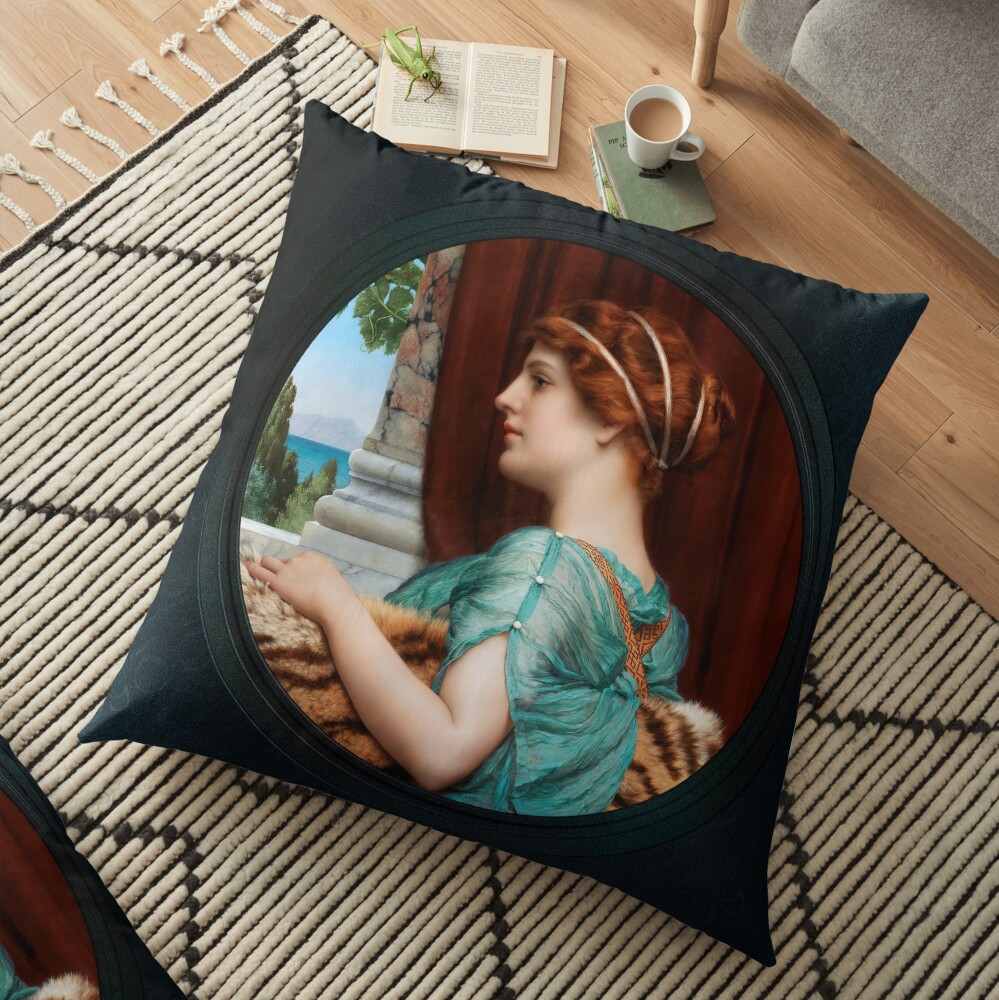
Table des matières
The Subject of the Artwork
Dans “A Pompeian Lady c1904,” the main subject is a young woman dressed in an opulent, robe fluide. Her attire is distinctly ancient Roman or Pompeian in style, reminiscent of the classical draped garments seen in the frescoes and sculptures from Pompeii. The woman’s posture is elegant and contemplative, as she gazes into the distance with a slight turn of her head. This pose exudes a sense of grace, while her expression remains calm and serene. The soft waves of her auburn hair are intricately styled, adorned with delicate headbands that emphasize the classical aesthetic of the time.
Her gaze is directed towards the natural beauty that lies outside the frame of the painting, suggesting a moment of quiet reflection. The painting’s composition draws attention to the delicate interplay between the figure’s posture and the surrounding environment. The softness of her features is contrasted against the sharp and detailed depiction of the materials in her attire, the textures of the background, and the natural elements in the landscape.
The Setting and Landscape
The setting of the painting features an outdoor terrace with a view of a lush, serene landscape. The woman is placed against a grand column made of marble, which serves to frame her figure while simultaneously grounding her within the classical world of ancient Rome. The background reveals an idyllic view of a coastal scene, where the sea meets the horizon under a clear, soft blue sky. Verdant trees and a tranquil landscape suggest a peaceful, secluded place, contributing to the overall sense of calm and elegance that pervades the work.
The architectural elements of the setting further emphasize the classical influence, with Roman-style columns and arches that evoke the grandeur of ancient structures. These elements are skillfully rendered, with Godward’s attention to detail in the textures of the stone, le jeu d'ombre et de lumière, and the intricate detailing on the column itself. The warm tones of the stone, combined with the cool colors of the sky and the distant sea, create a harmonious atmosphere that enhances the timeless beauty of the figure.
The Mood and Themes of the Painting
L'ambiance de “A Pompeian Lady c1904” is one of tranquil elegance and quiet introspection. The woman’s serene expression, coupled with her elegant posture, conveys a sense of peace and grace. There is no urgency or tension in her demeanor; plutôt, the painting invites the viewer to appreciate the moment and the beauty of the scene. Le doux, natural light illuminating her face and gown enhances this peaceful mood, with subtle gradients that highlight her delicate features.
The themes of classical beauty, tranquillité, and the idealized femininity of ancient Rome are central to the painting. Godward often portrayed women as the epitome of grace and purity, et ce tableau ne fait pas exception. The subject is not just a woman in classical attire; she represents an ideal of feminine beauty that transcends time and place. Her thoughtful expression and poised stance suggest a woman who is at peace with herself and her surroundings, embodying the refined elegance of a bygone era.
The landscape also plays a vital role in setting the tone of the painting. The natural elements—lush greenery, clear skies, and calm seas—serve as a backdrop that complements the subject’s calm demeanor. The connection between the figure and the natural world creates a sense of harmony and balance, reinforcing the classical theme of unity between humanity and nature.
Matériaux et Techniques
John William Godward’s use of oil paints is evident in the depth and richness of the colors throughout the painting. His technique is highly detailed, with a particular emphasis on texture and realism. The woman’s gown is rendered in exquisite detail, with each fold and drape carefully painted to capture the movement of the fabric. The translucency of the fabric adds a sense of lightness to the figure, contrasting with the solidity of the stone column and the softness of the natural landscape.
Godward’s brushwork is smooth and controlled, allowing him to create delicate textures such as the soft sheen of the woman’s hair, the smoothness of her skin, and the intricate patterns on her gown. The realism with which he captures light and shadow is particularly striking, as it adds dimension and depth to the figure and the surrounding environment. The artist’s skillful use of light also enhances the sense of realism, with highlights on the woman’s face and gown giving the impression of sunlight filtering through the space.
Conclusion
A Pompeian Lady c1904 by John William Godward is a quintessential example of the neoclassical style, showcasing the artist’s mastery in portraying idealized femininity, classical attire, and serene landscapes. The painting exudes a sense of tranquility and grace, capturing a moment of timeless beauty in the ancient world.
The careful rendering of the figure, her attire, and the surrounding environment reveals Godward’s technical skill and his deep appreciation for the classical world. This artwork not only reflects the artist’s personal style but also his reverence for the classical ideals that inspired much of his work. À travers cette peinture, Godward immortalizes the elegance and beauty of the ancient world, inviting viewers to step into a space where time stands still.
A Pompeian Lady is a remastered digital art old masters reproduction of a public domain image that is available as a toile, bois, acrylic and metal print online.
Cette création d'art numérique, comme toutes les œuvres d'art disponibles sur le site Web Xzendor7, elles sont disponibles à l'achat en ligne dans une variété de formats de matériaux, y compris des impressions sur toile., impressions acryliques, impressions métalliques, gravures sur bois, impressions encadrées, affiches, et sous forme d'impressions sur toile roulées dans une variété de tailles de 12 pouces à 72 pouces en fonction de la taille de l'œuvre d'art réelle et de la boutique d'impression à la demande auprès de laquelle vous choisissez d'acheter l'art.
L’œuvre d’art est également disponible sur une large gamme de vêtements pour hommes et femmes., tasses, fourre-tout, écharpes, cahiers et journaux et de nombreux produits de décoration intérieure.
Biographie de l'artiste
Info ci-dessous de Wikipedia.org
John William Godward était l'aîné de cinq enfants, et a été nommé d'après son père John et son grand-père William.
Il expose à la Royal Academy de 1887. Lorsqu'il a déménagé en Italie avec l'un de ses modèles en 1912, sa famille a rompu tout contact avec lui et a même coupé son image des photos de famille. Godward retourna en Angleterre en 1921, mort en 1922, et est enterré au cimetière de Brompton, Londres Ouest.
L'un de ses tableaux les plus connus est Dolce far Niente (1904), qui a été acheté pour la collection d'Andrew Lloyd Webber en 1995. Comme dans le cas de plusieurs autres peintures, Godward a peint plus d'une version; dans ce cas, un plus tôt (et moins connu) 1897 version avec un autre 1906 version.
Il s'est suicidé à l'âge de 61 et aurait écrit dans sa note de suicide que “le monde n'est pas assez grand pour [tous les deux] moi et un Picasso”.
Sa famille éloignée, qui avait désapprouvé qu'il devienne artiste, eu honte de son suicide et brûlé ses papiers. Une seule photographie de Godward est connue pour survivre.
Godward était un néo-classique victorien, et donc, en théorie, un disciple de Frederic Leighton. pourtant, il est plus étroitement lié stylistiquement à Sir Lawrence Alma-Tadema, avec qui il partageait un penchant pour le rendu de l'architecture classique - en particulier, éléments paysagers statiques construits en marbre.
La grande majorité des images existantes de Godward présentent des femmes en tenue classique posées contre des éléments du paysage; bien qu'il y ait des figures semi-nues et entièrement nues incluses dans son œuvre, un exemple notable étant “Dans le Tepidarium c1913”.
Un titre partagé avec une peinture controversée d'Alma-Tadema du même sujet qui réside dans le “Galerie d'art Lady Lever”. Les titres reflètent la source d'inspiration de Godward; qui était la civilisation classique, notamment celui de la Rome antique; un sujet liant Godward étroitement à Alma-Tadema artistiquement.
Étant donné que l'érudition classique était plus répandue parmi le public potentiel pour ses peintures de son vivant qu'aujourd'hui, une recherche méticuleuse des détails était importante pour atteindre une position d'artiste dans ce genre.
Alma-Tadema était archéologue et peintre, qui a visité des sites historiques et collecté des objets qu'il a ensuite utilisés dans ses peintures: Vers Dieu, trop, étudié des détails tels que l'architecture et la tenue vestimentaire, afin de garantir que ses œuvres portent le sceau de l'authenticité.
en plus, Godward a rendu minutieusement et méticuleusement d'autres éléments importants de ses peintures., peaux d'animaux dont les peintures “Repos de midi c1910” et “Une retraite fraîche c1910” contient des exemples d'une telle interprétation ainsi que des fleurs sauvages “Nerissa c1906” et “Fleurs d'été c1903”.
L’apparition de belles femmes dans des poses étudiées dans de nombreuses toiles de Godward amène de nombreux nouveaux venus dans ses œuvres à le classer à tort comme étant préraphaélite., d'autant plus que sa palette est souvent très colorée. Le choix du sujet (civilisation ancienne contre, par example, Légende arthurienne) est plus proprement celui du néo-classique victorien.
En commun avec de nombreux peintres contemporains de lui, Godward était un « grand rêveur victorien », produire des images d'un monde idéalisé et romancé qui, dans le cas de Godward et d'Alma-Tadema, est venu à être critiqué comme une vision du monde des Victoriens en toge.
Vers Dieu “rapidement établi une réputation pour ses peintures de jeunes femmes dans un cadre classique et sa capacité à transmettre avec sensibilité et maîtrise technique la sensation de textures contrastées de chair, marbre, fourrure et tissus.
Le penchant de Godward pour la création d’œuvres d’art se déroulant dans la période classique venait probablement de la période à laquelle il est né.; car ce fut la dernière renaissance classique à grande échelle dans les peintures occidentales, qui a prospéré en Angleterre des années 1860 aux années 1890.