

Una bellezza rara
Hugues Merle’s (1823 – 1881), 1871 capolavoru, Una bellezza rara, is a profound and evocative ritrattu representation of feminine allure and introspection. This oil painting encapsulates Merle’s skill in portraying psychological depth and his attention to detail, evident in the somber yet mesmerizing depiction of the young woman who serves as the focal point of the piece. Merle, a noted French academic painter, often aligned his work with themes of beauty, sentiment, è risonanza emotiva, and this painting is no exception.
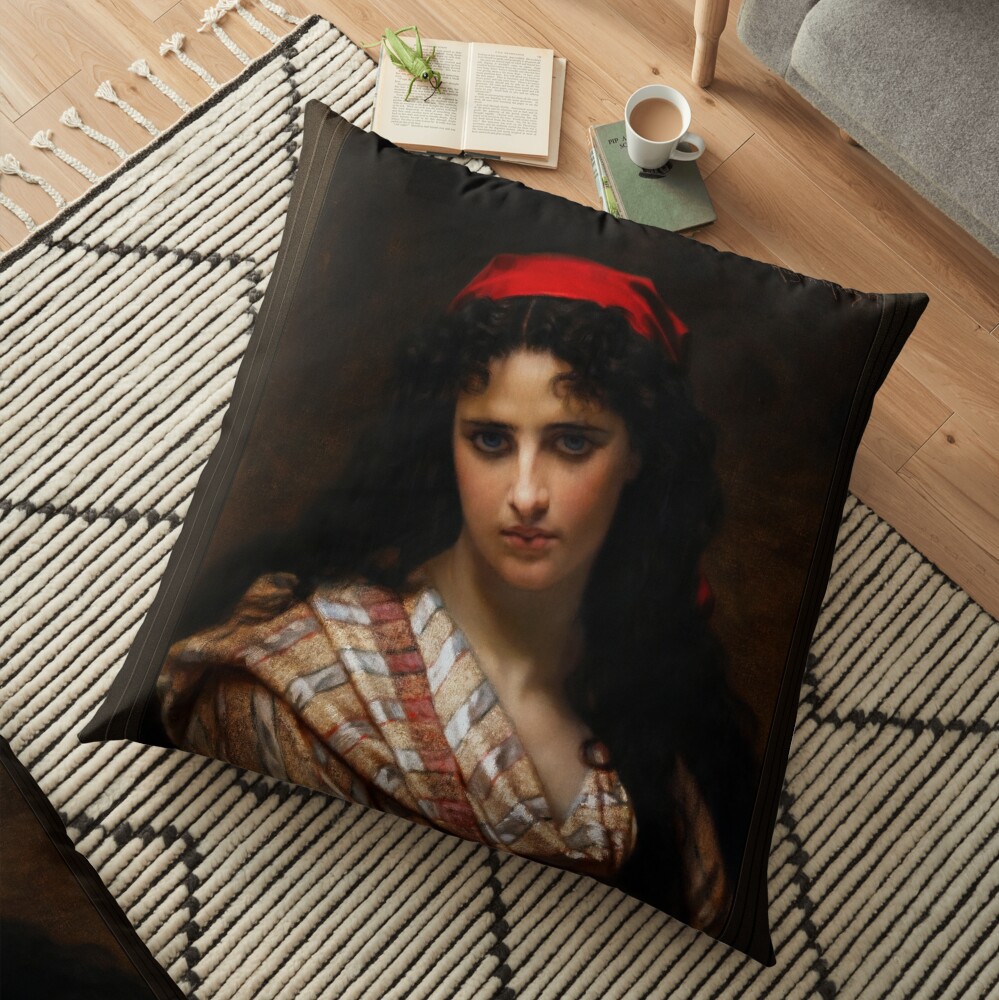
Table of Contents
U sughjettu principale: A Portrait of Introspection
At the center of Una bellezza rara is a young woman of striking appearance, her expression conveying a quiet melancholy mingled with an air of mystery. Her pale, delicate complexion is offset by her rich, dark curls, which cascade in soft waves around her shoulders. The deep, penetrating gaze of her azure eyes draws the viewer in, suggesting a narrative untold but deeply felt. Her pose is one of solemnity; her head tilts slightly forward, and her downcast eyes evoke an introspective mood, as though lost in thought or grappling with unspoken emotions.
The subject wears a vibrant red headscarf tied loosely around her head, a striking element that adds warmth to the otherwise subdued palette and contrasts with her dark hair. The bold crimson hue may symbolize passion or strength, but its simplicity also suggests her humble or modest origins. U so vestitu, a striped shawl of muted earthy tones, drapes across her shoulders, softening her figure and providing a textural balance to the painting. The choice of fabric, with its subtle folds and delicate stripes, reflects Merle’s meticulous attention to texture and material.
Objects, Materiali, and Technique
The painting is devoid of overtly distracting objects or background details, ensuring the viewer’s focus remains on the subject. This minimalist approach amplifies the intimacy of the portrait, allowing every aspect of the young woman to be examined without interference. The simplicity of the composition also enhances the universality of the theme, making her expression and form timeless.
Merle’s use of oil as the medium is masterful. The smooth blending of colors, especially in the gradients of her skin tone, showcases his command over chiaroscuro, a technique that employs stark contrasts of light and shadow to add depth and dimension. U sfondate, rendered in dark, earthy tones, provides a muted contrast to the luminosity of the subject’s face, further emphasizing her as the painting’s focal point. The restrained palette allows Merle to achieve a harmonious balance, evoking a naturalistic yet elevated depiction of the human form.
The textures of the shawl and the scarf are painted with delicate precision, the stripes rendered in soft, uneven lines that mimic the organic imperfections of woven fabric. Each brushstroke captures the interplay of light and shadow on the folds of the fabric, imbuing it with a tactile quality that enhances the realism of the work.
Thematic Elements and Symbolism
The painting embodies themes of beauty, introspezione, è emozioni, hallmark traits of Hugues Merle’s oeuvre. U titulu, Una bellezza rara, reflects the artist’s reverence for the subject’s individuality and the timeless allure she represents. Her understated elegance and the somber tone of her expression suggest a deeper narrative, possibly hinting at themes of longing, loss, or contemplation.
While Merle’s work is often compared to that of William-Adolphe Bouguereau, this piece stands apart for its nuanced emotional depth. The absence of an idealized, overtly decorative background places the focus solely on the subject’s humanity. The muted tones and the interplay of light and shadow create a mood that is both contemplative and melancholic, inviting the viewer to project their own interpretation onto her enigmatic expression.
The red scarf, while striking, is not overly ornate, suggesting an element of simplicity and modesty. Its boldness contrasts with her subdued attire and somber demeanor, perhaps hinting at the complexity of her character, a juxtaposition of outer vibrancy and inner turmoil.
Style and Artistic Context
Hugues Merle was associated with the academic style prevalent in mid-19th-century France, which emphasized technical precision, idealized beauty, and a focus on classical themes. Una bellezza rara reflects this academic tradition while also delving into a more personal and emotive realm, demonstrating Merle’s ability to convey psychological nuance alongside technical mastery.
The painting’s intimate scale and restrained composition align it with portraiture traditions that aim to reveal the essence of the individual. Merle’s contemporaries often celebrated similar themes of feminine beauty and emotional introspection, but his works, including this piece, stand out for their subtlety and sensitivity. The lack of theatricality in Una bellezza rara underscores its quiet power, drawing the viewer into a meditative engagement with the subject.
The Mood and Atmosphere
L'umore di Una bellezza rara is introspective and somber, yet it possesses an underlying warmth that prevents it from feeling cold or detached. The interplay of light on the subject’s face and the subdued tones of the background create an atmosphere of gentle intimacy, as though the viewer has stumbled upon a private moment of reflection.
This emotional resonance is heightened by the soft focus of the painting, which lends it a dreamlike quality. The viewer is left with a sense of quiet admiration for the subject’s beauty and the emotions she seems to carry. Her enigmatic expression, neither fully joyful nor sorrowful, mirrors the complexities of the human experience, making the painting deeply relatable and timeless.
Cunclusione
Hugues Merle’s Una bellezza rara is a masterful exploration of feminine grace, emotional depth, and technical precision. Through his use of light, struttura, è cumpusizioni, Merle captures the essence of his subject with an almost reverent sensitivity. The painting’s simplicity belies its emotional complexity, inviting viewers to ponder the inner world of the young woman portrayed. This work is a testament to Merle’s skill as a portraitist and his ability to evoke profound emotion through his art.
Questa hè una ripruduzzione di l'antichi maestri d'arte digitale rimasterizzata di una maghjina di duminiu publicu chì hè dispunibule cum'è a stampa su tela in linea.
Biografia di l'artista derivata da Wikipedia.org è Rehs.com
Hugues Merle hè natu in 1822 in La Zona, Francia è intornu à l'età di 21 ghjuntu in Parigi, Francia induve hà studiatu pittura cù u pittore storicu è di ritratti francese Léon Cogniet (1794 – 1880).
Bien qu'on sache peu de choses sur la vie d'Hugues, on suppose qu'il a reçu un certain degré d'éducation artistique avant d'arriver à Paris en 1843; perchè cuminciò à esporre à u Salone di Parigi in 1847 cù a so pezza Portrait de L’auteur è in 1848 espose l'opera Légende des Willis.
Quandu u tempu passava, a reputazione di Hugues cum'è ritrattista hà cresciutu assai durante l'anni 1850; è cum'è un pittore di successu è prominente, hà sappiutu attirà seri amanti di l'arti chì cercanu di custruisce e so cullezzione d'arte..
Unu di sti primi cullezzione d'arte era u 4u marchese di Hertford, Richard Seymour-Conway (1800-1870); chì hà acquistatu a so sottumissione di salone Reading the Bible in 1859.
Duranti l'anni 1860, Enorme lista di clienti di cullezzione include micca solu individui da u cuntinente europeu, ma ancu i cullezzione americani, cum'è William Walters di Baltimore chì hà cumandatu The Scarlet Letter.