

A Rare Beauty
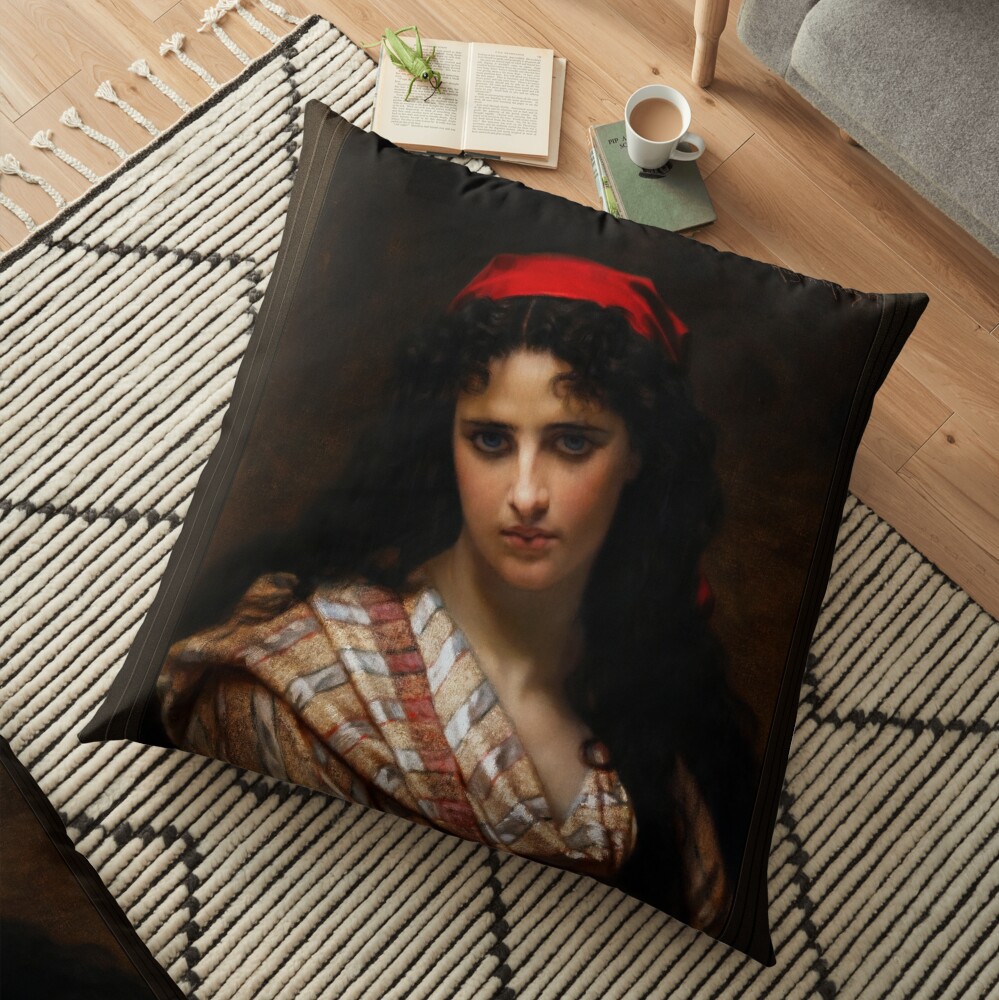
Hugues Merle’s (1823 – 1881), 1871 ĉefverko, A Rare Beauty, is a profound and evocative portreto representation of feminine allure and introspection. This oil painting encapsulates Merle’s skill in portraying psychological depth and his attention to detail, evident in the somber yet mesmerizing depiction of the young woman who serves as the focal point of the piece. Merle, a noted French academic painter, often aligned his work with themes of beauty, sentiment, kaj emocia resonanco, kaj ĉi tiu pentraĵo ne estas escepto.
Enhavtabelo
La Ĉefa Temo: A Portrait of Introspection
At the center of A Rare Beauty is a young woman of striking appearance, her expression conveying a quiet melancholy mingled with an air of mystery. Ŝi pala, delicate complexion is offset by her rich, dark curls, which cascade in soft waves around her shoulders. La profunda, penetrating gaze of her azure eyes draws the viewer in, suggesting a narrative untold but deeply felt. Her pose is one of solemnity; her head tilts slightly forward, and her downcast eyes evoke an introspective mood, as though lost in thought or grappling with unspoken emotions.
The subject wears a vibrant red headscarf tied loosely around her head, a striking element that adds warmth to the otherwise subdued palette and contrasts with her dark hair. The bold crimson hue may symbolize passion or strength, but its simplicity also suggests her humble or modest origins. Ŝia vesto, a striped shawl of muted earthy tones, drapoj trans ŝiaj ŝultroj, moligante ŝian figuron kaj disponigante tekstan ekvilibron al la pentraĵo. La elekto de ŝtofo, kun siaj subtilaj faldoj kaj delikataj strioj, reflektas la zorgeman atenton de Merle al teksturo kaj materialo.
Objektoj, Materialoj, kaj Tekniko
La pentraĵo estas sen malkaŝe distraj objektoj aŭ fondetaloj, certigante ke la fokuso de la spektanto restas sur la subjekto. Ĉi tiu minimumisma aliro plifortigas la intimecon de la portreto, permesante al ĉiu aspekto de la juna virino esti ekzamenita sen enmiksiĝo. La simpleco de la komponado ankaŭ plibonigas la universalecon de la temo, farante ŝian esprimon kaj formo sentempa.
La uzo de oleo de Merle kiel la medio estas majstra. La glata miksado de koloroj, precipe en la gradientoj de ŝia haŭta nuanco, elmontras sian komandon super klara obskuro, a technique that employs stark contrasts of light and shadow to add depth and dimension. La fono, rendered in dark, earthy tones, provides a muted contrast to the luminosity of the subject’s face, further emphasizing her as the painting’s focal point. The restrained palette allows Merle to achieve a harmonious balance, evoking a naturalistic yet elevated depiction of the human form.
The textures of the shawl and the scarf are painted with delicate precision, the stripes rendered in soft, uneven lines that mimic the organic imperfections of woven fabric. Each brushstroke captures the interplay of light and shadow on the folds of the fabric, imbuing it with a tactile quality that enhances the realism of the work.
Thematic Elements and Symbolism
The painting embodies themes of beauty, introspekto, kaj emocio, hallmark traits of Hugues Merle’s oeuvre. The title, A Rare Beauty, reflects the artist’s reverence for the subject’s individuality and the timeless allure she represents. Her understated elegance and the somber tone of her expression suggest a deeper narrative, possibly hinting at themes of longing, loss, or contemplation.
While Merle’s work is often compared to that of William-Adolphe Bouguereau, this piece stands apart for its nuanced emotional depth. The absence of an idealized, overtly decorative background places the focus solely on the subject’s humanity. The muted tones and the interplay of light and shadow create a mood that is both contemplative and melancholic, inviting the viewer to project their own interpretation onto her enigmatic expression.
The red scarf, while striking, is not overly ornate, suggesting an element of simplicity and modesty. Its boldness contrasts with her subdued attire and somber demeanor, perhaps hinting at the complexity of her character, a juxtaposition of outer vibrancy and inner turmoil.
Style and Artistic Context
Hugues Merle was associated with the academic style prevalent in mid-19th-century France, which emphasized technical precision, idealized beauty, and a focus on classical themes. A Rare Beauty reflects this academic tradition while also delving into a more personal and emotive realm, demonstrating Merle’s ability to convey psychological nuance alongside technical mastery.
The painting’s intimate scale and restrained composition align it with portraiture traditions that aim to reveal the essence of the individual. Merle’s contemporaries often celebrated similar themes of feminine beauty and emotional introspection, but his works, including this piece, stand out for their subtlety and sensitivity. The lack of theatricality in A Rare Beauty underscores its quiet power, drawing the viewer into a meditative engagement with the subject.
La Humoro kaj Atmosfero
La humoro de A Rare Beauty is introspective and somber, yet it possesses an underlying warmth that prevents it from feeling cold or detached. The interplay of light on the subject’s face and the subdued tones of the background create an atmosphere of gentle intimacy, as though the viewer has stumbled upon a private moment of reflection.
This emotional resonance is heightened by the soft focus of the painting, which lends it a dreamlike quality. The viewer is left with a sense of quiet admiration for the subject’s beauty and the emotions she seems to carry. Her enigmatic expression, neither fully joyful nor sorrowful, mirrors the complexities of the human experience, making the painting deeply relatable and timeless.
Konkludo
Hugues Merle’s A Rare Beauty is a masterful exploration of feminine grace, emocia profundo, and technical precision. Per sia uzo de lumo, teksturo, kaj komponado, Merle captures the essence of his subject with an almost reverent sensitivity. The painting’s simplicity belies its emotional complexity, inviting viewers to ponder the inner world of the young woman portrayed. This work is a testament to Merle’s skill as a portraitist and his ability to evoke profound emotion through his art.
Ĉi tio estas readaptita cifereca arta reproduktaĵo de malnovaj majstroj de publika domajna bildo disponebla kiel a tolo presaĵo rete.
Artisto Bio derivita de Vikipedio.org kaj Rehs.com
Hugues Merle estis naskita en 1822 en La Zono, Francio kaj ĉirkaŭ la aĝo de 21 alvenis Parizon, Francio kie li studis pentraĵon sub la franca Historia kaj Portretfarbisto Léon Cogniet (1794 – 1880).
Kvankam oni scias malmulte pri la frua vivo de Hugues, oni supozas, ke li ricevis iom da arta edukado antaŭ ol li alvenis en Parizo en 1843; ĉar li komencis ekspozicii ĉe la Pariza Salono en 1847 kun sia peco Portreto de la aŭtoro kaj en 1848 li ekspoziciis la pecon Légende des Willis.
Ĉar tempo daŭris Hugues reputacio kiel portretisto kreskis sufiĉe dum la 1850-aj jaroj; kaj kiel sukcesa kaj elstara farbisto li povis altiri seriozajn artamantojn kiuj serĉis konstrui siajn artkolektojn..
Unu el tiuj fruaj kolektantoj de arto estis la 4-a Markizo de Hertford, Richard Seymour-Conway (1800-1870); kiu aĉetis sian salonsubmetaĵon Reading the Bible in 1859.
Dum la 1860-aj jaroj, Huges client list of collectors included not only individuals from the European continent, sed ankaŭ usonaj kolektantoj, kiel ekzemple William Walters de Baltimoro kiu komisiis La Skarlatan Leteron.