

A Revealing Blonde
Enkonduko
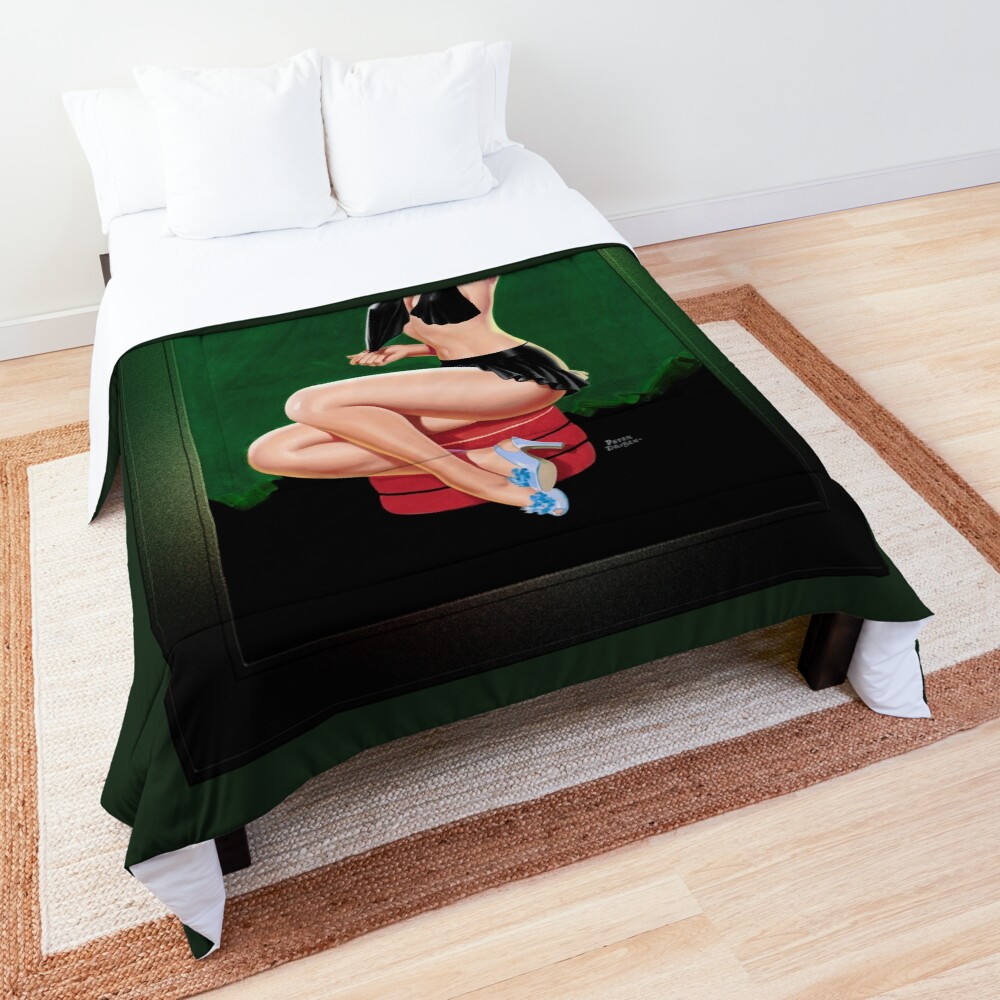
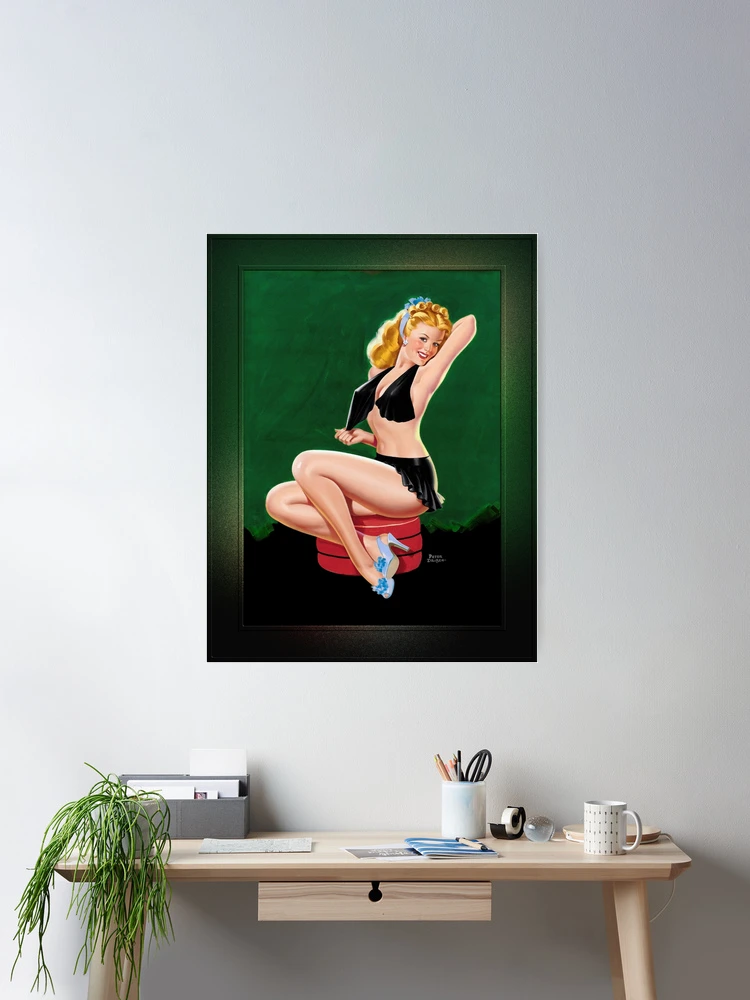
Peter Driben’s (1903 – 1968) artwork “A Revealing Blonde” captures the vivacious charm and sensuous elegance characteristic of mid-20th-century pin-up art. Renowned as one of the foremost illustrators of his time, Driben brings to life a captivating image of femininity, konfido, and allure, set against a strikingly minimal yet effective backdrop. This piece exemplifies the golden age of pin-up art, kie beleco, cheekiness, and glamour were interwoven into every stroke.
Enhavtabelo
La Subjekto: A Timeless Pin-Up Beauty
At the heart of the composition is a vibrant blonde woman, depicted with a radiant smile and an air of effortless confidence. Her pose is dynamic and playful, with one arm gracefully arched behind her head while the other tugs lightly at her cropped black top, lending an air of flirtation and spontaneity. The woman’s golden curls cascade over her shoulders, accentuated by a blue ribbon that adds a touch of innocence to her otherwise sultry demeanor. Her features are meticulously detailed, from her sparkling eyes and rosy cheeks to her perfectly sculpted smile, embodying the idealized beauty standards of the era.
Ŝia vesto, though minimal, is purposeful in its design. The black bikini top and ruffled skirt balance simplicity and sophistication, highlighting her figure while maintaining a sense of tasteful allure. Completing her outfit are light blue heels adorned with floral embellishments, an elegant detail that enhances the overall harmony of the image.
Background and Color Palette
The background is an expanse of rich green, a choice that creates a vivid contrast against the subject’s golden hair and fair skin. This bold use of color not only draws attention to the central figure but also emphasizes her liveliness and energy. The green backdrop is smooth and devoid of intricate detail, allowing the viewer to focus entirely on the subject while evoking a sense of timeless sophistication.
The subtle shadowing beneath the figure anchors her to the scene, giving a three-dimensional quality to the otherwise flat composition. The vibrant colors, puraj linioj, and lack of extraneous elements underscore Driben’s mastery in distilling a scene to its essence, ensuring the subject remains the focal point.
The Composition and Style
Driben’s style is emblematic of the classic pin-up genre, blending elements of realism with stylized exaggeration to create an idealized representation of femininity. The contours of the subject’s body are carefully crafted to accentuate her curves, a hallmark of the pin-up aesthetic. The overall composition is balanced and symmetrical, with the circular stool and her poised posture serving as grounding elements amidst the vivid dynamism of her pose.
The technique employed here is unmistakably painterly, with smooth gradients and bold, well-defined lines. This reflects the influence of commercial illustration of the time, where clarity and visual impact were paramount. Driben’s brushwork, while refined, retains a sense of warmth and accessibility, inviting the viewer to engage with the artwork on a personal level.
Humoro kaj temo
La humoro de “A Revealing Blonde” estas gaja kaj ludema, encapsulating the optimistic spirit of post-war America. There is an undeniable sense of joy and self-assurance in the subject’s demeanor, celebrating femininity without pretense or inhibition. The flirtatious nature of her pose and expression, coupled with the bright and vibrant color palette, evokes feelings of nostalgia and admiration.
The theme of the artwork aligns with the broader cultural fascination with glamour, beleco, and entertainment during the mid-20th century. Pin-up art, as epitomized by Driben’s work, was not just a celebration of beauty but also an expression of individuality and charm. Ĉi tiu peco, precipe, captures the playful yet empowering essence of the genre, offering a window into a bygone era where artistry and popular culture seamlessly intertwined.
Konkludo
“A Revealing Blonde” by Peter Driben is a quintessential example of classic pin-up art, combining technical excellence with a sense of fun and allure. The meticulous attention to detail in the subject’s features, vesto, and pose, paired with the simplicity of the background, highlights Driben’s ability to create works that are both visually striking and emotionally resonant. This piece stands as a testament to the enduring appeal of pin-up art, celebrating the beauty, konfido, and charm that defined an era.
Ĉi tio estas readaptita cifereca arta reproduktaĵo de malnovaj majstroj de publika domajna bildo disponebla kiel a tolo presaĵo rete.
Pri La Artisto
Informoj Malsupre De Vikipedio.org
Peter Driben estis naskita en Boston, kaj li studis ĉe Vesper George Art School antaŭ translokiĝi al Parizo enen 1925. Prenante klasojn ĉe la Sorbonne en 1925, li komencis serion de tre popularaj plum-kaj-inkaj desegnaĵoj de la danĝerinoj de la grandurbo.
En marto de 1934 Driben kreis sian unuan konatan pin-up kiu estis la kovro al La Paree Stories; kaj per 1935, li produktis kovrojn por Snappy, Pep, Novjorkaj Noktoj, Franca Nokta Vivo kaj Kaprico.
Ĉar la populareco de Driben daŭre pliiĝis en la fintridekaj li kreis pli da kovroj por aliaj periodaĵoj inkluzive de Silk Stocking Stories., Filma Karuselo kaj Reala Ekrana Amuzo.
La kariero de Driben disetendiĝis en reklamadon kiam li moviĝis al New York malfrue 1936. Ĉi tie li kreis originajn tridimensiajn ĵetkubajn fenestrajn ekranojn por Philco Radios, Kanono Bantukoj, kaj la Weber Baking Company.
Eble lia plej fama laboro estante la originaj afiŝoj kaj reklamarto por La Malta Falko. Peter Driben ankaŭ estis proksima amiko de eldonisto Robert Harrison, kaj en 1941 li estis kontraktita por produkti kovrojn por la nova revuo Beauty Parade de Harrison.
De tie Petro daŭriĝis por pentri centojn da kovriloj por tiu publikigo kaj por la aliaj sep titoloj Harrison devis lanĉi – Flirti, flustro, Rigardante, Palpebrumi, Okula, Ridas, kaj Joker.
Driben ofte havus nekredeblaj ses aŭ sep el siaj kovriloj eldonitaj ĉiun monaton. La laboro de Driben por Harrison establis lin kiel unu el la plej agnoskitaj kaj sukcesaj pin-up kaj ŝikaj artistoj de Ameriko.. Ĵus antaŭ ol li komencis labori por Harrison, Driben geedziĝis kun la artisto, aktorino kaj poeto, Louise Kirby.
En 1944 al li estis proponita la nekutima ŝanco, por pin-up artisto; tio devis iĝi la artdirektoro de la New York Suno, postenon, kiun li konservis ĝis 1946. Dum la milito, lia populara pentraĵo de amerikaj soldatoj levante la flagon ĉe Iwo Jima ekfunkciigis konsiderindan kvanton de telefamo.
En 1956, Driben kaj Louise translokiĝis al Miami Beach, kie li pasigis siajn emeritiĝjarojn pentrante portretojn (inkluzive de unu el Dwight D. Eisenhower) kaj aliaj belartaj verkoj, kiuj estis organizitaj en sukcesajn ekspoziciojn fare de lia edzino. Driben mortis en 1968, Louise en 1984.