

A Sicilian Woman
A Sicilian Woman c1861 by Belgian Painter Jean-François Portaels (1818 – 1895); austurlenskur stíll og portrettmálari.

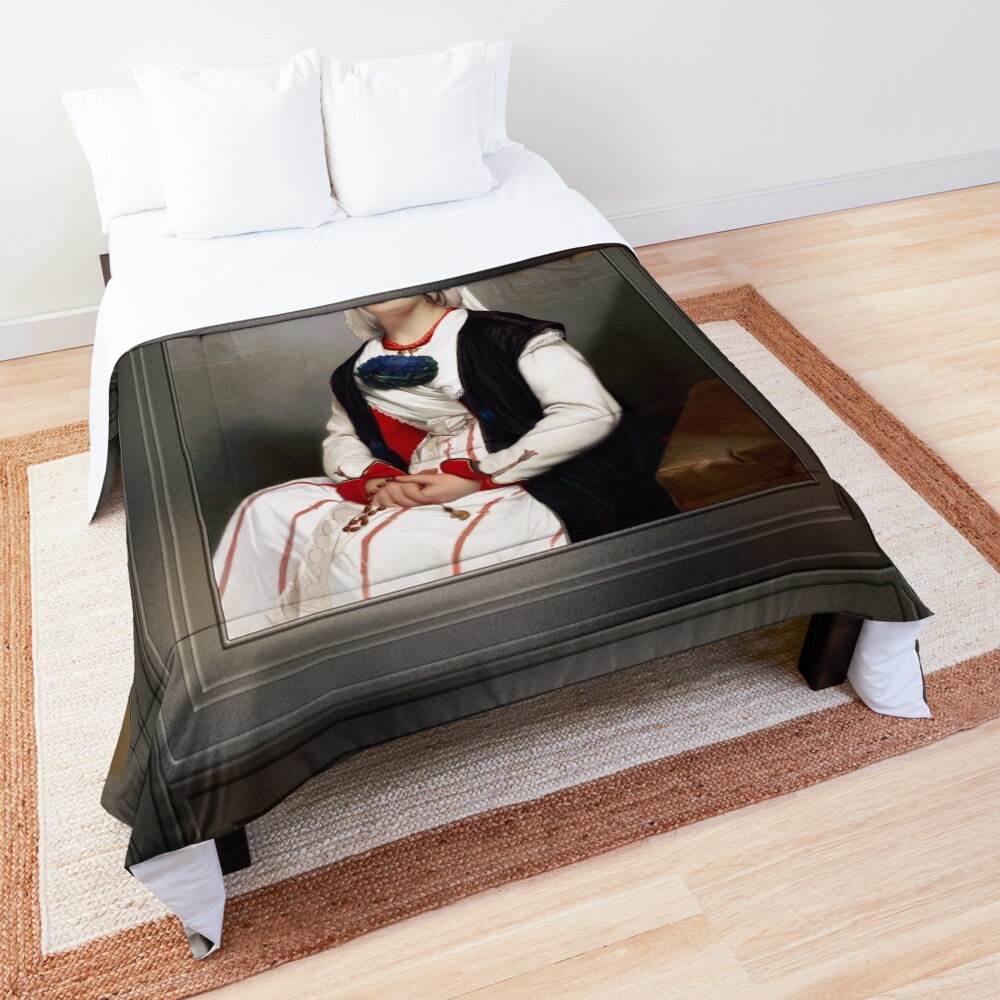
This is an alluring portrait of a beautiful young lady that is sitting in a room with her hands folded on her lap holding a wooden rosary; there is a blank picture frame behind her to the left and stone bench below it.
She is wearing an elaborate white cloth headdress round gold earrings with gemstones around the perimeter, a red gemstone necklace, a large blue and green flower that is pinned to the front of her white dress, with triangular lace trim along the edges, just above the flower that has a gold brooch which connects the upper open portion of her dress with two orbs and a pin.
The lower portion of her white dress is accented with thin red stripes that are widely spaced, while the sleeves of the dress are turned out which reveals a red velour lining with gold trim accents; also there is a long wide sash that is tied around her waist and flows down the dress that is accented with silver circles, each that is composed of multiple disc.
Her attire is then completed with a bluish-black and deep red sleeveless cloak, that seems to cover her back and that just drapes over her shoulders at the front.
Photo Retouching Of The Classical Artwork A Sicilian Woman by Jean-François Portaels
This is a remastered digital art old masters reproduction of a public domain image, which is available for purchase as metal, akrýl, veggspjöld, Rúlluð striga prentun á netinu.
Upplýsingar hér að neðan fengnar af Wikipedia.org
Jean-François fæddist í flæmska Brabant belgíska sveitarfélaginu Vilvoorde, til borgarstjórans í Vilvoorde ríkum bruggara; og eyddi miklum tíma sínum í að alast upp við að teikna atriði úr heimabæ sínum.
Í 1836 faðir hans sendi hann á Académie Royale des Beaux-Arts í Brussel; sem stofnað var í 1711 og hann lærði undir belgíska listamanninum François-Joseph Navez (1787 – 1869), sem sjálfur var nemandi hins fræga nýklassíska franska málara Jacques-Louis David (1748 – 1825).
Fimm árum síðar fór Jean-François til Parísar og skráði sig í frönsku akademíuna, Ecole des Beaux-Arts til að halda áfram námi; lærði í frítíma sínum gamla meistara í Louvre, auk þess að heimsækja Salons í París til að fá innblástur og rannsaka listrænar strauma í Frakklandi.
At the time Orientalism was becoming a popular trend in the arts, and this had an influence on Jean-Francois; also at this time he became a student of the historical French painter Paul Delaroche (1797 – 1856).
Í 1842 við heimkomuna til Belgíu vann hann Grand Prix de Rome, og peningarnir sem hann græddi á þessum vinningi gerði honum kleift að ferðast til Ítalíu; þar sem hann heimsótti Feneyjar, Flórens og Róm, og svo síðar til Marokkó, Alsír, Egyptaland, Líbanon, Júdea, Spánn, Ungverjaland og Noregur.
During this trip he had the ability to paint portraits of some of the prominent individuals at the time, such as the Viceroy of Egypt.
After 5 years Jean returned to Belgium and accepted the appointment as the director of the Academy in the Flemish Municipality of Ghent.
Jean-Francois var afkastamikill og fjölhæfur listamaður sem málaði yfir breitt svið tegunda, þar á meðal söguleg málverk, biblíuleg málverk, portrett málverk, landslagsmálverk, tegundarmálverk og austurlensk málverk ásamt portrettmyndum var aðaláherslan hans.