

A Single Rose: An Exploration of Vintage Pin-up Art
Introduction to the Artwork
Petru Driben‘s “A Single Rose” is a captivating piece of mid-20th-century American art that falls squarely within the genre of pin-up art, a style that reached its zenith during the 1940s and 1950s. Driben (1903 – 1968), known for his iconic pin-up girl illustrations, often depicted women in seductive, playful poses, encapsulating the spirit of the era’s more carefree and vibrant aspects. This artwork features one of his trademark sultry depictions, focusing on a beautiful young woman dressed in an eye-catching red outfit, her flirtatious pose further enhanced by the inclusion of a single rose held delicately between her lips.
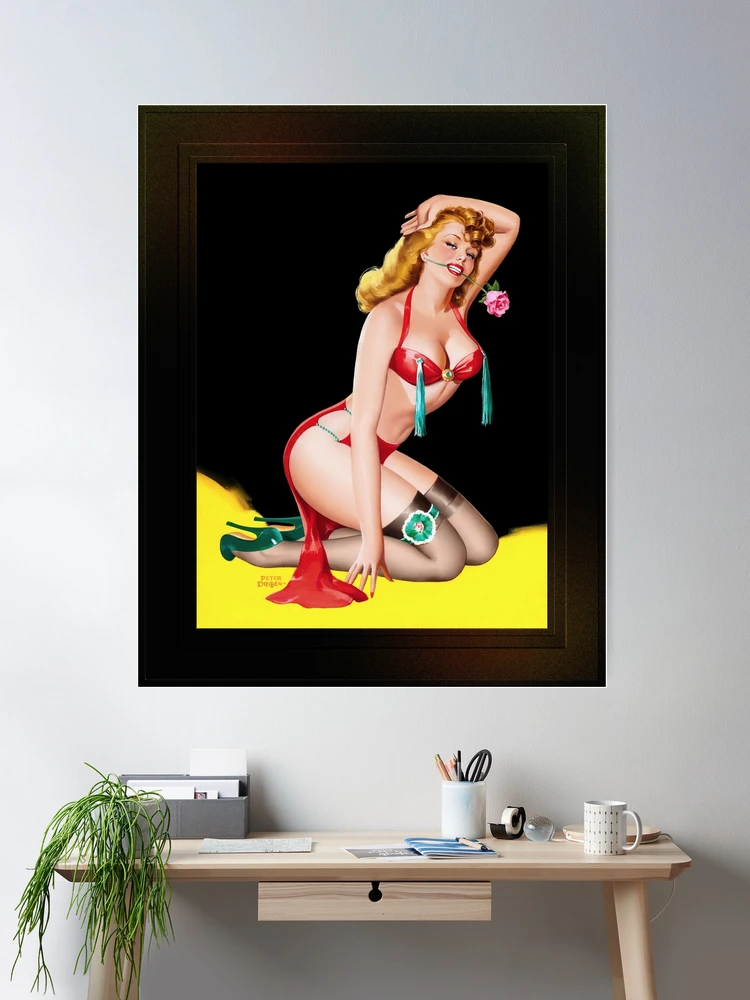
Table of Contents
Sugettu principale: The Pin-up Girl
The central focus of the painting is the striking woman with blonde, glamorous hair styled in soft waves. She is positioned seductively in a kneeling posture, her body angled slightly to the side, with one leg bent at the knee to accentuate her curves. Her playful expression—highlighted by a subtle smile and the rose in her mouth—conveys a sense of confidence and allure. The woman’s bright red attire, a revealing bikini-like top and matching skirt, contrasts beautifully with her pale skin, further emphasizing her figure. A turquoise ribbon is tied around the neckline of the top, adding a touch of color and visual interest to the scene.
The overall pose of the model is one of playful defiance, with one hand behind her head, as if to draw attention to her curves and her overall sensuality. The rose, positioned between her lips, introduces a layer of femininity and subtle romance, a symbol often associated with love, passion, and beauty. This simple yet effective accessory becomes both a visual and symbolic focal point of the artwork, suggesting themes of desire, flirtation, and the timeless appeal of the female form.
Objects and Elements in the Artwork
Apart from the central figure, the painting incorporates several other objects that complement the subject and contribute to the overall mood of the piece. The bright red heels she wears add to her seduction, a bold fashion choice that speaks to the glamour and style of the 1940s. The artist has rendered these shoes with meticulous care, ensuring they catch the light in a way that adds dimension to the overall composition.
The background of the piece is stark and minimalist, utilizing a dark backdrop that contrasts sharply with the model’s pale skin and bright clothing. This contrast is typical of Driben’s style, which often used contrasting tones to make the subject stand out. The absence of any significant background elements keeps the focus squarely on the woman, allowing her pose and facial expression to be the primary narrative devices in the composition.
In più, Driben uses shadows and highlights in a subtle yet effective manner. The light sources in the artwork appear to come from the front-left, casting gentle shadows on the woman’s face, her body, and her surroundings. The lighting draws attention to her curves and emphasizes her seductive posture. The smooth gradient of the yellow floor beneath her further enhances the sense of depth and space, making the figure of the woman appear as though she is poised on a stage, ready to capture the viewer’s full attention.
Materiali è Tecnica
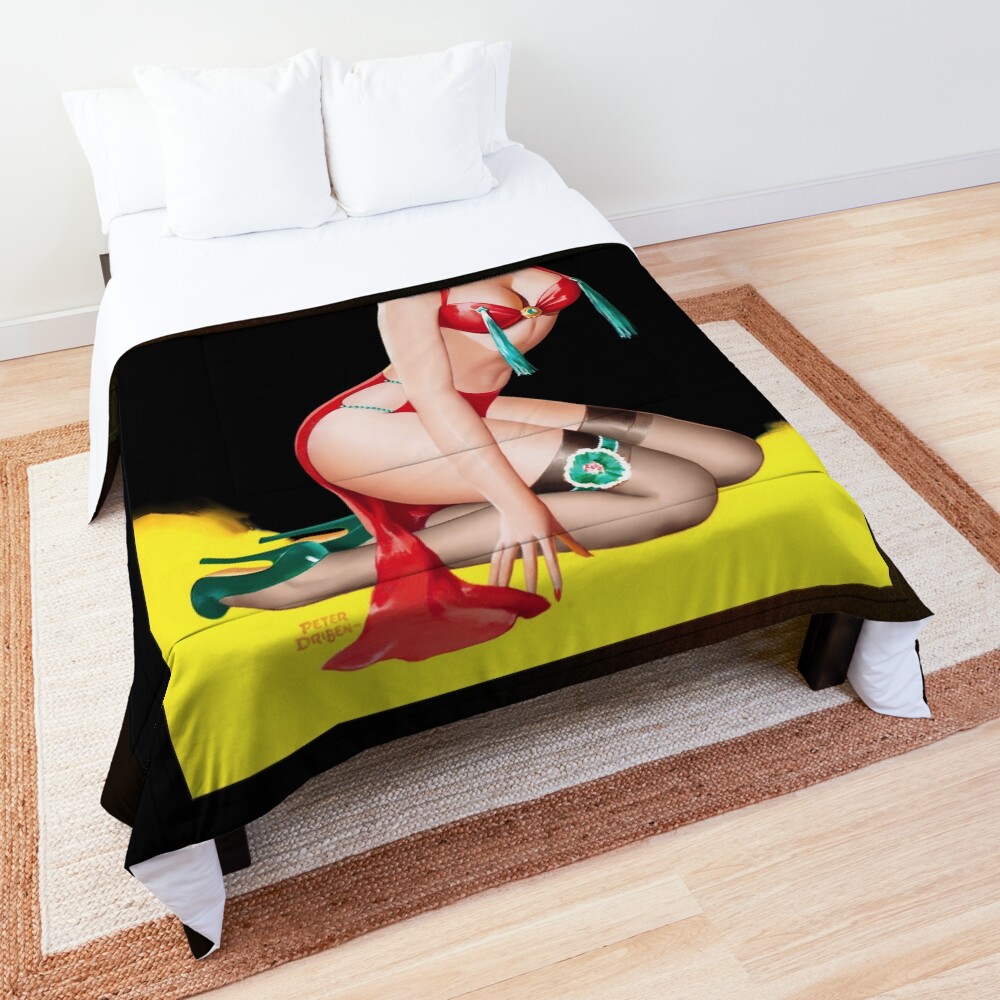
Driben’s technique is precise and controlled, showcasing his skill in rendering realistic textures and intricate details. The use of smooth, flowing brushstrokes gives the painting a polished appearance, especially in the depiction of the woman’s skin and clothing. The use of soft and radiant highlights creates a lifelike quality, while the subtle blending of shadows adds depth and form.
The smooth texture of the model’s skin contrasts beautifully with the softer, more muted surfaces of the surrounding elements, such as the yellow floor and the black background. The subtle textures used in the rose, her heels, and the turquoise ribbon reveal Driben’s eye for detail, elevating what might otherwise be a simple image into a sophisticated and visually appealing work.
Driben’s color palette is typical of the genre, cù rossi vibranti, verdi, and pinks creating an arresting visual spectacle. The striking red attire of the woman contrasts against the soft yellows of the floor and the dark background, ensuring that she remains the focal point of the piece. The teal accents of the ribbon around her neck offer a refreshing burst of color that enhances the sense of balance in the composition.
Tema è umore
U tema di “A Single Rose” speaks to the broader theme of sensuality and allure that is so prevalent in mid-century pin-up art. These works were designed not only to captivate the viewer’s attention but also to evoke a sense of fantasy and escapism. The exaggerated femininity of the model, her suggestive pose, and the flirtatious expression on her face all point to the ideals of glamour and sexuality that were prevalent in popular culture at the time.
The mood of the piece is playful yet seductive. The woman’s body language suggests both confidence and an invitation to indulge in the playful nature of the image, while the rose in her mouth adds a touch of romance and innocence to the otherwise provocative pose. The bright color choices and the smooth textures convey a sense of optimism, joy, è sensualità, while the minimal background directs the viewer’s attention entirely to the model and her allure.
This artwork reflects the pin-up style’s appeal as a celebration of femininity and beauty, encapsulating an era where women were idealized as symbols of glamour, sexuality, è grazia. The model in this painting becomes a representation of the time period’s cultural ideals—a muse for both the artist and the audience.
Cunclusione
“A Single Rose” by Peter Driben is a stunning example of vintage pin-up art that continues to capture the viewer’s imagination with its bold portrayal of feminine allure. Through its meticulous detail, vibrant color palette, and skillful composition, the artwork serves as both a visual feast and a cultural snapshot of the mid-20th century. Driben’s ability to render his subject with both sensuality and elegance ensures that this piece stands as a lasting representation of the glamour and appeal of the pin-up genre.
Questa hè una ripruduzzione di l'antichi maestri d'arte digitale rimasterizzata di una maghjina di duminiu publicu chì hè dispunibule cum'è a stampa su tela in linea.
À propositu di l'artista
Info sottu Da Wikipedia.org
Peter Driben hè natu in Boston, è hà studiatu à l'Ecole d'Art Vesper George prima di trasfurmà in Parigi 1925. Mentre faceva i corsi à a Sorbona in 1925, hà iniziatu una seria di disegni di penna è inchiostru assai populari di e showgirls di a cità.
In marzu di 1934 Driben hà criatu u so primu pin-up cunnisciutu chì era a copertina di La Paree Stories; è da 1935, stava producendo cover per Snappy, Pep, New York Nights, Vita notturna francese è Caprice.
Cume a popularità di Driben cuntinueghja à cresce à a fine di l'anni trenta, hà creatu più copertine per altri periodici cumpresi Silk Stocking Stories., Film Merry-Go-Round è Divertimentu Reale Screen.
A carriera di Driben hà sviluppatu in publicità quandu si trasferì in New York à a fine 1936. Quì hà creatu vetri tridimensionali originali fustellati per Philco Radios, Asciugamani da bagnu Cannon, è a Weber Baking Company.
Forsi u so travagliu più famosu essendu l'affiche originali è l'artwork publicitariu per U Falcon Maltese. Peter Driben era ancu un amicu strettu di l'editore Robert Harrison, è in 1941 hè statu cuntrattu per pruduce copertine per a nova rivista di Harrison Beauty Parade.
Da quì Petru hà continuatu à pitture centinaie di copertine per quella publicazione è per l'altri sette tituli Harrison avia da lancià. – Flirt, bisbiglià, Fighjendu, Wink, Ochju, Ridacchi, è Joker.
Driben avia spessu parechji sei o sette di e so copertine publicate ogni mese. U travagliu di Driben per Harrison l'hà stabilitu cum'è unu di l'artisti pin-up è glamour più ricunnisciuti è riesciuti d'America.. Just prima ch'ellu hà cuminciatu à travaglià per Harrison, Driben hà maritatu cù l'artista, attrice è poeta, Louise Kirby.
In 1944 on lui offrit l'occasion insolite, per un artista pin-up; chì era di diventà u direttore artisticu di u New York Sun, un postu ch'ellu hà ritenutu finu à 1946. Duranti a guerra, a so pittura populari di suldati americani chì alzanu a bandiera in Iwo Jima hà suscitatu una quantità considerableu di l'attenzione di i media.
In 1956, Driben è Louise si trasfirìu a Miami Beach, induve hà passatu i so anni di ritirata à pittura ritratti (cumpresu unu di Dwight D. Eisenhower) e altre opere d'arte, chì sò stati urganizati in mostre di successu da a so moglia. Driben hè mortu in 1968, Louise in 1984.