

Une rose d'été
François Martin-Kavel (1861 – 1931), un éminent peintre français, captured the essence of elegance and romance in his exquisite portrait titled Une rose d'été. Completed during the height of his career, this painting is a captivating testament to the delicate beauty of women, as well as a perfect embodiment of late 19th-century artistic ideals.
Through this composition, Martin-Kavel invites the viewer into a world where beauty, la nature, and innocence intertwine, all while adhering to the principles of classical portraiture. Le sujet de la peinture, une jeune femme, exudes a gentle, yet strong, grâce, with her soft expression and elegant attire framing her delicate features.
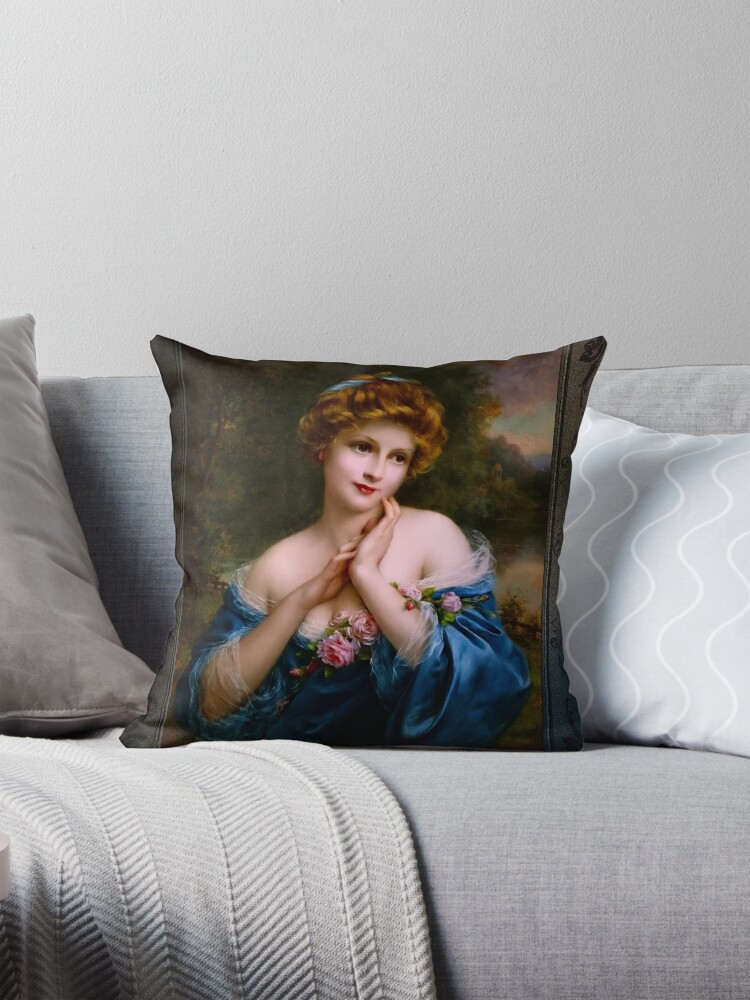
Table des matières
Le sujet principal
Le personnage central de Une rose d'été is a woman of youthful innocence, portrayed with an almost ethereal quality. Sa douceur, rosy complexion and delicate expression immediately draw attention. Son visage est encadré de douceur, wavy hair in a rich golden hue, with the strands gently flowing around her forehead and down her neck.
A soft blue ribbon, tied in her hair, adds a charming touch, gently contrasting with the warm tones of her hair and skin. Ses yeux, although not directly meeting the viewer’s gaze, suggest a quiet contemplation or introspection. The slight tilt of her head and the subtle yet confident pose of her hands convey a sense of poise and grace, as though she is caught in a serene moment of reflection.
Her attire is intricately designed, combining both opulence and softness. She is draped in a gown of soft blue and white, with the fabric billowing out from her shoulders in soft, transparent layers, qui sont ornés de douces touches d'éléments floraux. Le flux et la structure de la robe semblent se fondre parfaitement avec les délicates roses roses qui entourent sa forme..
Ces roses, qui semblent être à la fois une extension naturelle de sa tenue vestimentaire et un symbole de la grâce du sujet, rehausser davantage le thème général de la peinture, la féminité et la beauté juvéniles. Les roses semblent fleurir sur le tissu, comme s'ils faisaient partie de son être même, conférant une qualité onirique à l'ensemble de la composition.
The Objects and Details
L'arrière-plan du tableau est riche en beauté naturelle, complétant la nature délicate du sujet. Le doux, le paysage atmosphérique derrière la jeune femme présente un, mais dynamique, combinaison de feuillage vert et de collines lointaines. Un évanouissement, une lumière presque éthérée filtre à travers les arbres, casting a soft glow across the scene.
The sky above is bathed in warm hues, suggesting the late afternoon or early evening hours, a time when nature itself seems to pause in reverence. Le doux, almost indistinct quality of the landscape in the distance contrasts beautifully with the finely detailed foreground, where the woman is placed.
The roses that frame the figure, along with the faint hint of a flowering vine on the gown, further suggest the passage of time and the season of summer. These symbols of nature, fragile, mais dynamique, act as metaphors for the subject’s own youth and beauty.
They seem to speak of fleeting moments, encapsulating the ephemeral nature of life and love. À bien des égards, the roses and the soft landscape work together to underscore the subject’s delicate beauty, tandis que le tableau dans son ensemble évoque le thème d'un monde idéalisé, forme féminine intemporelle.
Style et technique
La technique de Martin-Kavel dans Une rose d'été met en valeur sa maîtrise de la lumière, Couleur, et texture. Les douces transitions de lumière et d’ombre sur le visage du sujet sont rendues avec une attention méticuleuse aux détails, créant une impression de profondeur et de tridimensionnalité. L’utilisation habile de la couleur par l’artiste, notamment les contrastes entre la peau pâle du sujet, le bleu doux de sa robe, et la riche verdure du fond, est une caractéristique du style académique français de la fin du XIXe siècle.
Chaque élément du tableau est rendu avec un haut niveau de réalisme, de la texture du tissu au subtil jeu de lumière sur le visage de la femme. Le résultat est une œuvre à la fois naturelle et intemporelle, un moment figé dans un monde de beauté et de grâce.
The brushwork is refined, with smooth transitions between the various elements of the painting. Martin-Kavel’s handling of the fabric, with its delicate folds and shimmering textures, demonstrates his thorough understanding of materiality and movement.
Les roses, trop, are delicately painted, with the soft petals appearing almost tangible. The texture of the leaves, the stems, and the blossoms are rendered in such a way that they seem to come alive within the context of the piece. The attention to detail in these elements enhances the sense of realism, while the overall composition remains harmonious and carefully balanced.
Thème et humeur
Le thème de Une rose d'été is undeniably romantic, capturing the essence of youthful beauty, innocence, and the transient nature of time. Le doux, muted tones of the painting evoke a sense of serenity and calm, while the figure of the woman embodies an idealized vision of femininity. Les fleurs, particularly the roses, serve as symbols of both beauty and fragility, suggesting that beauty, like nature, is both fleeting and precious. The artist’s choice to portray the subject in an almost dreamlike atmosphere, surrounded by the ethereal glow of the landscape and the delicate roses, speaks to the artist’s desire to preserve a moment of grace and purity.
L'ambiance du tableau est celle d'une contemplation tranquille. The subject’s gentle expression, combined with the soft glow of the surrounding environment, suggests a calm, peaceful world where beauty is celebrated in its most natural and unhurried form. Le spectateur est invité à faire une pause et à réfléchir, to appreciate the delicate, la beauté intemporelle du moment capturée sur la toile.
Conclusion
Une rose d'été de François Martin-Kavel est un chef-d'œuvre qui résume la beauté et la grâce de son sujet, ainsi que la nature éphémère de la jeunesse et de la beauté. Grâce à son utilisation de la couleur, lumière, et texture, l'artiste crée un monde où la nature, femme, et le symbolisme sont parfaitement liés. Le portrait est à la fois une célébration de la beauté féminine et une méditation sur le passage du temps., invitant le spectateur à faire une pause et à apprécier les moments délicats qui constituent les souvenirs les plus précieux de la vie.
Cette reproduction de maîtres anciens d'une image du domaine public, comme toutes les œuvres d'art disponibles sur le site Web Xzendor7, elles sont disponibles à l'achat en ligne dans une variété de formats de matériaux, y compris des impressions sur toile., impressions acryliques, impressions métalliques, gravures sur bois, impressions encadrées, affiches, et comme roulé impressions sur toile dans une variété de tailles de 12 pouces à 72 pouces en fonction de la taille de l'œuvre d'art réelle et de la boutique d'impression à la demande auprès de laquelle vous choisissez d'acheter l'art.
J'ai également créé une version de bordure de cadre plus élaborée qui peut être vue à mon J'ai également créé une version de bordure de cadre plus élaborée qui peut être vue à mon J'ai également créé une version de bordure de cadre plus élaborée qui peut être vue à mon; J'ai également créé une version de bordure de cadre plus élaborée qui peut être vue à mon 400 J'ai également créé une version de bordure de cadre plus élaborée qui peut être vue à mon.
Biographie de l'artiste
Informations ci-dessous dérivées de Artnet.com
François Martin-Kavel était un peintre de genre français qui est surtout connu pour ses portraits idéalisés de belles jeunes femmes, qu'il dépeint souvent dans des costumes exotiques ou dans des états de déshabillage émouvants.
Martin-Kavel a notamment souvent peint ses portraits féminins dans des compositions centrées qui étaient entourées de fonds de tissus sombres, et théâtralement éclairé comme par un projecteur braqué sur le modèle.
Même si François est connu pour ses portraits de figures féminines populaires, il était également bien connu pour ses natures mortes d'œuvres d'art florales et ses peintures de paysages; et était un exposant régulier au Salon des Artistes Français.
En tant que membre du salon, il a reçu une médaille pour ses contributions artistiques dans 1881.