

A Summertime Beauty
Emile Vernon, a renowned French artist (1872–1920), captured the essence of beauty and femininity in his 1910 sárshaothar, A Summertime Beauty. The painting portrays a delicate young woman amidst a soft and vibrant floral composition. A close-up of the subject reveals an ethereal beauty, with her poised expression and serene demeanor invoking a sense of tranquility and elegance. The mood of the painting is undeniably one of grace, evoking nostalgia and a celebration of youth and the natural world.
Clár na nÁbhar
An tÁbhar: A Portrait of Grace
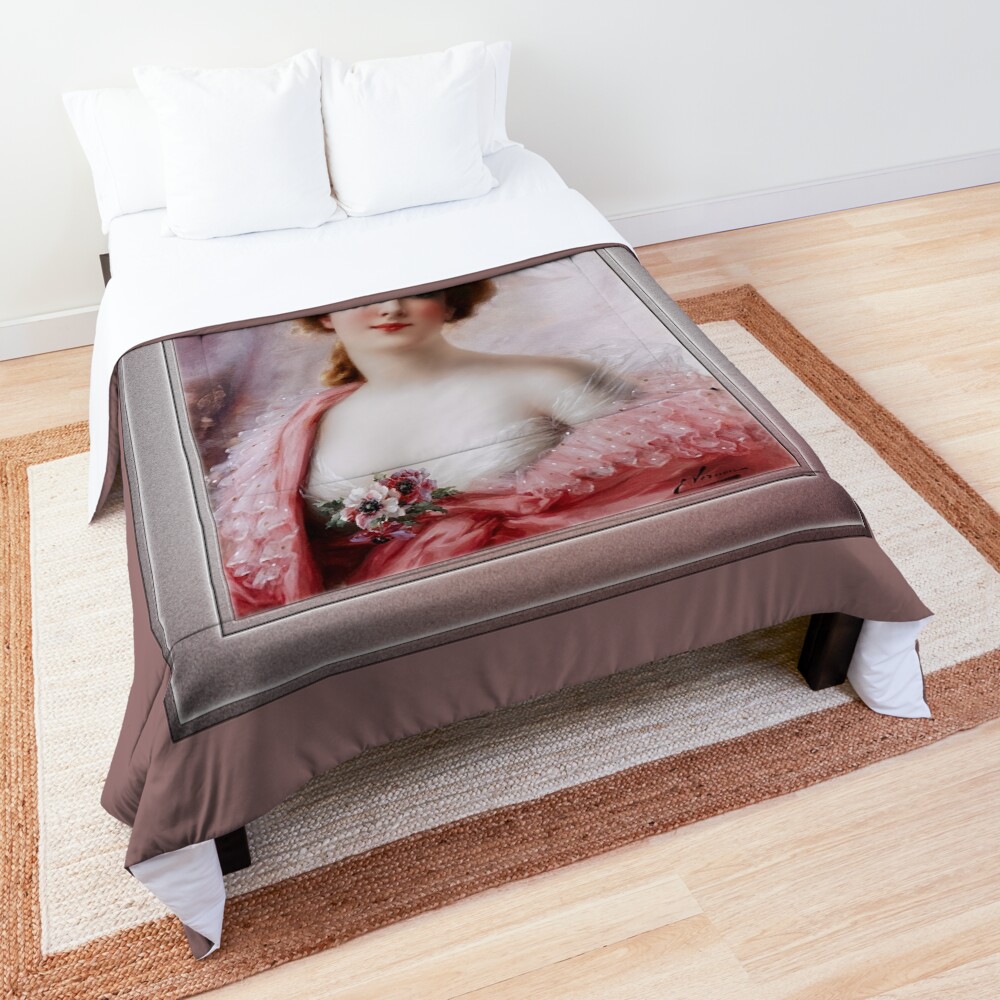
The central focus of the painting is a beautiful young woman, presented in a portrait format. Her hair is styled in soft waves, adorned with a delicate floral wreath composed of pale pink and white blossoms. This floral motif enhances her purity and innocence, while also symbolizing the joys of summer. The woman gazes gently toward the viewer with an inviting yet subtle smile, exuding an air of serenity and confidence.
Her attire consists of a soft, pink gown, which flows gently around her form and is dotted with delicate white flowers. The gown’s sheer texture gives a sense of lightness and softness, as though it were spun from the finest, airy fabric. The combination of the pale pink hue of the gown with the soft colors of the flowers gives a sense of harmony with nature, aligning with the summer theme that is central to the piece.
An bog, rounded features of the woman’s face are expertly captured. Her cheeks are flushed with a natural rosy glow, complementing the flowers in her hair and the delicate floral arrangement on her gown. The artist has skillfully blended light and shadow to create a lifelike texture that conveys youth, health, and vitality. Her expression is one of quiet confidence, while the soft gaze toward the viewer seems both intimate and distant, as if she is contemplating the fleeting nature of beauty itself.
Composition and Use of Color
Emile Vernon’s use of color in A Summertime Beauty is notable for its softness and lightness. The pastel tones dominate the piece, with the pink hues of the subject’s gown and the soft colors of the flowers creating a harmonious balance that emphasizes both the subject’s form and the floral elements in the painting. The artist’s palette focuses on tender colors like soft pinks, gealáin, and light greens, conveying a sense of calm and peace.
The light background adds a dreamy quality to the scene, with faint hints of mauve and pale lavender subtly enhancing the overall warmth of the composition. The soft hues of the background mirror the gentle presence of the subject, creating an atmospheric depth that feels almost like a dream. Vernon’s skillful blending and layering of the colors ensure that the entire painting remains cohesive, with the subject and the surrounding flowers seamlessly merging into one harmonious composition.
The texture of the piece is delicate, with the artist using soft brushstrokes to define the woman’s face, gruaig, agus gúna. The use of smooth transitions between light and shadow gives a sense of volume and depth, particularly on the contours of her face and the fabric of her gown. The flowers adorning her hair and dress are rendered with exquisite detail, each petal painted with care, further enhancing the naturalistic quality of the painting.
Symbolism of the Floral Elements
In addition to portraying beauty, the flowers in A Summertime Beauty serve as a symbol of both youth and the ephemeral nature of life. The wreath in the woman’s hair and the flowers on her gown are rich in symbolism, often associated with purity, femininity, and the fleeting beauty of youth. The choice of pink and white blossoms might also signify grace and innocence, qualities that are often associated with the summer season, a time of flourishing life and vitality.
The flowers surrounding the subject are not merely ornamental; they tie the subject to the natural world, enhancing the theme of harmony between the woman and her environment. They emphasize the idea that beauty, like flowers, is temporary and fragile, blooming in the moment but fading with time. This contrast between the delicate flowers and the woman’s timeless beauty hints at the duality of human existence—youth is fleeting, but the elegance it embodies is eternal in art.
Mood and Theme of the Artwork
The overall mood of the painting is one of serene contemplation, capturing a fleeting moment of natural beauty. The woman’s gentle expression and the soft light that surrounds her evoke feelings of nostalgia for the innocence and vitality of youth. The choice of the summertime theme aligns with feelings of warmth, suaimhneas, and the calm embrace of nature.
The painting encapsulates a sense of timelessness, as though the viewer is witnessing a moment suspended in time. Vernon’s ability to convey the delicate balance between youth and nature in his work highlights his mastery of capturing the beauty and fragility of life. The painting reflects a longing for the purity and simplicity of simpler times, and the soft color palette and calm expression reinforce the peaceful and idyllic tone that defines the piece.

Conclúid
A Summertime Beauty by Emile Vernon is a captivating portrayal of youthful grace, encapsulating a moment in time where beauty and nature converge. The artist’s exceptional technique, use of color, and symbolic incorporation of floral elements create a harmonious composition that invites the viewer to reflect on the delicate and fleeting nature of life. With its soft, pastel hues, léiriú suaimhneach, and elegant portrayal of femininity, the painting remains a testament to the timeless beauty that Emile Vernon so skillfully immortalized.
Seo atáirgeadh seanmháistrí ealaíne digiteach athmháistrithe d’íomhá fearainn phoiblí atá ar fáil mar phriontáil chanbhás ar líne.
Cruthú ealaíne digiteach seo, mar atá an saothar ealaíne go léir atá le fáil ar shuíomh Gréasáin Xzendor7 ar fáil le ceannach ar líne i bhformáidí éagsúla ábhar lena n-áirítear priontaí canbháis, priontaí aicrileach, priontaí miotail, priontaí adhmaid, priontaí frámaithe, póstaeir, agus mar phriontaí chanbhás rollta i méideanna éagsúla ó 12 orlach go 72 orlach ag brath ar mhéid an tsaothair ealaíne iarbhír agus ar an siopa priontála ar éileamh a roghnaíonn tú an ealaín a cheannach uaidh.
Tá an saothar ealaíne ar fáil freisin ar raon leathan éadaí fear agus ban, mugaí, totes, scaifeanna, leabhair nótaí agus irisleabhair agus go leor táirgí maisiúcháin tí.
Faoin Ealaíontóir
Eolas Thíos Ó Gailearaí Ary Jan
Bhí Émile Vernon ina mhac léinn i scoil na Mínealaíne i Tours áit ar bhuaigh sé an chéad duais as tarraingt isteach 1888; ina dhiaidh sin thug William Bouguereau agus Auguste Truphème meantóireacht air.
Ansin isteach 1898 ghlac sé páirt i dtaispeántas Tours ar na Mínealaíona agus na hEalaíona Maisiúla agus níos déanaí sa bhliain sin, sa Taispeántas Ealaíontóirí Francacha agus taispeánadh saothar hie go rialta ann ó 1898 chun 1913; ag cur i láthair portráidí, tírdhreacha, radhairc ón mBriotáin, bouquets fós den saol a phéinteáil sé in uiscedhath, chomh maith le figiúirí baininscneach, a tháinig chun bheith ina speisialtacht.
Bhain Émile barr feabhais amach ina phictiúir le solas bog, figiúirí adorable leanaí agus mná óga galánta, lena raibh baint aige go minic le peata ar nós cat, madra nó éan, agus a chuid íomhánna maisithe le garlands nó bouquets na bláthanna, ar feadh a shaoil; ach ba ealaíontóir thar a bheith ilúsáideach é freisin a d’fhéadfadh péinteáil le déine agus le cumhacht mar atá ina chuid saothar portráid de Madame Vernon agus Sous la Lampe (Faoin lampa).