

A Water Idyll: Exploring Enchantment in Hans Zatzka’s Romantic Vision
A Water Idyll by Hans Zatzka (1859-1945) även känd som P. Ronsard, Pierre de Ronsard, eller H. Zabateri och han undertecknade många av hans verk som Joseph Bernard, J. Bernard, or Bernard Zatzka to avoid the penalties of braking contracts that limited how many works he could sell; was a celebrated Austrian painter known for his idyllic scenes of nymphs, älvor, and romantic landscapes, often imbued with a delicate sense of melancholy and enchantment.
“A Water Idyll,” exemplifies this signature style, transporting the viewer to a secluded woodland pool where reality blurs with fantasy. The painting is not merely a depiction of nature; it’s an exploration of longing, observation, and the allure of the unseen world. Zatzka’s meticulous attention to detail, combined with his mastery of light and color, creates a captivating atmosphere that invites contemplation.
Innehållsförteckning
Sammansättning harmoni & Berättande förslag
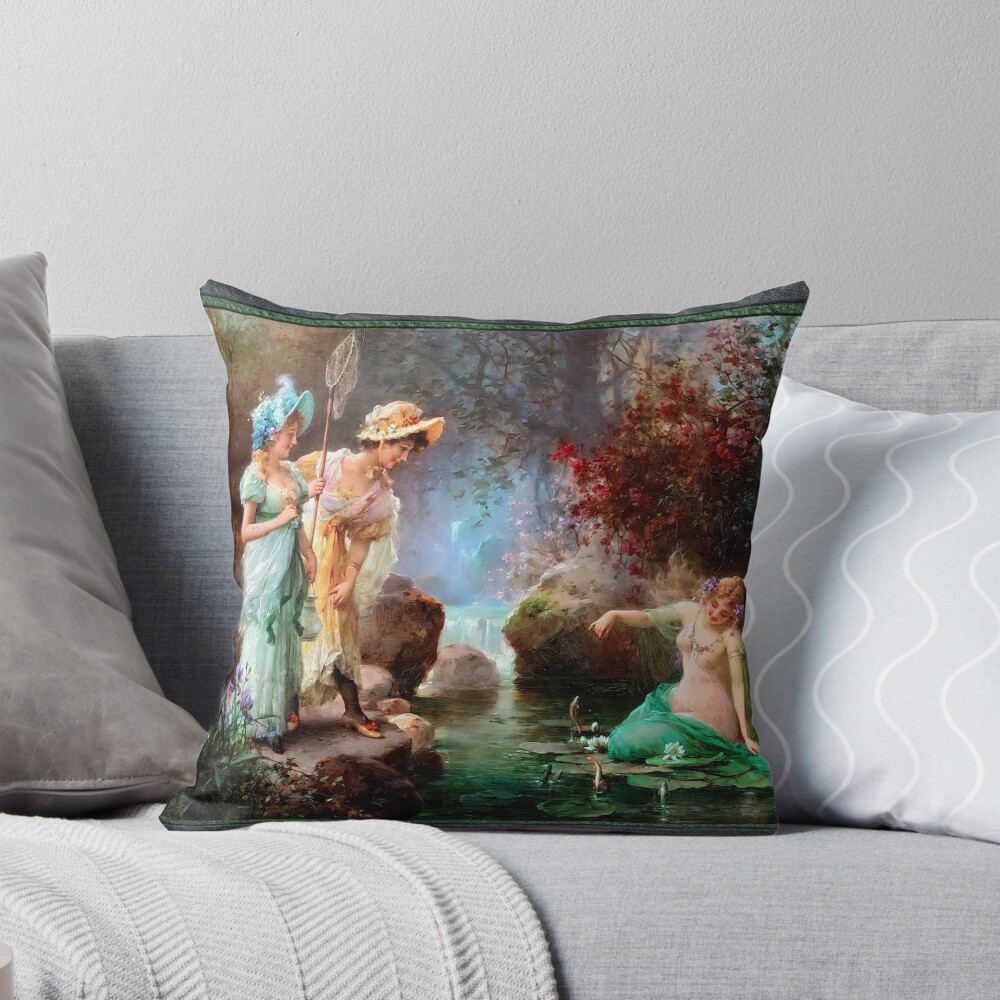
The composition is carefully structured around a central pool of water, acting as both a physical and metaphorical focal point. Two young women, dressed in fashionable attire of the late 19th century, stand on the bank, their gazes fixed upon a figure emerging from the depths – a nymph or water spirit.
The placement of these figures creates a clear visual triangle, guiding the eye across the canvas and establishing a narrative tension between the human world and the realm of myth. The background is densely populated with foliage, creating a sense of depth and seclusion, while also framing the central action. A small waterfall cascades into the pool, adding movement and auditory suggestion to the scene.
Siffrorna: Observation & Enchantment
The two women are rendered with remarkable detail, their expressions conveying a mixture of curiosity and wonder. One holds a butterfly net, suggesting an earlier pursuit of natural specimens, while the other leans forward slightly, her hand raised in a gesture of gentle inquiry. Their clothing – light-colored dresses with delicate embellishments – reflects the fashion of the era but also contributes to the overall sense of lightness and grace.
The nymph, partially submerged in the water, is depicted with an ethereal beauty. Her flowing hair, prydda med blommor, blends seamlessly with the surrounding foliage. Her pose suggests a moment of emergence, as if she has just risen from the depths or is about to return beneath the surface. She extends her hand towards the women on the bank, creating a subtle connection between the two worlds.
Light and Color: A Romantic Palette
Zatzka’s use of light and color is crucial in establishing the painting’s mood. The scene is bathed in a soft, diffused light that filters through the trees, creating dappled patterns on the water and foliage. Warm tones – golds, gula färger, and greens – dominate the foreground, while cooler blues and violets are used to depict the deeper recesses of the pool and background forest. This contrast enhances the sense of depth and creates an atmosphere of mystery. The artist skillfully employs chiaroscuro, using dramatic contrasts between light and shadow to highlight key elements and create a sense of drama. The overall palette is characteristic of Romanticism, emphasizing emotion and subjective experience over strict realism.
Botanical Detail & Environmental Storytelling
Beyond the figures, Zatzka’s painting showcases an impressive understanding of botanical detail. Various species of flowers and foliage are accurately depicted, adding to the richness and authenticity of the scene. The presence of wildflowers – irises, lilies, and other delicate blooms – reinforces the idyllic setting and suggests a place untouched by human intervention. The dense vegetation surrounding the pool creates a sense of enclosure, further isolating the figures from the outside world. This attention to environmental detail is not merely decorative; it contributes significantly to the painting’s overall narrative, suggesting a hidden sanctuary where nature and myth intertwine.
Zatzka’s Artistic Legacy & The Appeal of Romantic Fantasy
“A Water Idyll” exemplifies Zatzka’s enduring appeal as an artist who captured the imagination with his romantic visions. His paintings resonate with viewers seeking escape from the mundane, offering a glimpse into a world where beauty and enchantment reign supreme. Zatzka’s work was immensely popular during his lifetime, and continues to be admired for its technical skill, suggestiv atmosfär, and timeless themes of nature, fantasi, and human longing. The painting’s enduring popularity speaks to the universal desire for connection with something beyond the ordinary – a yearning that Zatzka so eloquently captured on canvas.
Artist Bio härledd från Wikipedia.org
Hans Zatzka har ibland varit känd som P. Ronsard, Pierre de Ronsard, eller H. Batterier, och signerade många av hans verk som Joseph Bernard, J. Bernard, eller Bernard Zatzka.
Syftet med Zatzkas stora utbud av pseudonymer var att undvika straff för att bryta kontrakt som begränsade mängden konstverk han kunde sälja.
Detta har fått vissa konstdatabaser att kombinera Zatzkas verk under pseudonymen Joseph Bernard med den franska skulptören med samma namn.
Hans Zatzka föddes den 8 Mars 1859 i Wien. Hans far Bartholomaüs var byggnadsarbetare, och hans mor var Marie Karpischek Zatzka.
Mellan 1877 och 1882, Han studerade vid Academie des Beaux-Arts, under Christian Griepenkerl, Carl Wurzinger, och Karl von Blaas.
Zatzka kunde försörja sig på att producera fresker för kyrkor och andra institutioner.
I 1885, Zatzka fick i uppdrag att skapa takfresken The Naiad of Baden på Kurhaus Baden.
Många av Zatzkas verk var religiösa målningar och altarbitar tillägnade olika kyrkor i Österrike.
i alla fall, han är mer känd för sina målningar av kvinnor, älvor, och andra fantastiska scener.
Ofta, han skulle hämta inspiration från Richard Wagners verk och sagorna om bröderna Grimm.
I slutet av 1800 -talet och början av 1900 -talet, flera stycken av Zatzka fotograferades och gjordes till kommersiella och samlingsbara vykort.
Under 1920 -talet, Zatzkas stil blev valfri inredning i hela Europa. Dessutom, de föregående trettio åren höll en återupplivning för Zatzka.