

A Winter Landscape with Activities around a Village
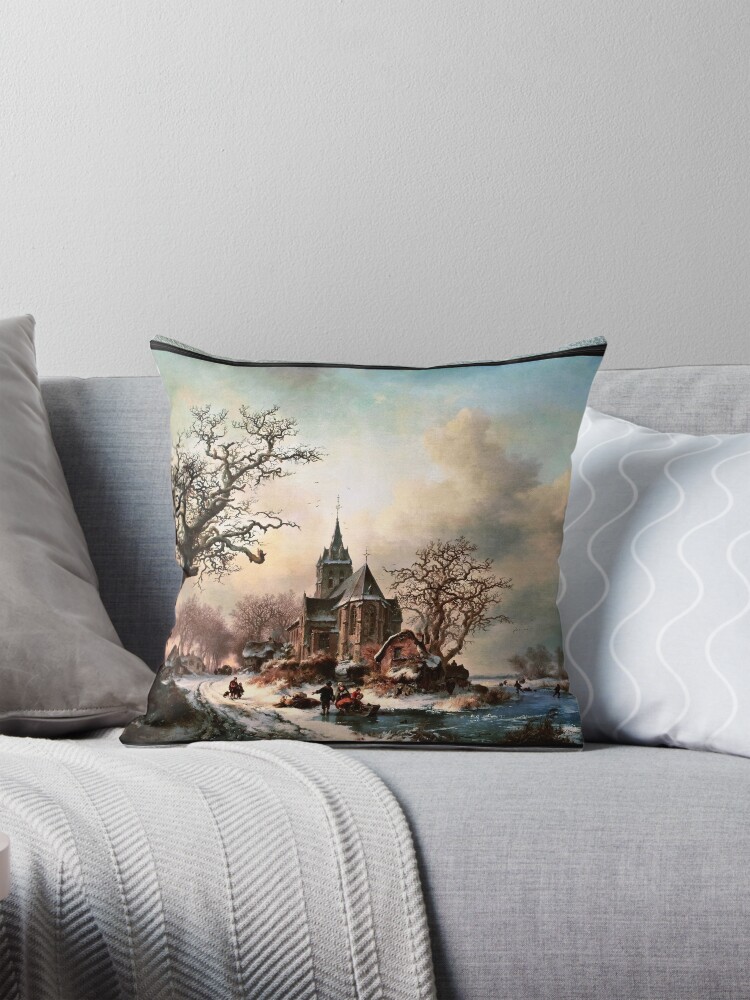
Winter Landscape with Activities around a Village c1857 by 19th century renowned Dutch painter Frederik Marinus Kruseman (1816 – 1882), captures a quintessential scene of rural life during the winter months. The painting exemplifies the Romantic style, known for its emphasis on emotion, Příroda, and the human connection to the environment. Kruseman’s use of light, barva, and natural elements conveys a sense of tranquility, while also celebrating the humble life of villagers as they engage in daily activities amidst the harsh beauty of winter. The composition invites the viewer into a detailed and atmospheric world, showcasing the harmony between humanity and the surrounding landscape.
Obsah
Scene Overview and Composition
In this detailed winter landscape, the village stands at the heart of the composition, surrounded by gently rolling hills covered in a blanket of snow. The church steeple in the distance rises against a backdrop of soft, swirling clouds, which suggests the cold yet peaceful atmosphere of a winter day. The building, likely the village church, is crafted with careful attention to architectural detail, indicative of the period’s devotion to realism. The figures below are shown in mid-action, capturing everyday life in the village as it unfolds amidst the snow.
The foreground features a snow-covered road that winds through the village. A cart, drawn by a horse, is being pulled along this road, with a couple of figures accompanying it. One man walks beside the cart, possibly helping to guide it along the snowy path, while another person, perhaps a woman, is seated atop the cart. This domestic activity, indicative of the season’s challenges, portrays the hardworking nature of rural life. In the middle ground, a group of people are seen walking along the path, bundled up in warm coats and hats, adding to the realistic portrayal of the village’s winter routine.
Téma a nálada
The primary theme of the painting revolves around the human experience in nature, particularly during the winter season. Kruseman’s depiction of the villagers working and moving through the snow evokes a sense of stoic perseverance, characteristic of rural life in the 19th century. The snow-covered landscape, though cold and harsh, is not presented as an obstacle, but rather as an element with which the villagers co-exist in a peaceful harmony. This image of daily labor amidst a breathtaking winter environment invites contemplation on the resilience and fortitude of human life in the face of nature’s challenges.
The mood of the artwork is peaceful yet dynamic, with Kruseman balancing the stillness of the landscape with the movement of the figures. The serene winter setting, punctuated by the activity in the foreground, suggests both calm and industriousness. The light in the sky creates a soft glow, enhancing the peacefulness of the scene while also contributing a sense of the day’s fleeting passage. There is a delicate sense of quiet beauty, evoking the stillness and introspective mood typical of winter.
Details of the Village and Terrain
The village depicted is small but recognizable, with a clear focus on the rural architecture of the time. Budovy, some with thatched roofs and others with more structured facades, are arranged in a way that suggests the tight-knit nature of the community. The church, as the tallest building in the composition, acts as the focal point of the village, reinforcing its central role in the daily life and spiritual practice of the inhabitants.
The terrain surrounding the village is dominated by snow-covered fields, trees with sparse foliage, and distant hills. The branches of the leafless trees twist and curve in the wind, adding a sense of movement to the otherwise static scene. The way the snow blankets the ground and the rooftops of the houses shows the depth of the season and the heaviness of the winter chill. Kruseman’s careful attention to the light and shadow cast on the snow provides a sense of depth and texture, highlighting the coldness of the day. There is an interplay between the earth and sky, with the colors in the sky transitioning from a soft pinkish hue near the horizon to a deeper blue above.
Material Use and Artistic Style
Kruseman’s choice of oil paints allows for a rich texture that brings life to the scene. Mistrovské je využití světla a stínu, as it subtly draws attention to the reflective surfaces of the snow and the warmth of the figures against the cool background. The details in the clothing of the figures are finely rendered, showcasing the artist’s skill in capturing both the textures of fabric and the nuances of the human form. The distinct brushwork used in the trees, the clouds, and the snow, conveys the feeling of motion, while maintaining the overall sense of stillness and calm that defines the scene.
The Romantic style is reflected in the composition’s emphasis on nature’s beauty and the connection between humanity and the landscape. The portrayal of the rural village and its people is both a celebration and a tribute to the past, evoking a sense of nostalgia and reverence for simple, agrarian life. There is an underlying celebration of both the quiet beauty of nature and the persistence of life through its seasons, particularly the harshness of winter.
Závěr
v A Winter Landscape with Activities around a Village, Frederik Marinus Kruseman creates an evocative, timeless depiction of a winter scene that balances the serenity of the landscape with the industriousness of the people who inhabit it. Through his careful rendering of figures and environment, he presents a vision of life that, while rooted in the specific context of 19th-century rural Netherlands, transcends its time and place. The artist invites us to consider not just the cold and stillness of winter, but also the warmth of community, vytrvalost, and connection to the natural world. The painting is both a quiet reflection on the challenges of rural life and a celebration of the enduring beauty of the natural world in winter.
A Winter Landscape with Activities around a Village is a retouched digital art old masters reproduction of a public domain image.
Tato digitální umělecká tvorba, stejně jako všechna umělecká díla, která lze nalézt na webu Xzendor7, je k dispozici ke koupi online v různých materiálových formátech včetně tisků na plátno, akrylové tisky, kovové potisky, otisky dřeva, zarámované tisky, plakáty, a jako rolované obrazy na plátně v různých velikostech od 12 palce až 72 palce v závislosti na velikosti skutečného uměleckého díla a obchodu s tiskem na vyžádání, ve kterém se rozhodnete umění koupit.
Umělecká díla jsou k dispozici také na široké škále pánského a dámského oblečení, hrnky, totes, šátky, sešity a deníky a mnoho produktů pro domácí dekoraci.
O umělci
Níže uvedené informace jsou odvozeny z Wikipedia.org
Frederik received his first drawing lessons from still life painter Jan Reekers (1790 – 1858), who at the time was Director of the Royal Acadamy of Fine Arts in Amsterdam; and who had also tutored his cousin Jan Adam[ while attending a vocational school in Haarlem from 1832 na 1833.
v 1833 poté začal studovat malbu u holandského malíře, Rytec, Litograf, Akvarelista a ilustrátor Nicolaas Johannes Roosenboom (1805 – 1880).
Pak v 1835 přestěhoval se do Het Gooi ve středu Nertherlands, kde absolvoval pokročilá studia u holandského krajináře Jana van Ravenswaaye (1789 – 1869); stejně jako krátkodobé studium s holandským krajinářem a litografem Barendem Cornelisem Koekkoekem (1803 – 1862).
Později se vrátil do Haarlemu a odtud do Kleve v severozápadním Německu, kde maloval krajinu, před návratem domů dovnitř 1839.
v 1841 přestěhoval se do Bruselu a zůstal tam do 1852, kromě krátkého období několika měsíců, kdy odešel do Paříže. v 1852 vrátil se domů do Haarlemu a zůstal tam čtyři roky, poté odešel do Belgie, kde zůstal až do své smrti v r 1882.