

Alexander Lord Loughborough c1800
Konstverk med titeln “Alexander Lord Loughborough c1800” was created by the esteemed Florentine engraver Francesco Bartolozzi (1727 – 1815); liksom en målare, en av grundarna av Royal Academy och känd för att ha populariserat kritmetoden för gravering. This fine engraving portrays Alexander Wedderburn 1st Earl of Rosslyn, PC, KC (1733 – 1805); a Scottish lawyer and politician who served in the House of Commons from 1761 till 1780, and who was raised to the peerage as Baron Loughborough; as well as serving as Lord High Chancellor of Great Britain from 1793 till 1801.
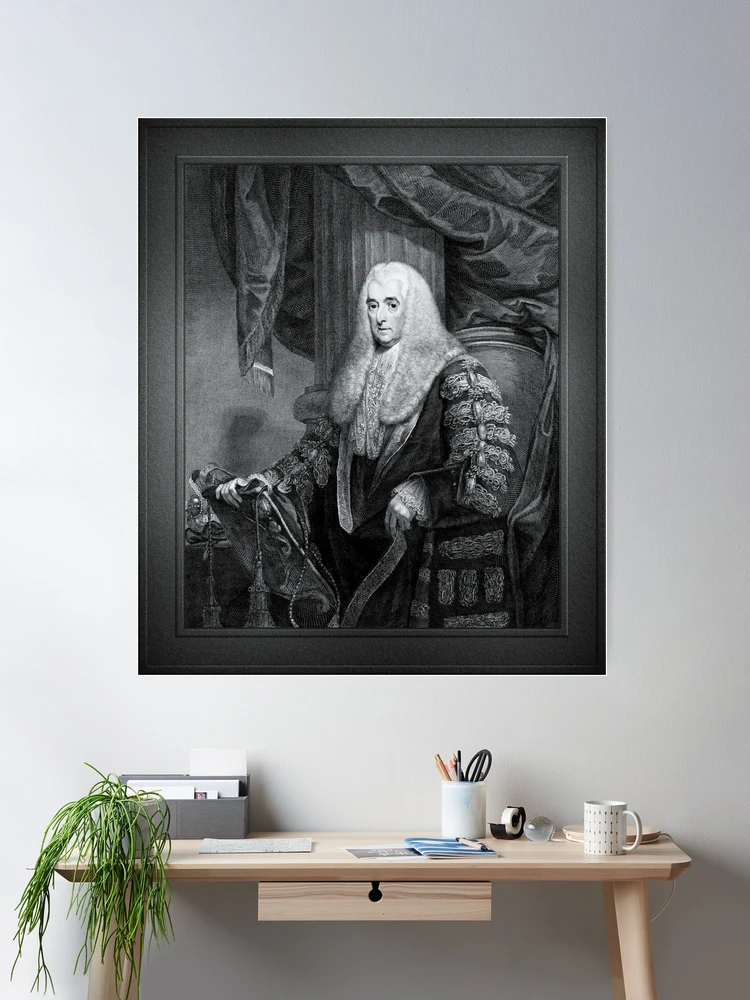
Lord Alexander Loughborough, an influential figure of the 18th century, dressed in elaborate judicial attire, showcasing the refinement and authority of the era. The image is a detailed depiction of the subject’s dignified posture and lavish robes, which were common among prominent figures of the time.
Innehållsförteckning
Main Subject and Figures
The central figure of this engraving is Lord Alexander Loughborough, whose distinguished presence commands the viewer’s attention. Lord Loughborough, a British nobleman, is captured sitting in a grand, somewhat solemn pose, dressed in an ornate judicial robe, indicative of his high rank. The fine details in his attire, from the lace cuffs to the richly textured fabric of his robes, underscore his status in society and the era’s appreciation for elaborate fashion and decorum. His countenance, stern yet reflective, is etched in remarkable detail, enhancing the gravitas of his character as a man of power, intellekt, and wisdom.
The engraving emphasizes Loughborough’s sense of dignity, with his thoughtful expression paired with his poised stance. His finely carved wig, typical of high-ranking figures during the late 18th century, is a characteristic feature in the work, showcasing both style and the societal norms of the time. It is clear that Bartolozzi sought not only to capture the likeness of his subject but to convey the noble and authoritative qualities that defined Lord Loughborough.
Föremål och symbolik
While the main focus remains on Lord Loughborough, there are several objects present in the artwork that contribute to its overall theme of high social standing and judicial power. The chair on which he rests is elegantly detailed, with its ornate carving and flowing lines, a representation of the grandeur associated with nobility. Bakgrunden, consisting of heavy curtains, further suggests an aura of privacy and exclusivity, perhaps referencing the closed doors of power in which Loughborough operated.
The artist carefully arranges the composition so that every detail of Lord Loughborough’s attire and environment reflects his elevated position within British society. The presence of a scepter-like object near the subject’s hand, while subtle, alludes to the authority and leadership of Loughborough, suggesting his involvement in governance or law. Such items were often used to symbolize control, intellekt, and legal jurisdiction, enhancing the prestige of the figure depicted.
Terräng och bakgrund
The background of the engraving is minimal yet effective. The heavy drapes in the background, carved into the frame, create a soft sense of depth while not detracting from the main figure. This subtle backdrop allows the viewer to focus on Lord Loughborough’s persona and attire, without unnecessary distractions. The use of shadow in the background adds dimension and weight to the composition, giving the piece a sense of groundedness, which contrasts with the elevated social standing of the subject.
Though no natural terrain or outdoor environment is directly shown, the sense of grandeur is derived from the interior setting suggested by the draped curtains and luxurious textures. This formal, indoor scene was typical of official portraits during the era, where subjects were depicted in settings that emphasized their status, often within the walls of their own estates or in carefully curated settings.
Material och teknik
Francesco Bartolozzi was renowned for his skill in engraving, particularly in the delicate art of stipple engraving. This work showcases his mastery of light and shade, which he achieved through the use of tiny dots and fine lines. The use of stipple engraving gives the image a remarkable texture, allowing Bartolozzi to convey both the soft fabric of Loughborough’s robes and the hard, stately contours of his chair and surroundings with equal precision. The cross-hatching and careful shading add depth and dimension, giving the figure a lifelike presence.
The engraving is executed in black and white, a common practice of the time. The contrast between light and dark tones accentuates the detailing in the subject’s facial features and attire, as well as the fabric’s texture. Den övergripande tonala variationen bidrar också till den dystra och värdiga stämningen i stycket, med djupa skuggor som förstärker känslan av tyngd och auktoritet kring Lord Loughborough.
Stil, Tema, och humör
Gravyren följer stilistiska konventioner för 1700-talsporträtt, där ämnet ofta idealiseras och deras sociala position betonas. Denna speciella gravyr, i alla fall, är inte bara en skildring av en adelsman; det är en utforskning av status, värdighet, och tidens intellektuella gravitas. Konstnären, Bartolozzi, var en mästare på att fånga essensen av sina undersåtar, och detta verk är ett bevis på hans förmåga att lyfta ett enkelt porträtt till något som talar till den makt och auktoritet som figuren innehar.
Stämningen i konstverket är formell och inåtvänd. There is a quiet reverence to the way Lord Loughborough is presented, a mood that likely reflects his own demeanor and the respect that he commanded. The fine details, the soft light, and the overall composition of the work give it a solemn yet serene atmosphere, characteristic of portraits intended for public and private admiration during the period.
Slutsats
“Alexander Lord Loughborough c1800” by Francesco Bartolozzi is a profound example of 18th-century engraving, one that speaks to both the technical brilliance of Bartolozzi and the esteemed position of the subject. Through meticulous detail and subtle use of light and shadow, the engraving not only captures the likeness of Lord Loughborough but also conveys the societal values and attitudes of the time. Gravyrens eleganta utförande och dess fokus på de ädla och rättsliga aspekterna av Loughboroughs liv återspeglar den bestående traditionen av porträtt som ett sätt att föreviga dem som format historien.
Till höger om honom står ett tygklätt bord som verkar ha en krona vilande på sig.
Detta är en remastrad digital konst-gamla mästare-reproduktion av en offentlig egendomsbild som är tillgänglig som en canvastavla online.
Konstnärsbio
Info nedan härledd från Wikipedia.org
Bartolozzi föddes i Florens, och som dåtidens sed var, man trodde att han skulle gå i sin fars fotspår och bli guld- och silversmed.
Detta skulle dock förändras eftersom den unge Bartolozzi visade en hel del skicklighet och smak i design; som ett resultat sattes han således under överinseende av två florentinska konstnärer, inklusive den italienske målaren Ignazio Hugford (1703 – 1778) och italiensk rokokostilmålare Giovanni Domenico Ferretti (1692 – 1768) som instruerade honom i målning.
After three years of art training, he went to Venice to study engraving; and spent six years working for German Engraver and Draughtsman Joseph Wagner (1706 – 1780), en graverare och tryckare, innan han startade sin egen verkstad.
The first engraving Bartolozzi produced in Venice were plates in the style of Italian Baroque Period Painter Marco Ricci (1676 – 1730) and Giacomo Francesco Zuccarelli (1702 – 1788) a Late Baroque or Rococo Period Landscape Painter.
Sedan i 1762 Bartolozzi moved to Rome for a short period of time, where he completed a set of engravings representing frescoes at Grottaferrata by Italian Baroque Painter Domenichino (Domenico Zampieri 1581 – 1641) depicting the life of St Nilus.
That set of engravings and his etchings of old master’s works, began to draw public attention throughout Europe; och i 1763 han träffade Richard Dalton (1715 – 1791), draughtsman, engraver and the English Royal Librarian who was traveling in Italy looking for acquisitions for King George III art collection.
Dalton offered him an appointment as Engraver to the King; which Bartolozzi accepted and left for London in 1764; where he lived for 42 år.
During his time in London he produced a large number of engravings, which included Clytie after Italian Painter Annibale Carracci (1560 – 1609), and of the Virgin and Child, after Italian Baroque Painter Carlo Dolci (1616/7 – 1686).
A large proportion of them are from the works of Italian Painter Giovanni Battista Cipriani (1727 – 1785) and British Painter Angelica Kauffman (1741 – 1807). Bartolozzi bidrog också med ett antal tallrikar till Boydells Shakespeare Gallery.