

Allegorie de la Musique
Allegorie de la Musique, Music Of The Lyre c1898 by Czech Painter Alphonse Mucha (1860 – 1939); bem como um ilustrador e artista gráfico talentoso que foi uma grande força do período Art Nouveau; conhecido por seu estilo, cartazes teatrais ornamentados e decorativos.

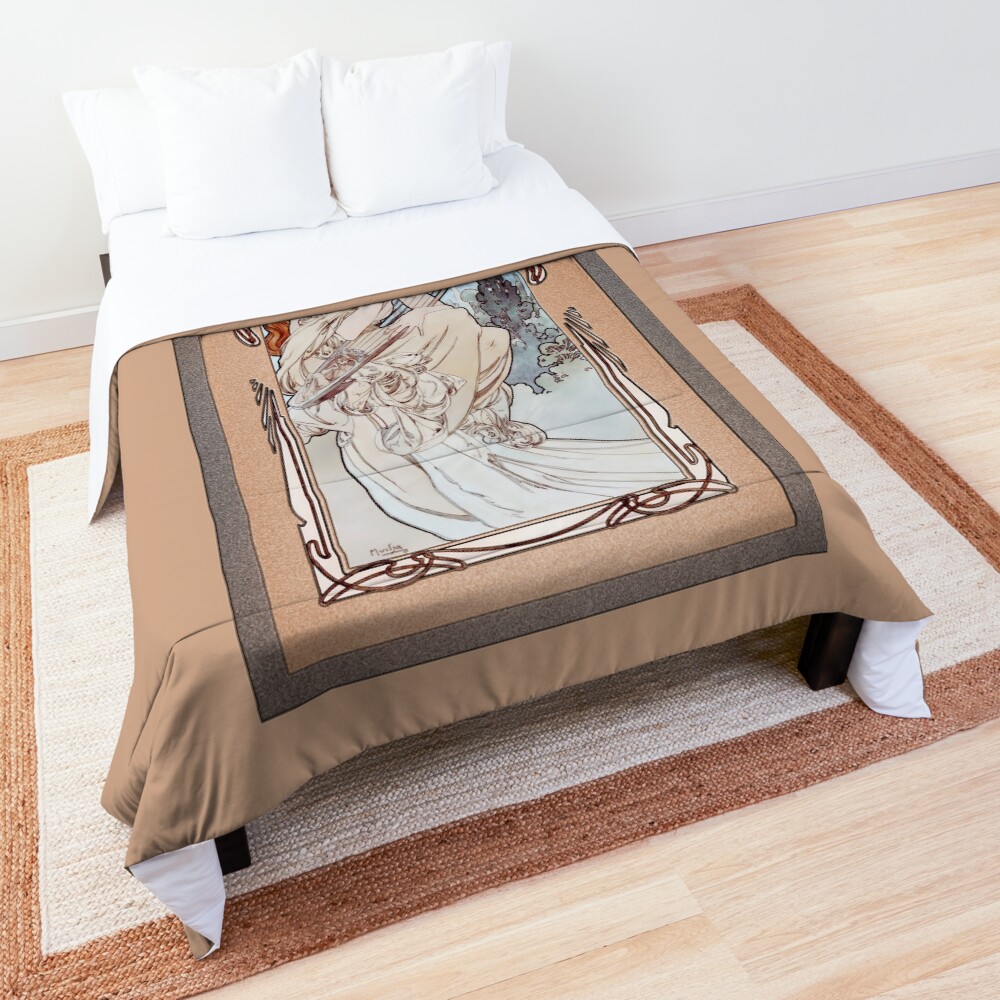
This is a beautiful illustration of a young redhead sitting in a forest in deep contemplation with a bright star shinning in the heavens behind her; with its rays of light pointing in all directions, illuminating the trees below and the night sky.
The young lady is wearing a tiara over her flowing hair, and as a long gown that is hanging from her waist down to the ground, with part of it draped over her right upper arm as it blends into the bush outline on the ground.
She has a large decorative lyre resting on the side of her right thigh, that she is holding onto with her left hand at its mid-section, with her right elbow resting on the frame of the lyre and her right hand slightly touching the upper frame of the musical instrument as her face leans against her right hand.
Esta é uma reprodução retocada de arte digital de antigos mestres de uma imagem de domínio público que está disponível para compra on-line como um impressão em tela enrolada.
Informações abaixo de Wikipédia.org
Alfons Maria Mucha julho 24, 1860 – Julho 14, 1939), era conhecido internacionalmente como Alphonse Mucha. Ele foi um proeminente pintor tcheco, ilustrador e artista gráfico, morando em Paris durante o período Art Nouveau, e é mais conhecido por seus pôsteres teatrais distintamente estilizados e decorativos, particularmente os de Sarah Bernhardt.
Ele produziu ilustrações, anúncios, painéis decorativos, e desenhos, que se tornou uma das imagens mais conhecidas do período.
Na segunda parte de sua carreira, com a idade de 43, ele retornou à sua terra natal, na região da Boêmia-Morávia, na Áustria, e se dedicou à pintura de uma série de vinte telas monumentais conhecidas como A Epopéia Eslava., retratando a história de todos os povos eslavos do mundo, que ele pintou entre 1912 e 1926.
Em 1928, no 10º aniversário da independência da Checoslováquia, ele apresentou a série para a nação tcheca. Ele considerou seu trabalho mais importante. Agora está em exibição em Praga.