

Alegori dewrder (Alegori Dewrder)
Alegori dewrder (Alegori Dewrder) c1859 gan yr arlunydd o Awstria Karl von Blaas (1815 – 1894); adnabyddus am ei bortreadau, gwaith celf hanesyddol a chrefyddol.
Mae hwn yn brydferth a swynol i'r llygad alegorïaidd paentiad sy'n darlunio Dewrder fel Duwies fel rhyfelwraig fenywaidd mewn gwisg frwydr wedi'i gosod yn erbyn awyr las gyda chymylau gwyn.
Mae hi'n gwisgo helmed asgell arian gyda draig ar y blaen, crys post cadwyn sydd wedi'i orchuddio â chrys gwyrdd dwfn dros ei frodio â seirff asgell arian uwch ei bron a choron yn y canol; gyda phatrymau arian ychwanegol wedi'u hanodi ag addurniadau coch.
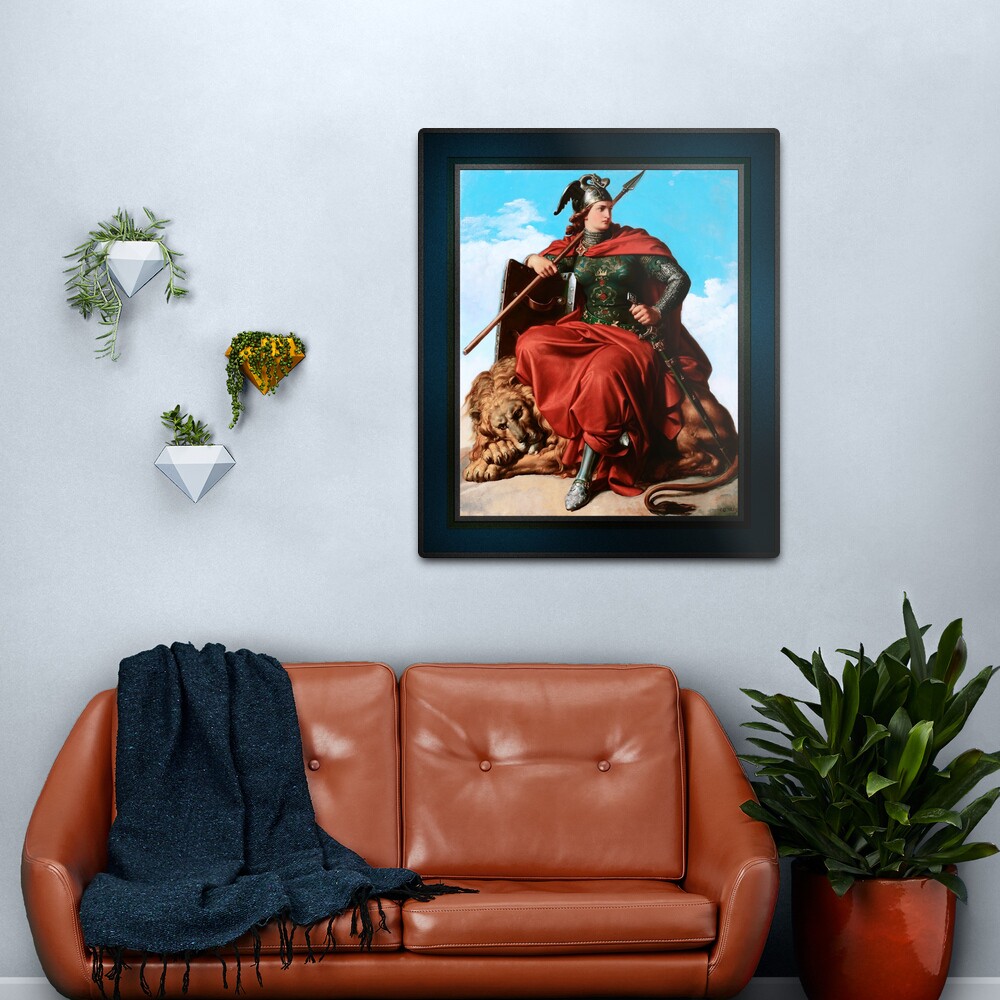
Mae ganddi glogyn coch wedi'i glymu o amgylch ei gwddf sy'n lapio o amgylch ei chorff a thros ei chanol a'i hesgidiau metel, gyda gwregys gwyrdd mawr ac addurniadau arian wedi'i lapio o amgylch ei chanol y mae ei bladur wedi'i glymu wrthi, sy'n cario cleddyf llaw arian, that she is holding with her left hand.
In her right hand she is holding a wooden spear with a metal tip as it leans over her right shoulder, as she rest her forearm over her shield, while sitting across the back of a male lion with an annoyed look on his face that she has subdued.
Allegorie Der Tapferkeitt is a remastered digital art old masters reproduction of a public domain image that is available as a canvas print online.
Gwybodaeth Isod Yn Deillio O Wikipedia.org
Karl was born in Nauders, Tyroi, Austria on April 28, 1815, and first received his artistic training in Innsbruck, Austria where he received an education to be a writer; but his interest in art made him change his career path and with the help of his uncle who was a judge in Verona, Yr Eidal; provided him with the financial support he required to study at the Venice Academy from 1832 i 1837 under the direction of Italian Painter Ludovico Lipparini (1800 – 1856).
During this time Karl won many awards and was also receiving commissions for creating portraits; ac yn 1837 received the Prix de Rome from the Venetian Academy, which made it possible for him to study in Rome for the next five years; where he came into contact with the German artist Johann Friedrich Overbeck (1789 – 1869), the leading member of the Nazarene School; which a influenced the direction that his art would take as he grew as an artist.
Traveling extensively throughout Italy, Karl would study and copy the works of the old masters, and would eventually devote himself to creating ecclesiastical art and genre scenes, which led to him obtaining commissions for altarpieces and frescoes.
For a two year period Karl also studied in Munich, Germany and would go on to do commission for churches in Italy, Llundain, Paris, Hungary and Russia; then at the age of 35 he was appointed to the Academy of Vienna, where he painted several frescoes in the Alt-Lerchenfeld church; ac yn 1855 accepted his nomination as professor in the Venice Academy, which lasted from 1856 i 1866.
Sometime later in his career he undertook and eleven year project to paint forty two frescoes at the Vienna Arsenal in Austria; now known as the Heeresgeschichtliches Museum (Museum of Military History); which are considered to be among his major works of art.
As a side note, Karl is the father of Italian Painters Eugene von Blass (1843 – 1931) and Julius von Blaas (1845 – 1923); and he was the teacher of Italian Painter Francesco Beda (1840 – 1900).