

Amalia de Llano y Dotres, Condesa de Vilches
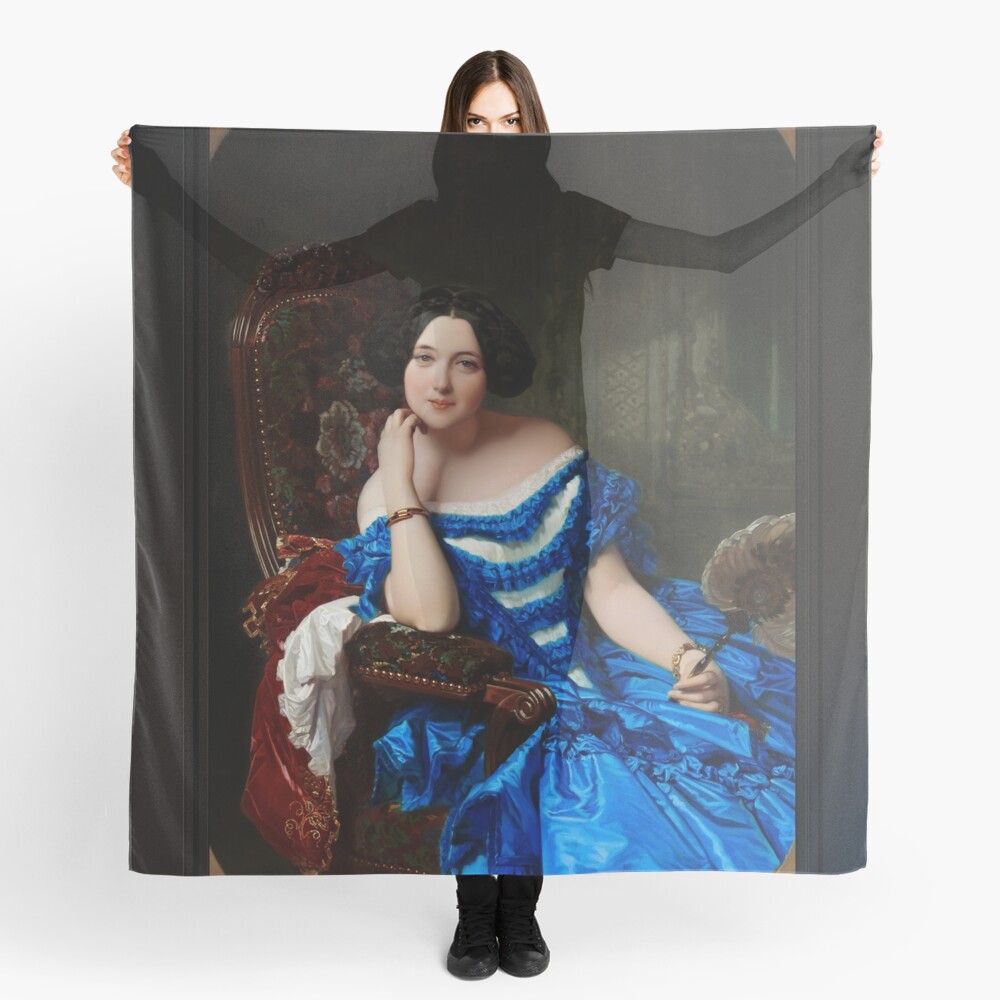
Amalia de Llano y Dotres, Condesa de Vilches (Amalia de Llano, a Spanish countess and author) c1853 by Spanish-Italian Painter Federico de Madrazo agus Kuntz (1815 – 1894); freisin lithographer, scríbhneoir agus polaiteoir.
This is a wonderful portrait of the Spanish countess and writer Amalia de Llano (1822 – 1874); who was a significant figure of the Spanish cultural life of 19th century Madrid.
She was born into the wealthy bourgeoisie family of Ramón de Llano y Chávarri and Pilar Dotres y Gibert; and when her father passed away, her mother married the IX Marquis of Almonacid de los Oteros; Francisco Falcó y Valcárcel, which moved the family into the circles of the aristocracy.
Nuair a bhí sí 17 bliana d'aois, Amalia married Gonzalo Vilches y Parga (1808 – 1879), the Viscount of La Cervanta; agus i 1848 Queen Isabel II ennobled her husband, which elevated hime to the dignity of Count of Vilches; this then made her the Viscountess of La Cervanta as well as the Countess of Vilches.
This portrait of Amalia has her sitting in a room with a large mirror on the wall to her left, in a beautifully carved wooden chair with a high back with elaborately floral embroidered padding.
She is wearing a blue ruffled dress with a white undergarment with a gold wrap bracelet on her right forearm, a chained and jeweled bracelet on her left wrist as well as a pearl ring with a gold band on the fourth finger of her left hand in which she is holding a large feathered hand fan.
She is resting her right cheek on the fingers of her right hand that are held upwards to her face; and behind her just over the arm of the chair is a deep red cape with a white silk lining and gold decorative trim along its perimeter.
Amalia de Llano y Dotres, Condesa de Vilches is a remastered digital art old masters reproduction of a public domain image that is available as a canvas print online.
Eolas Thíos Díorthaithe Ó Wikipedia.org
Federico was born in Rome to José de Madrazo y Agudo (1781 – 1859), a painter and former Director of the Prado Museum; and was part of a line of great artists, that included his grandfather on his mother side; Tadeusz Kuntze (1733 – 1793), a Polish painter.
Other members of this creative family include his brothers, who were the painter Luis de Madrazo (1825 – 1897), Pedro de Madrazo (1816 – 1898), an art critic and Juan de Madrazo (1829 – 1880), an architect.
I measc leanaí Federico bhí an péintéir Ricardo de Madrazo (1851 – 1917), Raimundo de Madrazo agus Garreta (1841 – 1920) agus Cecilia de Madrazo y Garreta (1846 – 1932) a phós an t-ealaíontóir iontach Orientalist, Maria Fortuny (1838 – 1874).
Tá cur síos déanta ar theaghlach Madrazo mar cheann de na dynasties péintéireachta Spáinneacha is tábhachtaí sa 19ú haois; a bhí chun tosaigh go hiomlán sa phéintéireacht sa Spáinn le linn na tréimhse sin.
Thosaigh Federico ag cur ceacht ealaíne óna athair, agus cé go bhfuil fós ag freastal ar Acadamh Ríoga San Fernando, phéinteáil sé a chéad phictiúr The Resurrection of Christ c 1829; a cheannaigh an Bhanríon Christina.
Go luath ina dhiaidh sin chruthaigh sé Achilles ina Phuball, agus ina dhiaidh sin cuireadh faoi bhráid an Acadaimh The Continence of Scipio, rud a thug cead isteach mar bhall dó “ar son fiúntais”.
Trí bliana ina dhiaidh sin d’fhág Federico go Páras áit a ndearna sé staidéar ar an Franz Winterhalter agus phéinteáil sé portráidí den Bharún Taylor agus Ingres (Péintéir Neoclassical Francach).
I 1837 fuair sé coimisiún chun pictiúr a chruthú don ghailearaí i Versailles, a phéinteáil sé “D’fhógair Godfrey de Bouillon Rí Iarúsailéim”; go luath ina dhiaidh sin d'fhill sé ar an Róimh agus chuaigh sé i mbun tionscadail chun portráidí a chruthú d'Aristocracy na Spáinne.
Cruthú ealaíne digiteach seo, mar atá an saothar ealaíne go léir atá le fáil ar shuíomh Gréasáin Xzendor7 ar fáil le ceannach ar líne i bhformáidí éagsúla ábhar lena n-áirítear priontaí canbháis, priontaí aicrileach, priontaí miotail, priontaí adhmaid, priontaí frámaithe, póstaeir, agus mar priontaí chanbhás rollta i méideanna éagsúla ó 12 orlach go 72 orlach ag brath ar mhéid an tsaothair ealaíne iarbhír agus ar an siopa priontála ar éileamh a roghnaíonn tú an ealaín a cheannach uaidh.