

Amarilla
Amarilla by British Painter Frederic Leighton (1830 – 1896); estis pentristo kaj skulptisto, kiu estis parto de la Akademiulo, Neoklasikaj kaj britaj Estetikaj Movadoj; same kiel politikisto.
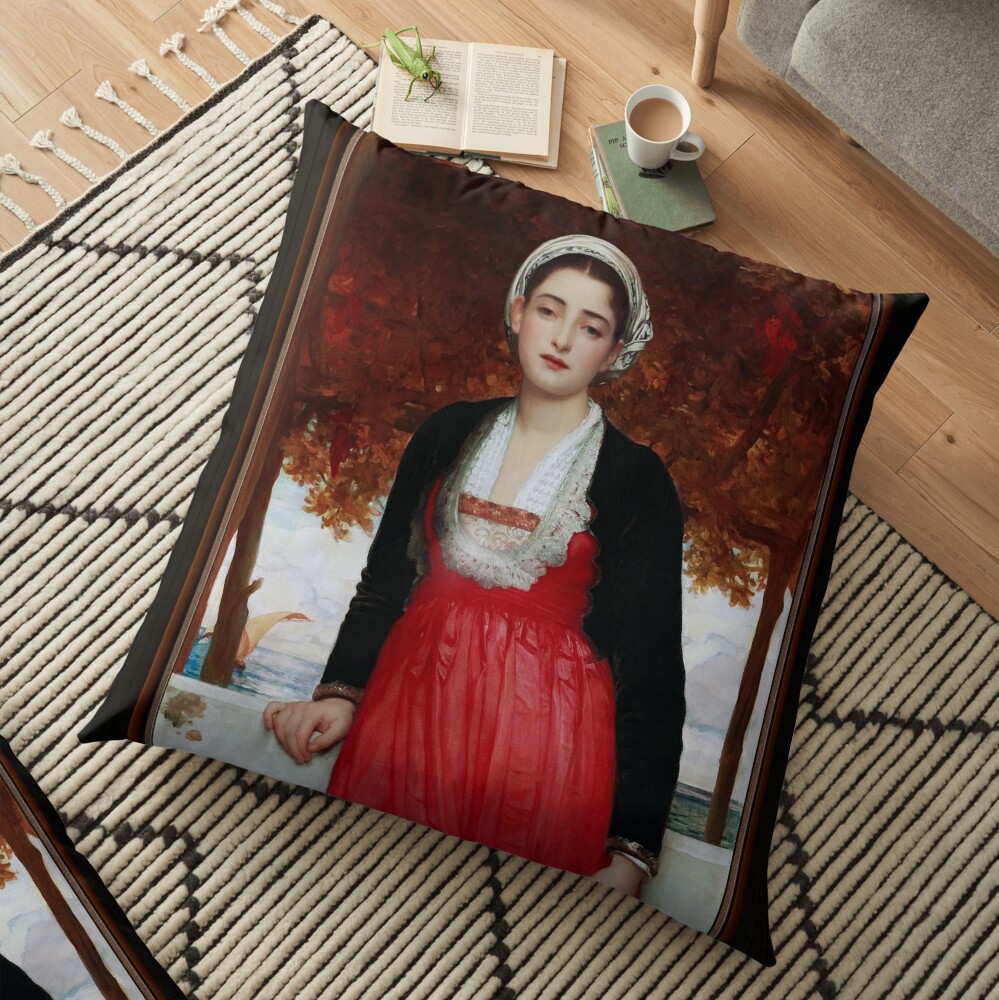
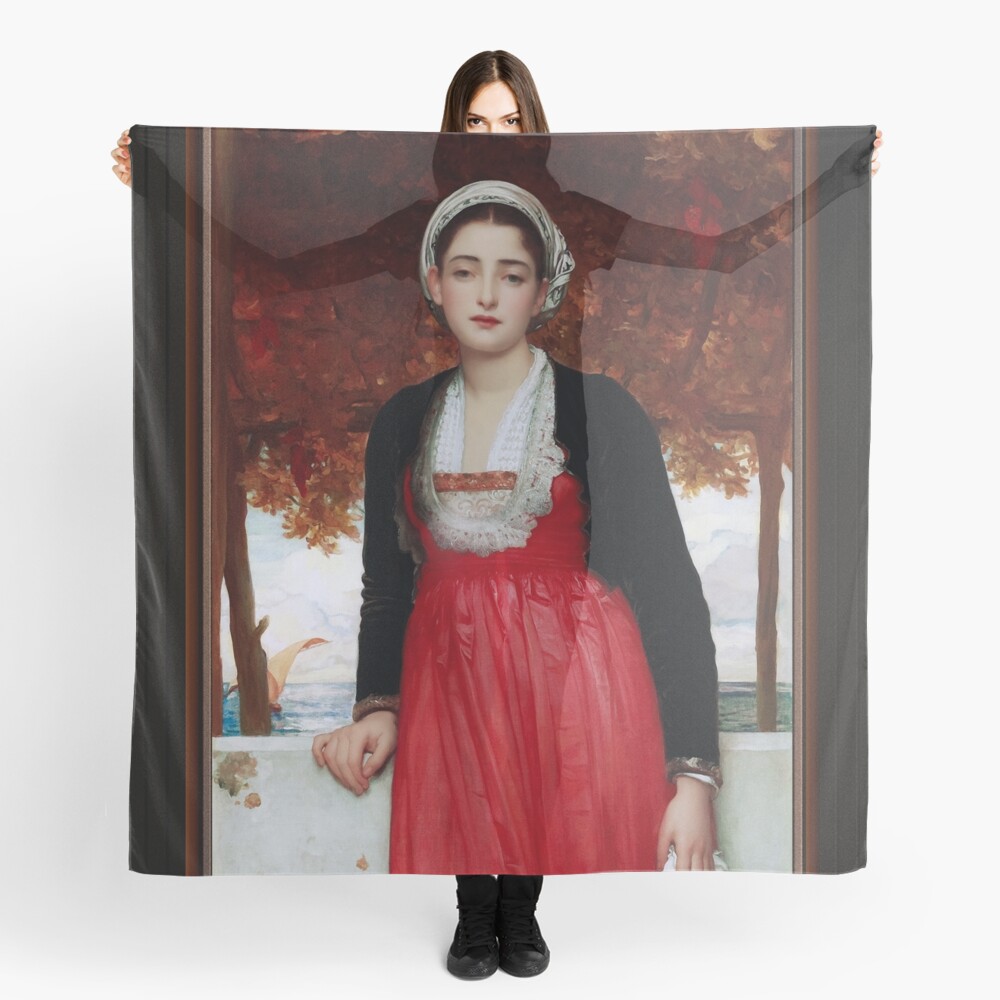
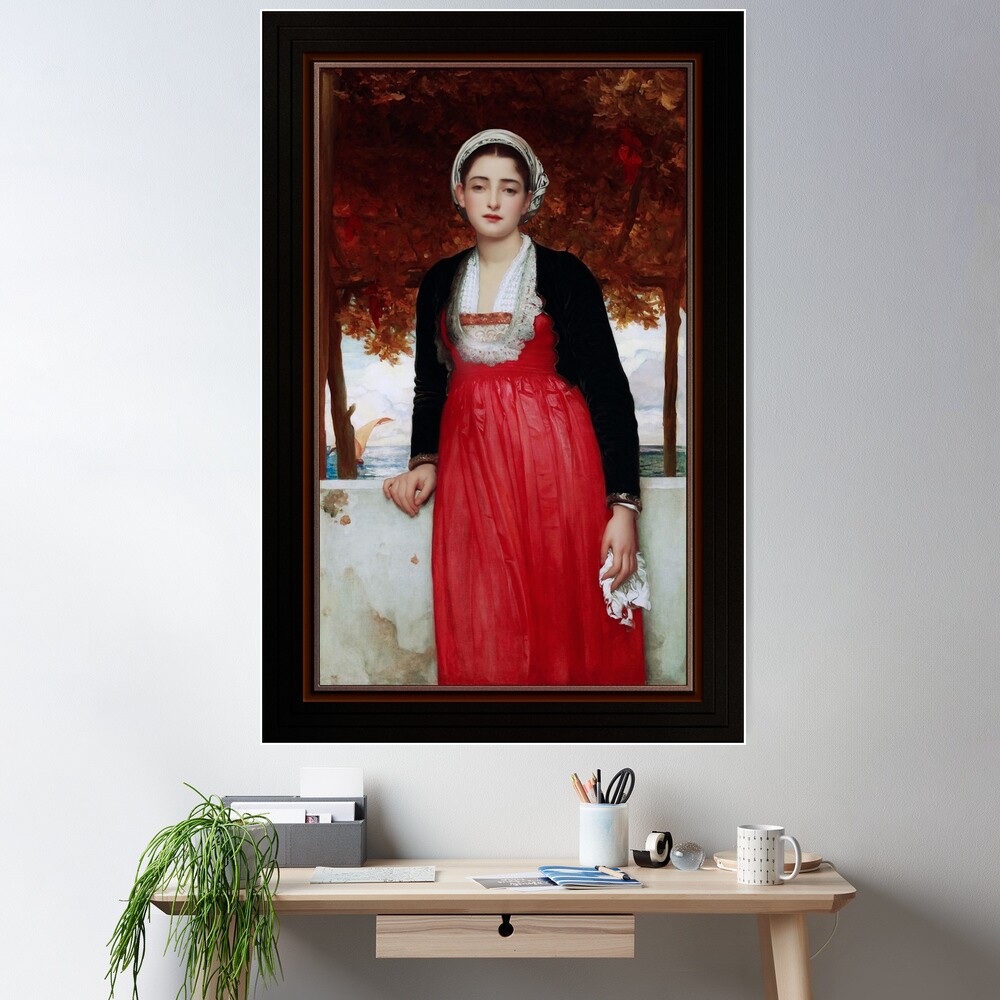
This is a beautiful portrait of a young alluring brunette girl with a sad look on her face posing by a stone wall that overlooks the ocean and a shoreline of green foliage.
Directly behind her are two large trees with brown leaves and some red leaves, that indicate the fall season has arrived; and just off to her right we can see small sailboat coming towards the shore.
She has wrapped around her head a white kerchief with a black line pattern along its edge, a white blouse, a full length red dress, a black velour vest jacket; and is holding a handkerchief in her left hand, with her right hand resting on the ledge of the stone wall.
Ĉi tio estas readaptita cifereca arta reproduktaĵo de malnovaj majstroj de publika domajna bildo disponebla kiel a tolo presaĵo rete.
Informoj Malsupre De Vikipedio.org
Leighton estis naskita en Scarborough al Augusta Susan kaj Dr. Frederic Septimus Leighton. Li havis du fratinojn inkluzive de Alexandra kiu estis la kinejo de Robert Browning.[2] Li estis edukita en University College School, Londono.
Li tiam ricevis sian artan trejnadon sur la eŭropa kontinento, unue de Eduard von Steinle kaj poste de Giovanni Costa. En aĝo 17, en la somero de 1847, li renkontis la filozofon Arthur Schopenhauer en Frankfurto kaj desegnis sian portreton, en grafito kaj guaŝo sur papero – la nura konata plenlonga studo de Schopenhauer farita de vivo.
Kiam li estis 24 li estis en Florenco; li studis ĉe la Akademio de Belartoj, kaj pentris la procesion de la Cimabue Madonna tra la Borgo Allegri. De 1855 al 1859 li vivis en Parizo, kie li renkontis Ingres, Delacroix, Corot kaj Millet.
En 1860, li translokiĝis al Londono, kie li asociis kun la antaŭrafaelitoj. Li dizajnis la tombon de Elizabeth Barrett Browning por Robert Browning en la Angla Tombejo, Florenco en 1861. En 1864 li iĝis partnero de la Reĝa Akademio kaj en 1878 li fariĝis ĝia Prezidanto (1878–96).
His 1877 Skulptaĵo, Athlete Wrestling with a Python, was considered at its time to inaugurate a renaissance in contemporary British sculpture, referred to as the New Sculpture. American art critic Earl Shinn claimed at the time that “Except Leighton, there is scarce any one capable of putting up a correct frescoed figure in the archway of the Kensington Museum”. His paintings represented Britain at the great 1900 Paris Exhibition.
Leighton was knighted at Windsor in 1878, and was created a baronet, of Holland Park Road in the Parish of St Mary Abbots, Kensington, in the County of Middlesex, eight years later. He was the first painter to be given a peerage, in the 1896 New Year Honours.
The patent creating him Baron Leighton, of Stretton in the County of Shropshire, was issued on 24 januaro 1896; Leighton died the next day of angina pectoris.
On his death his barony was extinguished after existing for only a day; this is a record in the Peerage. His house in Holland Park, London has been turned into a museum, the Leighton House Museum.
It contains many of his drawings and paintings, as well as some of his former art collection including works by Old Masters and his contemporaries such as a painting dedicated to Leighton by Sir John Everett Millais.
The house also features many of Leighton’s inspirations, including his collection of Iznik tiles. Its centerpiece is the magnificent Arab Hall. The Hall is featured in issue ten of Cornucopia. A blue plaque commemorates Leighton at Leighton House Museum.