

Ceann Dearg Mheiriceá
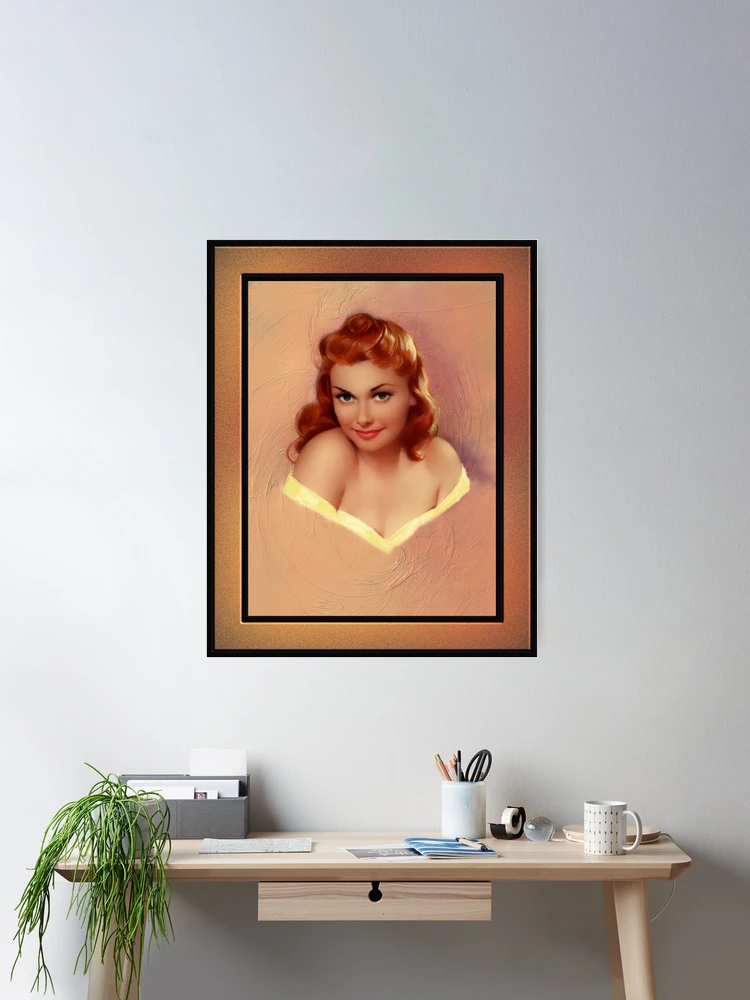
Pearl Alice frush, an esteemed American artist known for her refined and expressive depictions of women, brought to life her artwork titled Ceann Dearg Mheiriceá in 1950. Rugadh i 1907 agus rith isteach 1986, Frush is celebrated for her mastery in blending realism with a touch of idealized beauty. This portrait is a timeless example of mid-20th-century American femininity, capturing a moment of soft elegance through her distinctive, warm color palette. I Ceann Dearg Mheiriceá, Frush not only displays her technical skill but also conveys a sense of personal connection with the subject, offering the viewer a glimpse into the calm serenity of this red-haired woman.
Clár na nÁbhar
An phríomh -ábhar: The Redhead
At the center of the composition, the woman in the painting is the undeniable focal point. Her porcelain-like skin contrasts with her fiery red hair, which cascades in soft curls around her shoulders, adding to the striking visual impact of the piece. The subject’s expression is gentle yet inviting, with her bright green eyes softly gazing directly at the viewer, creating a sense of intimacy and warmth.
The graceful lines of her face are illuminated by light, emphasizing her youthful beauty and the natural elegance of her posture. The soft sheen of her skin, the subtle curve of her neckline, and the delicate play of light and shadow on her face all combine to create a portrait of restrained yet undeniable allure.
A feisteas, a simple yet sensual off-the-shoulder dress, adds a layer of refinement to her portrayal. The pale yellow tones of her dress seem to harmonize with the soft pink and cream hues of the background, allowing the subject’s hair and features to stand out more vividly. The bare shoulders further suggest an intimate, personal moment, one of quiet confidence and understated glamour. This portrait does not demand overt attention, but rather invites the viewer to linger and appreciate the quiet beauty of the moment.
Ábhair, Teicníc, and Style
The materials used in Ceann Dearg Mheiriceá are in line with Frush’s traditional approach to painting. The canvas itself serves as a foundation for the rich, smooth layers of oil paint that Frush masterfully applies, creating the soft blending of light and color. The brushwork is subtle yet meticulous, with fine detail in the facial features and a more fluid, less precise treatment of the background. This technique allows Frush to convey both the realism of the woman’s image while still maintaining a sense of artistic idealization.
Frush’s style blends elements of realism with soft romanticism. She avoids sharp contrasts or harsh edges, instead favoring a smooth, almost ethereal treatment of light and form. The result is a portrait that is both lifelike and idealized, showcasing the artist’s ability to evoke emotion and beauty through the art of subtle detail. The gentle color palette of peaches, pale yellows, and soft greens accentuates the softness of the subject’s complexion, while the rich red of her hair introduces a bold but harmonious pop of color, bringing the viewer’s attention directly to her face.
The mood of the painting is one of calm serenity and beauty, yet also conveys an underlying strength. The subject appears confident in her own skin, proud of her striking features and unbothered by the world around her. There is an air of quiet sophistication in her gaze, which exudes warmth without being overtly dramatic. The work evokes a sense of nostalgia, a nod to an idealized view of femininity that was prevalent in mid-century American art.
Socrú agus Comhdhéanamh
Frush employs a minimalist approach to the composition of Ceann Dearg Mheiriceá, focusing entirely on the subject. The absence of a complex background or setting allows the viewer to concentrate solely on the woman herself. The background is gently textured, with soft swirls of pink, uachtar, and light orange, which creates a sense of depth without distracting from the central figure. This simple, yet effective, background treatment highlights the subject’s luminous skin and radiant red hair, while the absence of any detailed surroundings ensures that the viewer’s attention is focused entirely on the woman’s face and form.
The portrait’s framing is equally subtle, with the face occupying most of the canvas space. The artist’s decision to crop the composition in such a way directs the viewer’s attention upward, emphasizing the subject’s face and shoulders. This framing, combined with the smoothness of the background, amplifies the natural beauty of the subject, giving her a presence that fills the entire canvas. The viewer feels as if they are in the presence of the subject, invited into her personal space through her direct gaze.
Téama agus giúmar
An téama lárnach de Ceann Dearg Mheiriceá lies in the celebration of feminine beauty in its most natural and refined form. There is no attempt to exaggerate or sensationalize the subject; in áit, Frush captures her in a moment of tranquil elegance. The painting’s mood is one of timeless beauty, subtly suggesting the artist’s admiration for the subject’s grace and poise. The soft hues and natural textures elevate the portrait, transforming it from a mere depiction of a woman into a work of art that resonates with an air of personal warmth and delicate strength.
The overall tone of the painting is gentle and serene, evoking feelings of admiration, respect, and nostalgia. It is a celebration of the feminine form, not in an overtly sensual or dramatic way, but in a quiet and dignified manner. An pailéad dathanna bog, the focus on the subject’s delicate features, and the serene mood all combine to create a timeless portrait of grace.
Conclúid
Pearl Alice Frush’s Ceann Dearg Mheiriceá stands as a testament to her exceptional skill as an artist and her ability to capture the subtleties of feminine beauty. Through her delicate handling of light, dath, agus foirm, Frush has created a portrait that feels both intimate and universal. The painting speaks to the timeless allure of the subject, capturing her at the height of her natural beauty and offering the viewer a quiet moment of reflection on the elegance of the human form. Frush’s work continues to be a shining example of mid-century American portraiture, agus Ceann Dearg Mheiriceá remains a beloved part of her artistic legacy.
Seo atáirgeadh seanmháistrí ealaíne digiteach athmháistrithe d’íomhá fearainn phoiblí atá ar fáil mar a priontáil chanbhás ar líne.
Ealaíontóir Bith Díorthaithe Ó Wikipedia.org
Rugadh Pearl Alice Frush i gCathair Sioux, Woodbury, Iowa ar aghaidh 1907; nuair a bhí sí óg bhog a teaghlach go dtí an Mississippi Gold Coast agus thosaigh a cuid staidéir ealaíne i New Orleans, Philadelphia agus Cathair Nua-Eabhrac agus ansin ag Scoil Institiúid Ealaíne Chicago a bhfuil baint aige le Institiúid Ealaíne Chicago.
I rith na 1930idí déanacha agus na 1940idí luatha rinne Pearl obair fógraíochta neamhspleách i Chicago lena n-áirítear Vogue-Wright Studios, Bláth na gréine, Johnson & Bán, agus Gerlach Barklow Co.
D'fhoilsigh na cuideachtaí seo go leor dá ealaín féilire cailín pinup rathúil, Liberty Belles ina measc, Cailíní Glamour, agus Glamour Babhta an Chlog.
Bhí Pearl ar dhuine den triúr ban-ealaíontóir glamour pinup mná a raibh Joyce Ballantyne ina measc (1918 – 2006), agus Zoë Mozilla (1907 – 1993) ar éirigh go han-mhaith leo sa saothar ealaíne léaráidí cailín a bhí faoi cheannas Alberto Vargas (1896 – 1982), George Petty (1894 – 1975), Gil Elvgren (1914 – 1980), Bille Medcalf (1920 – 2005), Rolf Armstrong (1889 – 1960) agus go leor eile.