

Angelica and Medoro
Angelica and Medoro: A Rococo Dreamscape by François Boucher
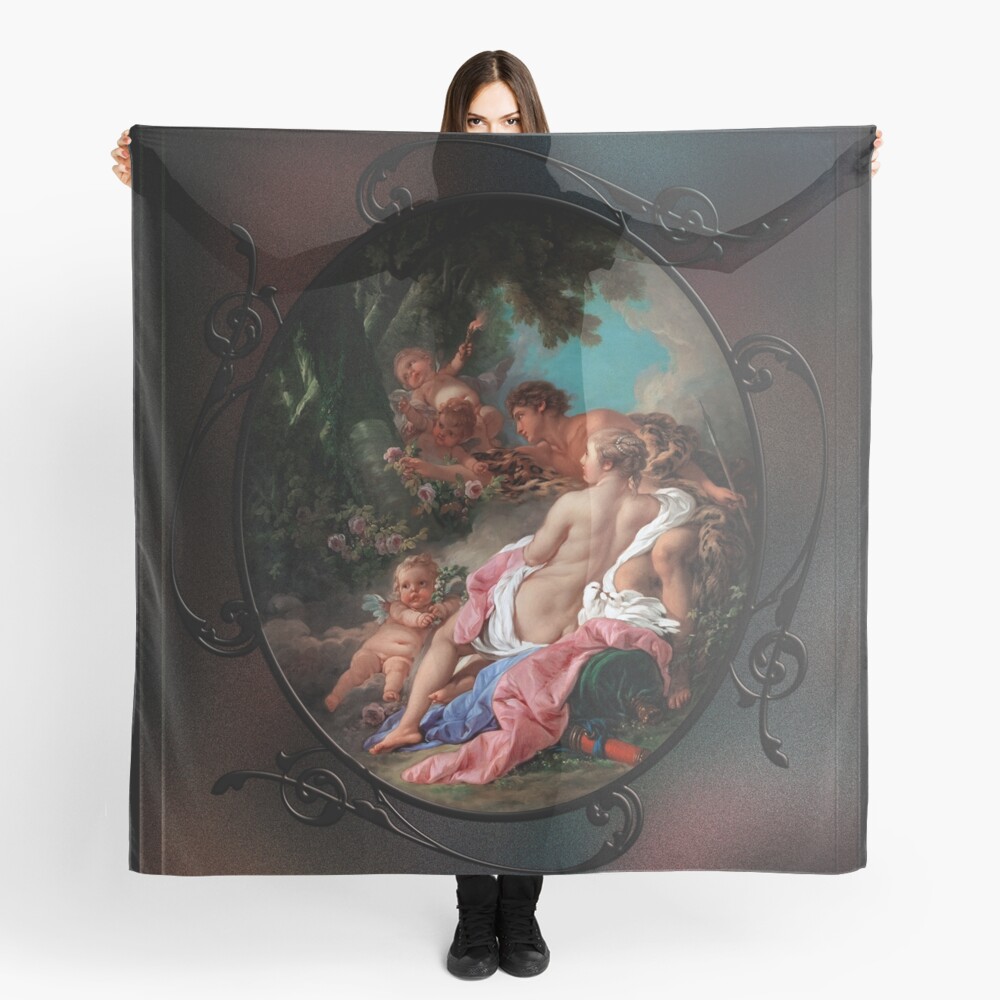
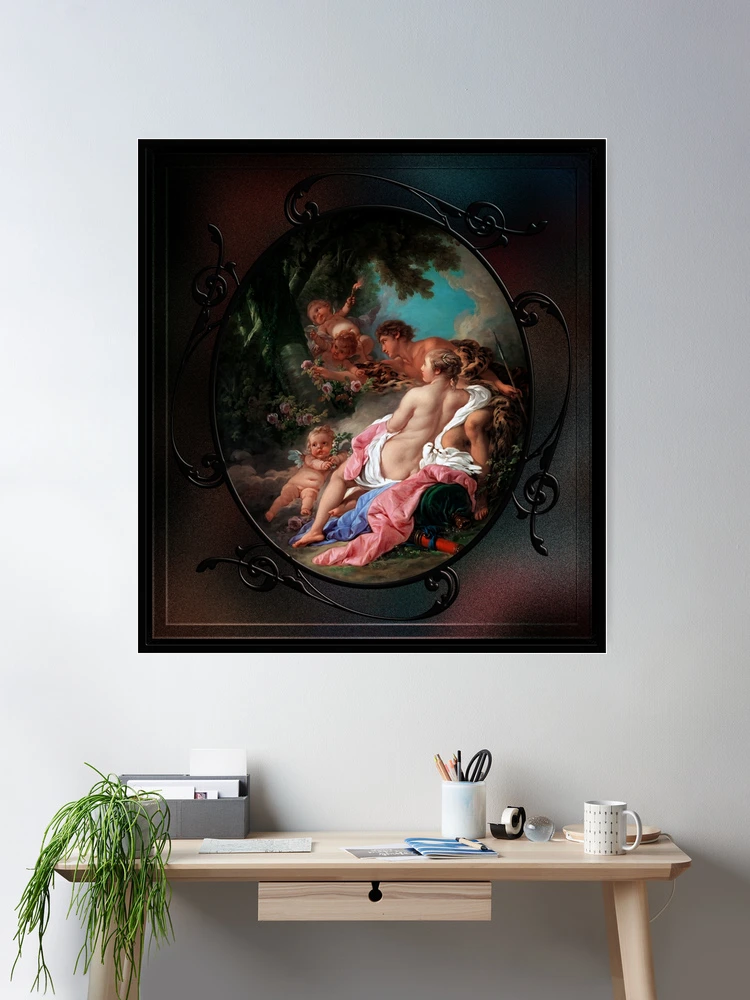
François Boucher’s “Angelica and Medoro,” pentris ĉirkaŭe 1763, exemplifies the height of the Rococo style in French art. This captivating work, currently housed at the Musée du Louvre, transports viewers to a realm of idyllic beauty and sensual delight, characteristic of Boucher’s artistic vision. The painting depicts a scene drawn from Ariosto’s epic poem Orlando Furioso, where Angelica, a beautiful pagan princess, has fallen asleep in a woodland glade, attended by playful putti and the captive knight Medoro.
Enhavtabelo
Kompona harmonio & Narrative Context
The composition is carefully orchestrated to create a sense of harmonious balance and visual pleasure. Boucher employs a pyramidal structure, with Angelica at its apex, drawing the eye immediately to her figure. The lush foliage forms a verdant backdrop, framing the central figures and enhancing the feeling of seclusion and enchantment. Medoro sits beside Angelica, his gaze fixed upon her face, conveying a sense of tender devotion. He is partially draped in armor, hinting at his former role as a warrior, now softened by his proximity to the sleeping princess. The scene unfolds within a dense forest setting; trees with vibrant green foliage create an immersive atmosphere.
Figures and Their Representation
Angelica’s portrayal embodies the Rococo ideal of feminine beauty: soft skin, fluantaj haroj, and a languid pose that suggests both vulnerability and allure. Ŝia robo, rendered in delicate pinks and whites, cascades around her form, emphasizing her graceful contours. The artist’s masterful use of light and shadow sculpts her body, highlighting its curves and creating a sense of ethereal beauty. Medoro is depicted with a more muscular physique, yet his posture is relaxed and gentle as he gazes at Angelica. His attire blends elements of armor and softer fabrics, reflecting his transition from warrior to lover.
The Role of the Putti
Adding to the scene’s whimsical charm are several putti – cherubic figures often associated with love and playfulness in Renaissance and Baroque art. These small figures frolic around Angelica and Medoro, scattering flowers and engaging in playful antics. Their presence reinforces the painting’s overall atmosphere of carefree joy and sensual indulgence. One putto sits at Angelica’s feet, gently touching her hand, while others playfully toss blossoms into the air. The putti are rendered with a delicate touch, their forms soft and rounded, further contributing to the painting’s aesthetic appeal.
Boucher’s Artistic Technique & Stilo
Boucher’s technique is characterized by his fluid brushstrokes, subtle gradations of color, and an emphasis on texture. He skillfully employs sfumato, a technique popularized by Leonardo da Vinci, to soften edges and create a hazy, dreamlike quality. The colors are rich and vibrant, with a particular focus on pastel hues – pinks, Bluso, Verduloj, and creams – that evoke the atmosphere of a sun-drenched garden. Boucher’s style is distinctly Rococo; it prioritizes elegance, Graco, and sensual pleasure over realism or historical accuracy. He was known for his decorative paintings intended to adorn the homes of wealthy patrons, and “Angelica and Medoro” perfectly embodies this aesthetic.
Lumo & Atmosfero
La lumigado en “Angelica and Medoro” is soft and diffused, creating a gentle glow that bathes the scene in warmth. The light source appears to be coming from above, illuminating Angelica’s face and highlighting her delicate features. This creates a sense of intimacy and tranquility, drawing the viewer into the idyllic setting. The atmospheric perspective – the gradual blurring of details in the background – enhances the feeling of depth and distance, further immersing the viewer in the painting’s world.
Ĝenerale Impreso & Heredaĵo
“Angelica and Medoro” is more than just a depiction of a literary scene; it’s an embodiment of Rococo ideals—beauty, plezuro, and escapism. Boucher’s masterful technique and evocative imagery have made this painting one of his most celebrated works, and a quintessential example of the Rococo style. It continues to captivate audiences with its exquisite beauty and timeless appeal, offering a glimpse into the world of 18th-century French art and culture. The work’s enduring popularity stems from its ability to evoke feelings of romance, trankvilo, and sensual delight, qualities that remain highly valued even today.
Decorative Accents Used In This Piece Are Available At HeritageType
Artisto Bio derivita de Vikipedio.org
Hejmanto de Parizo, Boucher estis la filo de malpli konata farbisto Nicolas Boucher, kiu donis al li sian unuan artan trejnadon. En la aĝo de dek sep, pentraĵo de Boucher estis admirita de la pentristo François Lemoyne. Lemoyne poste nomumis Boucher kiel sia metilernanto, sed post nur tri monatoj, li iris labori por la gravuristo Jean-François Cars.
En 1720, li gajnis la elitan Grand Prix de Rome por pentrado, sed ne prenis la konsekvencan ŝancon studi en Italio ĝis kvin jaroj poste, pro financaj problemoj ĉe la Reĝa Akademio de Pentrarto kaj Skulptaĵo.[1] Sur lia reveno de studado en Italio li estis konfesita la refonditan Académie de peinture et de sculpture on 24 novembro 1731. Lia akceptpeco (akcepta peco) Estis lia Rinaldo kaj Armida de 1734.
Boucher geedziĝis kun Marie-Jeanne Buzeau en 1733. La paro havis tri infanojn kune. Boucher iĝis fakultatano en 1734 kaj lia kariero akcelis de tiu punkto kiam li estis promociita Profesoro tiam Rektoro de la Akademio, iĝante inspektisto ĉe la Reĝa Gobelins Manufactory kaj finfine ĉefministro Peintre du Roi (Unua Pentristo de la Reĝo) en 1765. Portreto de Marie-Louise O'Murphy ĉ. 1752
Boucher mortis plu 30 majo 1770 en sia naskiĝa Parizo. Lia nomo, kune kun tiu de lia patrono Madame de Pompadour, fariĝis sinonima kun la franca rokoka stilo, kondukante la fratojn Goncourt skribi: “Boucher estas unu el tiuj viroj, kiuj reprezentas la guston de jarcento, kiuj esprimas, personigi kaj enkorpigi ĝin.”
Boucher estas fama pro diri ke naturo estas “tro verda kaj malbone lumigita” (tro verda kaj malbone lumigita).
Boucher estis asociita kun la gemogravuristo Jacques Guay, kiun li instruis desegni. Li ankaŭ mentores la morav-aŭstran farbiston Martin Ferdinand Quadal same kiel la novklasikan farbiston Jacques-Louis David en 1767.[4] Poste, Boucher faris serion de desegnaĵoj de verkoj de Guay kiujn sinjorino de Pompadour tiam gravuris kaj distribuis kiel bele ligita volumeno al favoritaj korteganoj.