

At The Fountain
Guillaume Seignac’s 1910 pittura, At The Fountain, beautifully captures a moment in time filled with elegance, grazia, and timeless beauty. Seignac, a prominent French painter from the late 19th and early 20th centuries, and student of French Painter William-Adolphe Bouguereau (1825 – 1905) who painted in the Neoclassicism and Realism Styles, with a focus on mythological themes; is well known for his depictions of idealized women, often in classical or historical settings.
In questa opera d'arte, Seignac invites us into a lush, serene scene where a young woman, draped in a simple yet ethereal white gown, interacts with an ancient vessel, offering a glimpse into the tranquility of a classical world. This painting exemplifies Seignac’s signature style of combining romanticism with classicism, creating a scene that is both graceful and refined.
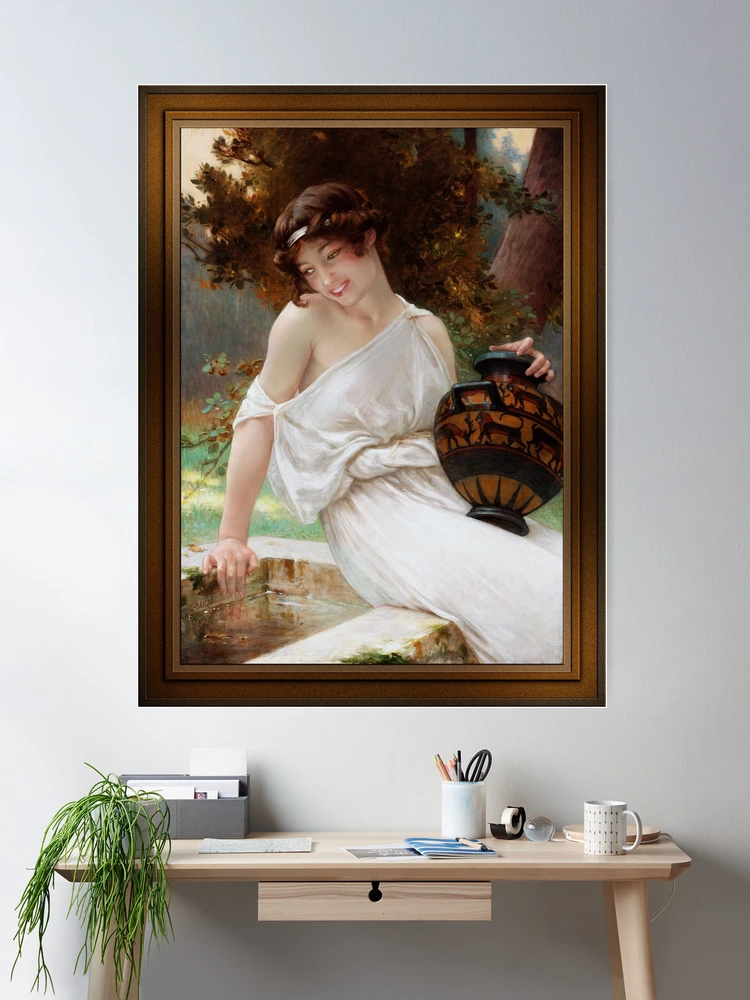
Table of Contents
U sughjettu principale: A Maiden in Classical Attire
The central figure of the painting is a young woman, delicately posed at the edge of a stone fountain. U so dolce, flowing white gown is simple in design, yet the fabric is rendered with a mastery that gives it an almost tangible quality. The gown is draped loosely across her figure, evoking a sense of natural elegance and modesty. U so vestitu, reminiscent of classical Greek or Roman dress, adds a sense of timelessness to the scene, suggesting that the moment could belong to any era, whether ancient or modern.
Her face is adorned with a gentle, subtle smile, which imparts a sense of calm serenity to her demeanor. Seignac’s careful attention to her facial features emphasizes her youthful innocence and grace. A so longa, wavy brown hair is styled in loose curls, secured by a simple headband that complements her attire without drawing attention away from her natural beauty. The young woman gazes off to her right, her expression both thoughtful and serene, as if lost in a quiet moment of reflection.
The woman’s hands are delicately poised—one hand resting on the edge of the stone fountain, the other holding an ancient Greek-style vase. The vase, decorated with mythological scenes, serves as both a symbol of classical antiquity and a subtle narrative element within the artwork. It enhances the setting, grounding the painting in a classical theme that is central to Seignac’s work. The overall effect is one of elegance and purity, as if the woman is a living embodiment of classical ideals.
U Setting: A Tranquil Garden Scene
The background of the painting features a lush, natural landscape that complements the central figure’s grace. The garden scene is bathed in soft, luce d'oru, evoking a peaceful and tranquil atmosphere. The foliage surrounding the fountain is lush and full of life, with delicate branches and leaves that frame the composition and add depth to the scene. The artist’s use of color and light in the garden is subtle, with warm tones that suggest the time of day is either early morning or late afternoon, contributing to the quiet, almost dreamlike mood of the artwork.
The stone fountain itself is a modest yet beautiful structure, partially hidden beneath the overhanging branches of trees. The flowing water, though not the focus of the painting, adds a dynamic element to the scene, gently alluding to the theme of purity and renewal. The stones surrounding the fountain appear worn by time, further enhancing the sense of historical continuity in the painting. The environment, while idyllic and serene, carries an air of quiet reverence for nature and the past.
Stile, Tecnica, and Materials
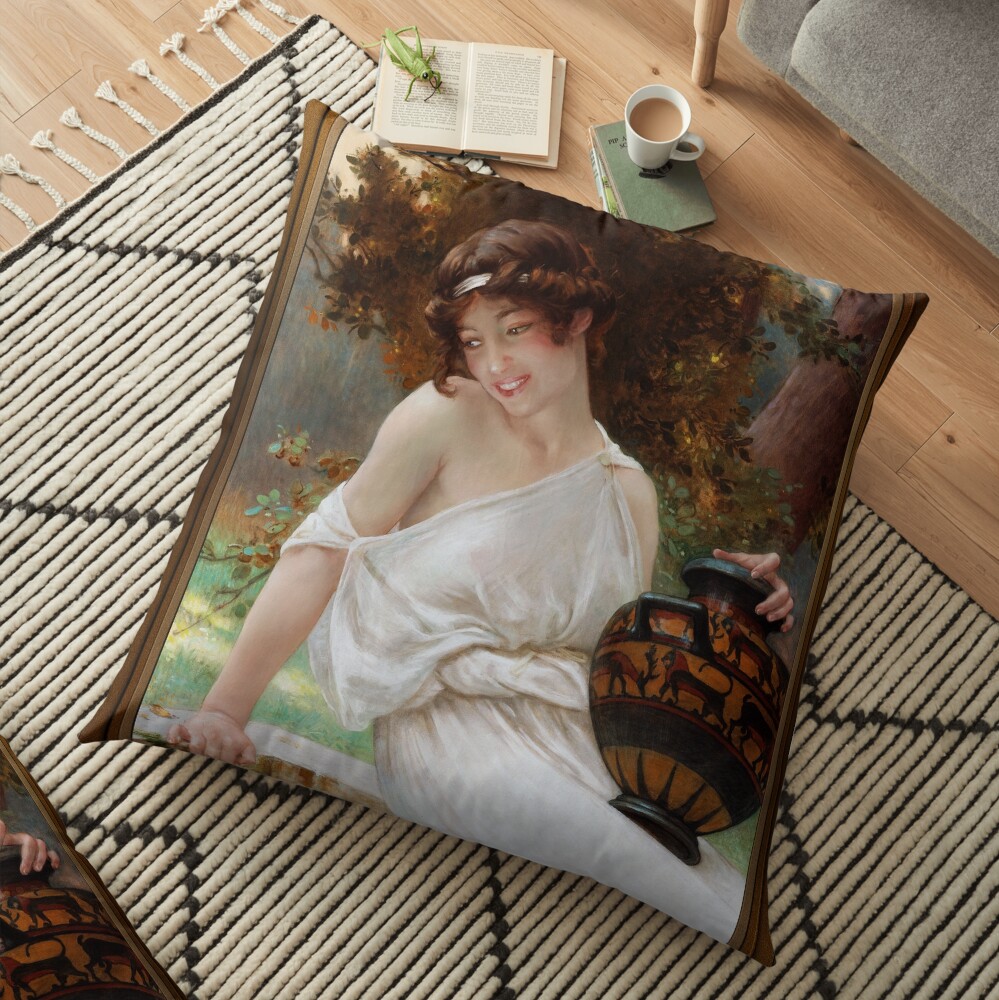
Seignac’s painting exemplifies the academic realism and romanticism that were prevalent in France at the turn of the 20th century. His meticulous attention to detail is evident in the soft, luminous rendering of the woman’s gown and the texture of the surrounding foliage. The gentle blending of colors creates a soft, atmospheric effect that invites the viewer to linger in the quiet beauty of the scene. The figures are painted with a refined delicacy, yet their three-dimensionality is achieved through the careful use of light and shadow, giving the painting a sense of depth and volume.
Seignac’s use of soft, natural colors—pale blues, verdi, and the warm earth tones of the stone fountain—serves to further enhance the serene and peaceful mood of the painting. The textures in the background, from the leaves and branches to the weathered stone, are rendered with great care and attention to detail, giving the scene an organic, lifelike quality. The overall effect is one of harmony between the subject and her environment, creating a visual unity that invites the viewer to appreciate the beauty of the classical world.
Umore è tema: Serenity, Timelessness, and Classical Elegance
L'umore di At The Fountain is one of serene contemplation. The young woman, with her delicate expression and graceful posture, exudes an air of peace and tranquility. There is no sense of hurry or disturbance in the scene; piuttostu, the viewer is invited to experience the stillness of the moment alongside the subject. The fountain, the ancient vase, and the lush garden all contribute to an atmosphere of timeless beauty, reinforcing the classical theme of the painting.
The theme of the artwork can be interpreted as a celebration of idealized femininity and the elegance of classical antiquity. The woman’s gentle demeanor and her connection to the classical elements around her, from the vase to the garden, suggest a harmonious balance between humanity and nature. Seignac’s choice to depict this timeless moment in the soft light of early morning or evening only enhances the sense of peacefulness, as if the subject is part of a world that exists outside the constraints of time.
Cunclusione
At The Fountain is a masterful example of Guillaume Seignac’s ability to blend realism, romanticismu, and classical ideals into a single, harmonious work of art. Through the depiction of a young woman in a tranquil garden setting, the artist captures the grace and beauty of the classical world while inviting the viewer to reflect on the purity and serenity of the scene. The painting’s timeless theme, coupled with its serene mood, speaks to the enduring allure of classical art and the quiet elegance of the female form.
Questa hè una ripruduzzione di l'antichi maestri d'arte digitale rimasterizzata di una maghjina di duminiu publicu chì hè dispunibule cum'è a stampa su tela in linea.
Questa creazione d'arte digitale, cum'è cù tutte l'opere d'arte chì ponu esse truvate nantu à u situ web di Xzendor7 hè dispunibule per cumprà in linea in una varietà di formati di materiale cumprese stampe di tela., stampe acriliche, stampe metalliche, stampe di lignu, stampe in cornice, manifesti, è cum'è stampe su tela rolled in una varietà di dimensioni da 12 centimetri à 72 centimetri secondu a dimensione di l'opera d'arte attuale è a stampa nantu à a tenda chì sceglite di cumprà l'arte da.
L'opera d'arte hè ancu dispunibule nantu à una larga gamma di vestiti di l'omi è di e donne, mugs, tote, sciarpe, quaderni è ghjurnali è parechji prudutti di decoru di casa.