

Best Friends
“Best Friends” is a charming and whimsical artwork created by the French painter Emile Vernon in 1903. natu in 1872 and active until his death in 1920, Vernon was renowned for his delicate and detailed depictions of young girls in intimate, often serene moments of daily life. This particular piece exemplifies his ability to combine innocence with a playful sense of joy, presenting a young girl in an outdoor setting alongside her playful companion, a kitten. The theme of companionship, purezza, and the simple pleasures of life resonate throughout the painting, encapsulating the grace and tenderness of childhood.
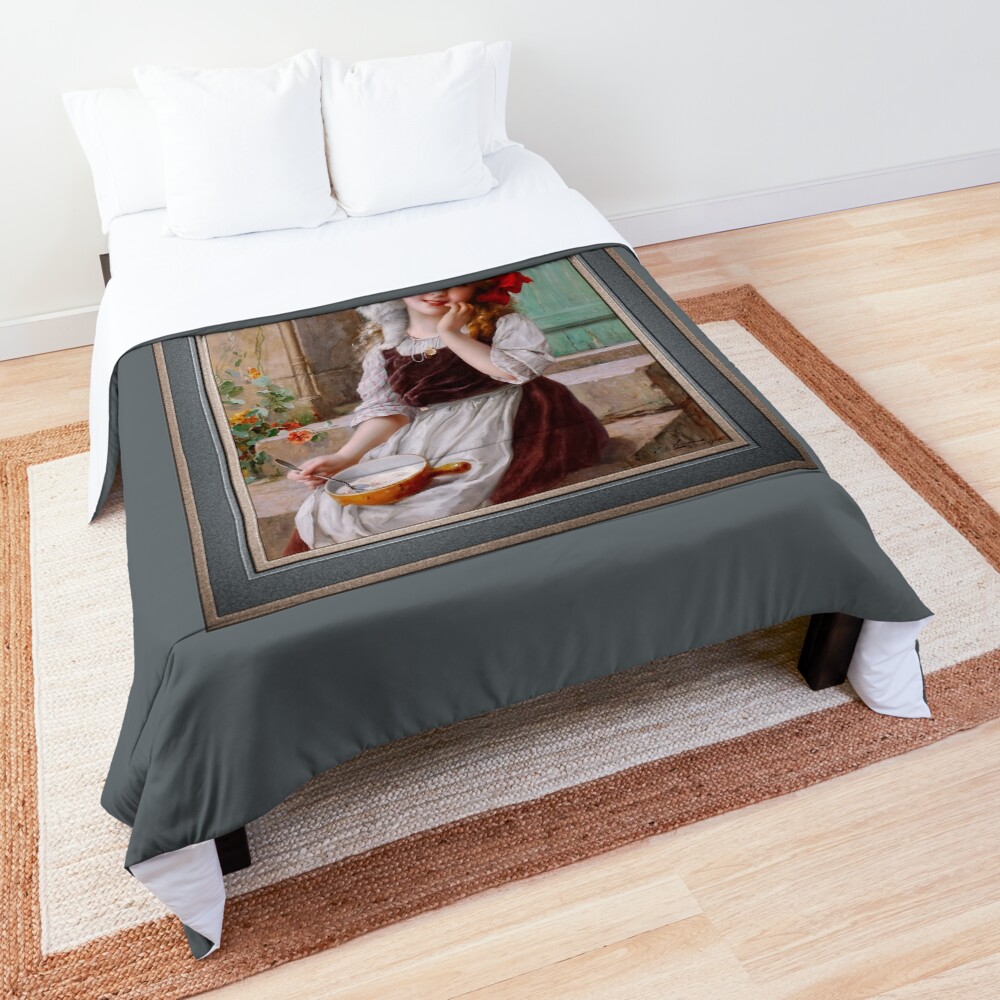
Table of Contents
Sugettu principale: The Girl and the Kitten
The central subject of the painting is a young girl, with a light, fair complexion and bright blonde hair cascading in loose waves. Her youthful face is illuminated by a soft smile, revealing the natural innocence that defines the subject matter of many of Vernon’s works. The girl’s red ribbon, which is tied at the side of her head, adds a touch of bold color to the otherwise soft and natural tones of the painting. Her expression is playful yet serene, as if caught in a moment of quiet joy, engaged in the act of feeding or caring for her small kitten.
The kitten, perched comfortably on her shoulder, adds an element of whimsy to the scene. The playful creature, a fluffy gray and white cat, wears a light blue bow around its neck, complementing the girl’s attire. The cat’s curious gaze and tilted head reflect the youthful energy of the pair, hinting at their strong bond. This gentle companionship between the girl and her pet is a testament to the artist’s exploration of childhood innocence, where pets and playmates are not only companions but also confidantes in the imaginary worlds that children create.
U Setting: Outdoors with a Hint of Nature
The setting of “Best Friends” appears to be an outdoor garden or courtyard, captured with vivid, yet soft brushwork. The stone walls, painted in light neutral tones of beige and taupe, create a warm backdrop for the young girl and her kitten. A wooden door, painted in a soft greenish hue, opens to a slightly blurred, sun-dappled space, suggesting a transition from the enclosed space of the building to the wide world beyond. The architectural elements—the stone and the wooden door—serve as a grounding element in the painting, offering stability to the otherwise soft and flowing nature of the girl’s figure.
In front of the girl, the small table where she sits is adorned with a bowl of porridge or oatmeal, which she delicately holds with a spoon. The bowl, a simple yet elegant piece of pottery, has an earthy, natural tone, tying it to the setting’s overall rustic charm. Daretu à ella, clusters of soft, colorful flowers in the garden provide a gentle burst of natural color. They seem almost to echo the girl’s youthfulness, with delicate petals and trailing vines that invite a closer inspection of the detailed brushwork, which Vernon was known for.
Umore è tema: Innocenza, Playfulness, and Companionship
The mood of the artwork is light-hearted and joyful, capturing a fleeting moment of childhood innocence. The girl’s gentle expression and playful interaction with her kitten evoke feelings of warmth and tenderness. Her pose—sitting comfortably, spoon in hand, with her kitten perched on her shoulder—further enhances the sense of ease and contentment that the painting exudes. This is a quiet, intimate moment of companionship, without any external disruptions, allowing the viewer to fully immerse in the peaceful world of childhood.
U tema di “Best Friends” revolves around the purity of youth and the unspoken bond between a child and her pet. Vernon’s depiction of the girl with her kitten conveys a sense of closeness, as the young girl leans into her pet’s presence, both figuratively and physically. This interaction is timeless, representing the uncomplicated and unconditional love that exists between children and their animals. The kitten, though a small creature, plays a significant role in enhancing the scene’s emotional depth, symbolizing the simplicity and joy that animals bring to our lives.
Stile artisticu: Realism with a Touch of Romanticism
Emile Vernon’s style in “Best Friends” is rooted in the realism movement, yet it carries the romanticism of the time. A maestria di l'artista di a luce è l'ombra, along with his precise attention to detail, showcases his technical skill and ability to capture the world around him with striking clarity. The textures of the girl’s hair, the softness of her dress, and the fluffy fur of the kitten are all meticulously rendered, drawing the viewer into the intimacy of the moment.
Vernon’s brushwork is delicate and nuanced, lending a softness to the composition that enhances the overall feeling of tranquility. The palette is gentle, featuring warm, earthy tones of browns, verdi, and beiges, which complement the girl’s attire and the natural surroundings. The application of light, particularly on the girl’s face and the kitten’s fur, gives the painting a luminous quality, evoking a sense of warmth and affection. This blend of realism and romanticism in Vernon’s work was characteristic of the late 19th and early 20th centuries, when the push for technical accuracy in painting was often tempered by an emphasis on emotional and idealized representation.
Cunclusione
In “Best Friends,” Emile Vernon presents a timeless portrayal of the pure bond between a young girl and her pet. Through the delicate depiction of their interaction and the gentle setting, Vernon captures a moment of serene joy and companionship, reminding us of the simple, yet profound, pleasures of childhood. A cumpusizioni, luce, and subject matter combine to create an artwork that not only illustrates the artist’s skill but also evokes an enduring sense of warmth and nostalgia.
Questa hè una riproduzzione di l'antichi maestri d'arte digitale rimasterizzata di una maghjina di duminiu publicu chì hè dispunibule cum'è stampa di tela in linea..

Questa creazione d'arte digitale, cum'è cù tutte l'opere d'arte chì ponu esse truvate nantu à u situ web di Xzendor7 hè dispunibule per cumprà in linea in una varietà di formati di materiale cumprese stampe di tela., stampe acriliche, stampe metalliche, stampe di lignu, stampe in cornice, manifesti, è cum'è stampe su tela rolled in una varietà di dimensioni da 12 centimetri à 72 centimetri secondu a dimensione di l'opera d'arte attuale è a stampa nantu à a tenda chì sceglite di cumprà l'arte da.
L'opera d'arte hè ancu dispunibule nantu à una larga gamma di vestiti di l'omi è di e donne, mugs, tote, sciarpe, quaderni è ghjurnali è parechji prudutti di decoru di casa.
À propositu di l'artista
Info sottu Da Galleria Ary Jan
Émile Vernon era un studiente à a scola di Belle Arti di Tours induve hà vintu u primu premiu di disegnu 1888; in seguitu hè statu guidatu da William Bouguereau è Auguste Truphème.
Allora in 1898 hà participatu à a mostra di Tours di Belle Arti è Arti Decorative è più tardi quellu annu, à l'Exposition des artistes français et y expose régulièrement ses œuvres 1898 à 1913; presentanu ritratti, paisaghji, scene di Bretagna, bouquets de nature morte qu'il a peint à l'aquarelle, è ancu figure femminili, chì più tardi diventò hè specialità.
Émile eccelleva in i so dipinti di luce dolce, figure adorabili di zitelli è donne eleganti, cù quale hà spessu assuciatu un animali domesticu cum'è un gattu, cane o uccello, è adornava e so imagine cù ghirlande o bouquets di fiori, tutta a so carriera; ma era ancu un artista assai versatile chì pudia dipinge cù rigore è putenza cum'è in i so opere u ritrattu di Madame Vernon è Sous la Lampe. (Sottu à u lampu).