

Best Friends
“Best Friends” is a charming and whimsical artwork created by the French painter Emile Vernon in 1903. Gebuer zu 1872 and active until his death in 1920, Vernon was renowned for his delicate and detailed depictions of young girls in intimate, often serene moments of daily life. This particular piece exemplifies his ability to combine innocence with a playful sense of joy, presenting a young girl in an outdoor setting alongside her playful companion, a kitten. The theme of companionship, purity, and the simple pleasures of life resonate throughout the painting, encapsulating the grace and tenderness of childhood.
Inhaltsverzeechnes
Haaptthemium: The Girl and the Kitten
The central subject of the painting is a young girl, with a light, fair complexion and bright blonde hair cascading in loose waves. Her youthful face is illuminated by a soft smile, revealing the natural innocence that defines the subject matter of many of Vernon’s works. The girl’s red ribbon, which is tied at the side of her head, adds a touch of bold color to the otherwise soft and natural tones of the painting. Her expression is playful yet serene, as if caught in a moment of quiet joy, engaged in the act of feeding or caring for her small kitten.
The kitten, perched comfortably on her shoulder, adds an element of whimsy to the scene. The playful creature, a fluffy gray and white cat, wears a light blue bow around its neck, complementing the girl’s attire. The cat’s curious gaze and tilted head reflect the youthful energy of the pair, hinting at their strong bond. This gentle companionship between the girl and her pet is a testament to the artist’s exploration of childhood innocence, where pets and playmates are not only companions but also confidantes in the imaginary worlds that children create.
De Kader: Outdoors with a Hint of Nature
De Kader vun “Best Friends” appears to be an outdoor garden or courtyard, captured with vivid, yet soft brushwork. The stone walls, painted in light neutral tones of beige and taupe, create a warm backdrop for the young girl and her kitten. A wooden door, painted in a soft greenish hue, opens to a slightly blurred, sun-dappled space, suggesting a transition from the enclosed space of the building to the wide world beyond. The architectural elements—the stone and the wooden door—serve as a grounding element in the painting, offering stability to the otherwise soft and flowing nature of the girl’s figure.
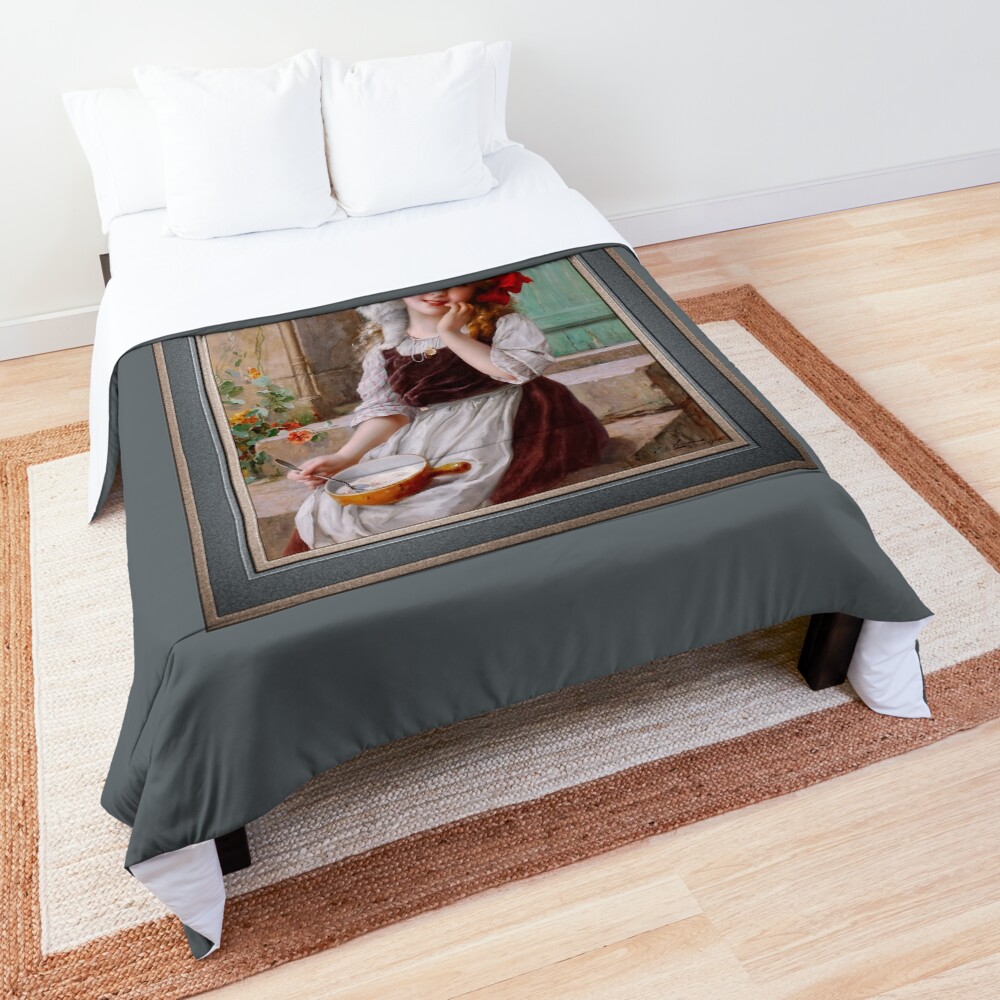
In front of the girl, the small table where she sits is adorned with a bowl of porridge or oatmeal, which she delicately holds with a spoon. The bowl, a simple yet elegant piece of pottery, has an earthy, natural tone, tying it to the setting’s overall rustic charm. Hannert hatt, clusters of soft, colorful flowers in the garden provide a gentle burst of natural color. They seem almost to echo the girl’s youthfulness, with delicate petals and trailing vines that invite a closer inspection of the detailed brushwork, which Vernon was known for.
Stëmmung an Thema: Onschold, Playfulness, and Companionship
The mood of the artwork is light-hearted and joyful, capturing a fleeting moment of childhood innocence. The girl’s gentle expression and playful interaction with her kitten evoke feelings of warmth and tenderness. Her pose—sitting comfortably, spoon in hand, with her kitten perched on her shoulder—further enhances the sense of ease and contentment that the painting exudes. This is a quiet, intimate moment of companionship, without any external disruptions, allowing the viewer to fully immerse in the peaceful world of childhood.
D'Thema vun “Best Friends” revolves around the purity of youth and the unspoken bond between a child and her pet. Vernon’s depiction of the girl with her kitten conveys a sense of closeness, as the young girl leans into her pet’s presence, both figuratively and physically. This interaction is timeless, representing the uncomplicated and unconditional love that exists between children and their animals. The kitten, though a small creature, plays a significant role in enhancing the scene’s emotional depth, symbolizing the simplicity and joy that animals bring to our lives.
Kënschtleresch Stil: Realism with a Touch of Romanticism
Emile Vernon’s style in “Best Friends” is rooted in the realism movement, yet it carries the romanticism of the time. The artist’s mastery of light and shadow, along with his precise attention to detail, showcases his technical skill and ability to capture the world around him with striking clarity. The textures of the girl’s hair, the softness of her dress, and the fluffy fur of the kitten are all meticulously rendered, drawing the viewer into the intimacy of the moment.
Vernon’s brushwork is delicate and nuanced, lending a softness to the composition that enhances the overall feeling of tranquility. The palette is gentle, featuring warm, earthy tones of browns, Greener, and beiges, which complement the girl’s attire and the natural surroundings. The application of light, particularly on the girl’s face and the kitten’s fur, gives the painting a luminous quality, evoking a sense of warmth and affection. This blend of realism and romanticism in Vernon’s work was characteristic of the late 19th and early 20th centuries, when the push for technical accuracy in painting was often tempered by an emphasis on emotional and idealized representation.
Conclusioun
An “Best Friends,” Emile Vernon presents a timeless portrayal of the pure bond between a young girl and her pet. Through the delicate depiction of their interaction and the gentle setting, Vernon captures a moment of serene joy and companionship, reminding us of the simple, yet profound, pleasures of childhood. D'Kompositioun, Liicht, and subject matter combine to create an artwork that not only illustrates the artist’s skill but also evokes an enduring sense of warmth and nostalgia.
Dëst ass eng remastered digital Konscht al Master Reproduktioun vun engem Public Domain Bild dat als Canvas Print online verfügbar ass.

Dës digital Konscht Kreatioun, wéi mat all de Konschtwierker, déi op der Xzendor7 Websäit fonnt kënne ginn, ass online a verschiddene Materialformater ze kafen, dorënner Canvas Prints, acryl Prints, Metallofdréck, Holzdrécker, cadréiert Printen, Plakater, a wéi gewalzt Canvas Printen a ville Gréissten vun 12 Zoll zu 72 Zoll ofhängeg vun der Gréisst vum aktuellen Konschtwierk an dem Print-on-Demande Buttek vun deem Dir gewielt hutt d'Konscht ze kafen.
D'Konschtwierk ass och op eng breet Palette vu Männer- a Fraekleedung verfügbar, Becher, totes, Schal, Notizbicher an Zäitschrëften a vill Heemdekoratiounsprodukter.
Iwwer de Kënschtler
Info Ënnen Vun Beauty Under The Orange Tree vum Émile Vernon
Den Émile Vernon war e Student an der Fine Arts School zu Tours, wou hien den éischte Präis fir Zeechnen gewonnen huet 1888; Den Émile Vernon war e Student an der Fine Arts School zu Tours, wou hien den éischte Präis fir Zeechnen gewonnen huet.
Den Émile Vernon war e Student an der Fine Arts School zu Tours, wou hien den éischte Präis fir Zeechnen gewonnen huet 1898 Den Émile Vernon war e Student an der Fine Arts School zu Tours, wou hien den éischte Präis fir Zeechnen gewonnen huet, Den Émile Vernon war e Student an der Fine Arts School zu Tours, wou hien den éischte Präis fir Zeechnen gewonnen huet 1898 an 1913; Den Émile Vernon war e Student an der Fine Arts School zu Tours, wou hien den éischte Präis fir Zeechnen gewonnen huet, Den Émile Vernon war e Student an der Fine Arts School zu Tours, wou hien den éischte Präis fir Zeechnen gewonnen huet, Den Émile Vernon war e Student an der Fine Arts School zu Tours, wou hien den éischte Präis fir Zeechnen gewonnen huet, Den Émile Vernon war e Student an der Fine Arts School zu Tours, wou hien den éischte Präis fir Zeechnen gewonnen huet, Den Émile Vernon war e Student an der Fine Arts School zu Tours, wou hien den éischte Präis fir Zeechnen gewonnen huet, Den Émile Vernon war e Student an der Fine Arts School zu Tours, wou hien den éischte Präis fir Zeechnen gewonnen huet.
Den Émile Vernon war e Student an der Fine Arts School zu Tours, wou hien den éischte Präis fir Zeechnen gewonnen huet, Den Émile Vernon war e Student an der Fine Arts School zu Tours, wou hien den éischte Präis fir Zeechnen gewonnen huet, Den Émile Vernon war e Student an der Fine Arts School zu Tours, wou hien den éischte Präis fir Zeechnen gewonnen huet, Den Émile Vernon war e Student an der Fine Arts School zu Tours, wou hien den éischte Präis fir Zeechnen gewonnen huet, Den Émile Vernon war e Student an der Fine Arts School zu Tours, wou hien den éischte Präis fir Zeechnen gewonnen huet, Den Émile Vernon war e Student an der Fine Arts School zu Tours, wou hien den éischte Präis fir Zeechnen gewonnen huet; mee hien war och e ganz versatile Kënschtler, dee mat Streng a Kraaft molen konnt wéi a senge Wierker de Portrait vun der Madame Vernon a Sous la Lampe (mee hien war och e ganz versatile Kënschtler, dee mat Streng a Kraaft molen konnt wéi a senge Wierker de Portrait vun der Madame Vernon a Sous la Lampe).