

Kaliope, Muse of Epic Poetry
The Voice of Heroes: Examining Charles Meynier’s “Calliope, Muse of Epic Poetry”
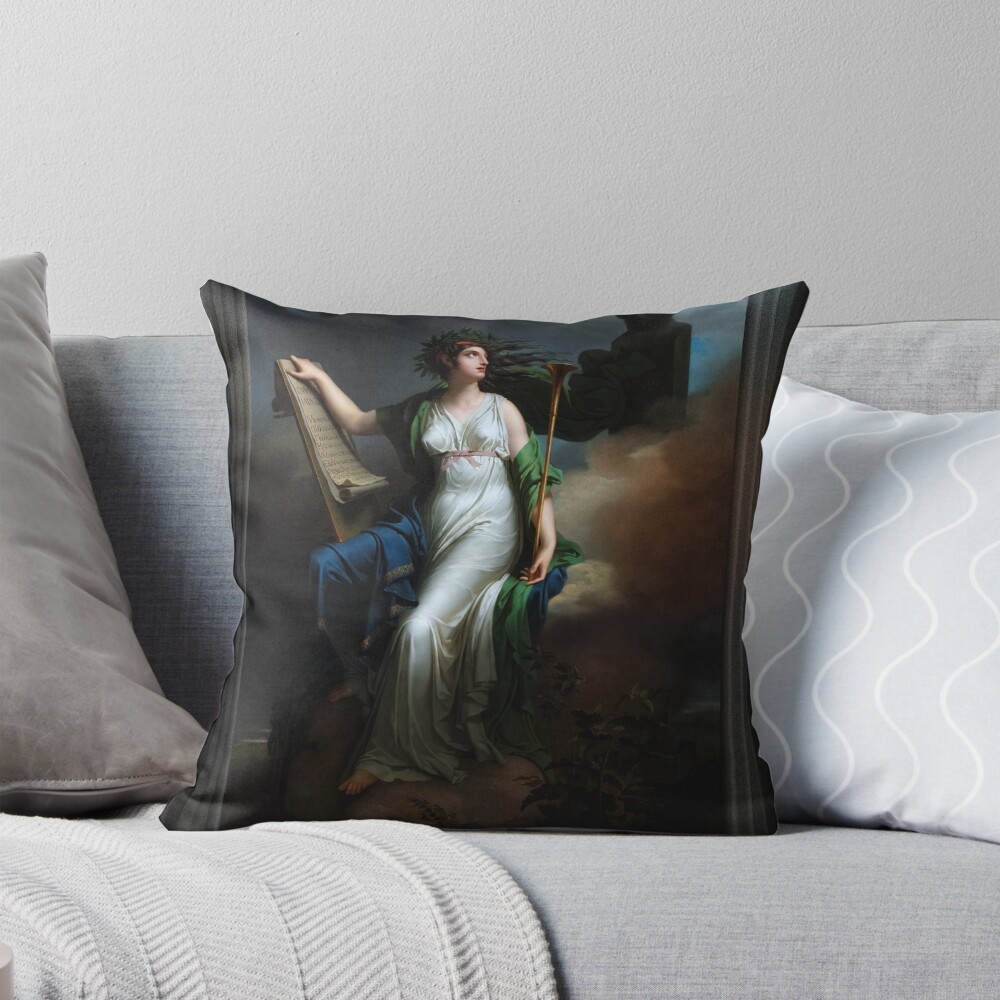
Karola Meyniera‘s (1763 lub 68 – 1832) “Kaliope, Muse of Epic Poetry,” pomalowane dookoła 1798, is a striking allegorical representation of the Greek goddess responsible for inspiring heroic narratives. The artwork portrays Calliope seated upon a rocky outcrop amidst swirling clouds, holding a scroll and a laurel-crowned staff—symbols of her role as the patroness of epic poetry. Meynier’s skillful use of dramatic lighting and classical composition creates an atmosphere of grandeur and timeless significance.
Spis treści
Elementy kompozycyjne & Symbolic Representation
The painting’s composition is carefully structured to emphasize Calliope’s elevated status and divine nature. She occupies a central position within the frame, seated on a rugged rock formation that rises above a sea of swirling clouds. This placement suggests her dominion over both earthly and celestial realms. Za nią, partially obscured by mist, stands a bust of Homer—the legendary author of the Iliad and the Odyssey, further reinforcing Calliope’s association with epic poetry. The scroll she holds displays fragments of text, presumably excerpts from heroic tales, while the laurel-crowned staff symbolizes victory and artistic achievement.
Paleta kolorów & Efekty atmosferyczne
The color palette in “Kaliope, Muse of Epic Poetry” is dominated by cool tones—blues, szarości, and whites—which evoke a sense of solemnity and grandeur. Calliope’s flowing white gown contrasts sharply with the dark background, drawing attention to her figure as the focal point of the composition. Meynier masterfully uses chiaroscuro—the contrast between light and dark—to create depth and drama within the scene. The swirling clouds and misty atmosphere contribute to a sense of ethereal beauty and timelessness.
Kaliope: Goddess of Inspiration & Narrative Power
Kaliope, in Greek mythology, is the eldest of the nine Muses, each representing a different art or science. As the muse of epic poetry, she was believed to inspire poets with tales of heroic deeds, divine interventions, and grand adventures. Meynier’s portrayal captures her essence as a source of creative inspiration—a figure who embodies the power of storytelling and the enduring legacy of classical literature. The artwork serves as a tribute to the art of epic poetry and its ability to transport audiences to worlds beyond their own.
Wpływ artystyczny & Kontekst historyczny
Charles Meynier was a French painter known for his neoclassical style, which drew inspiration from ancient Greek and Roman art. His work often featured allegorical subjects and historical scenes rendered with meticulous detail and classical elegance. “Kaliope, Muse of Epic Poetry” exemplifies these qualities; it reflects the artistic trends of the late 18th and early 19th centuries, a period marked by renewed interest in classical antiquity. The painting’s creation coincides with a time of significant political and social upheaval in France—the French Revolution and Napoleonic era—during which artists often turned to classical themes for inspiration and solace.
Szczegóły techniczne & Przybory
The artwork is executed with oil paints on canvas, allowing for rich color saturation and subtle gradations of tone. Meynier’s technique involves meticulous attention to detail, particularly evident in the rendering of Calliope’s drapery, facial features, and the textures of the rocks and clouds. Close examination reveals a mastery of brushwork; it’s smooth and controlled, contributing to the overall sense of elegance and refinement. The canvas itself appears well-prepared, providing a suitable surface for the artist’s skillful application of paint.
Bio artysty pochodzące z Wikipedia.org
Meynier był synem krawca; i młody wiek wykazał talent plastyczny, i rozpoczął szkolenie pod okiem francuskiego rysownika i rytownika Pierre-Philippe Choffarda *1731 – 1809).
Jako uczeń francuskiego neoklasycystycznego i historycznego malarza François-André Vincenta (1746 – 1816), Meynier zdobył drugą nagrodę w konkursie im 1789 cena konkurencji w Rzymie; podczas gdy Anne-Louis Girodet de Roussy-Trioson zdobyła pierwszą nagrodę. Cztery lata później w 1793 Meynier wrócił do Paryża.
W 1815 Meynier został członkiem Akademii Francuskiej w Rzymie; oraz w okresie pomiędzy 1819 do 1822, stworzył wspaniałą dekorację sufitu Luwru; a także tworząc liczne dzieła gloryfikujące legendę napoleońską, który w większości pozostaje w Château de Versailles.
Wykonał również projekty płaskorzeźb i posągów na Łuku Triumfalnym Carrousel i Paris Bourse. Od 1816 naprzód, Meynier był członkiem Akademii Sztuk Pięknych; i w 1819 został mianowany nauczycielem w École des Beaux-Arts.
This is a retouched digital art old masters reproduction of a public domain image that is available for print on multiple products, as well as a druk na płótnie online.