

Caprice aux figures élégantes
Capriccio avec figures élégantes c1750 par le peintre italien Antonio Joli (1700 – 1777); connu pour ses peintures de scènes vedute et capricci.
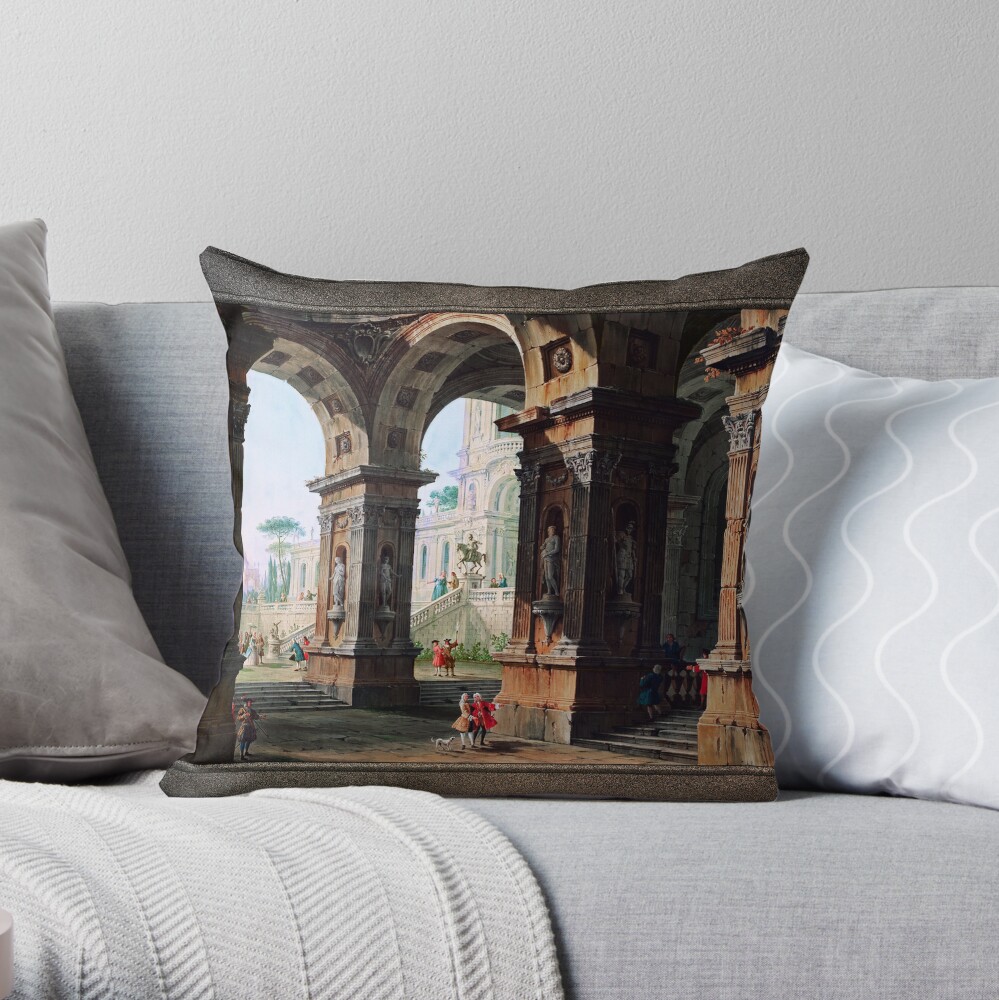
C'est un merveilleux peinture fantaisiste showing people of the upper class of the time in an old Roman palace.
We ca see in the foreground two men who are walking with a white dog beside them in conversation, with a possible guard and another man near a large pillar that has a statue of a goddess standing on a pedestal.
These goddesses can be seen through the palace on all four sides of the four major columns in the scene; and up the stairs where the two men and the dog are, we can see more people that have gathered by a Roman statue in the main column of the scene.
In the open area we can see a lush garden, où se trouvent des marches qui mènent au bâtiment principal avec des statues à la base et une statue de cheval et son cavalier au sommet; nous voyons ce qui est le plus probablement un noble et une noble, marcher avec un homme derrière une dame tenant un parasol au-dessus de sa tête, et ce qui semble être une servante porte la partie bleue de sa robe au-dessus du sol.
Vidéo de retouche photo de Capriccio avec des figures élégantes par Antonio Joli
Derrière le noble couple se trouve leur entourage et le long du balcon du bâtiment principal se trouvent d'autres hommes et femmes conversant et profitant de la belle journée claire et ensoleillée..
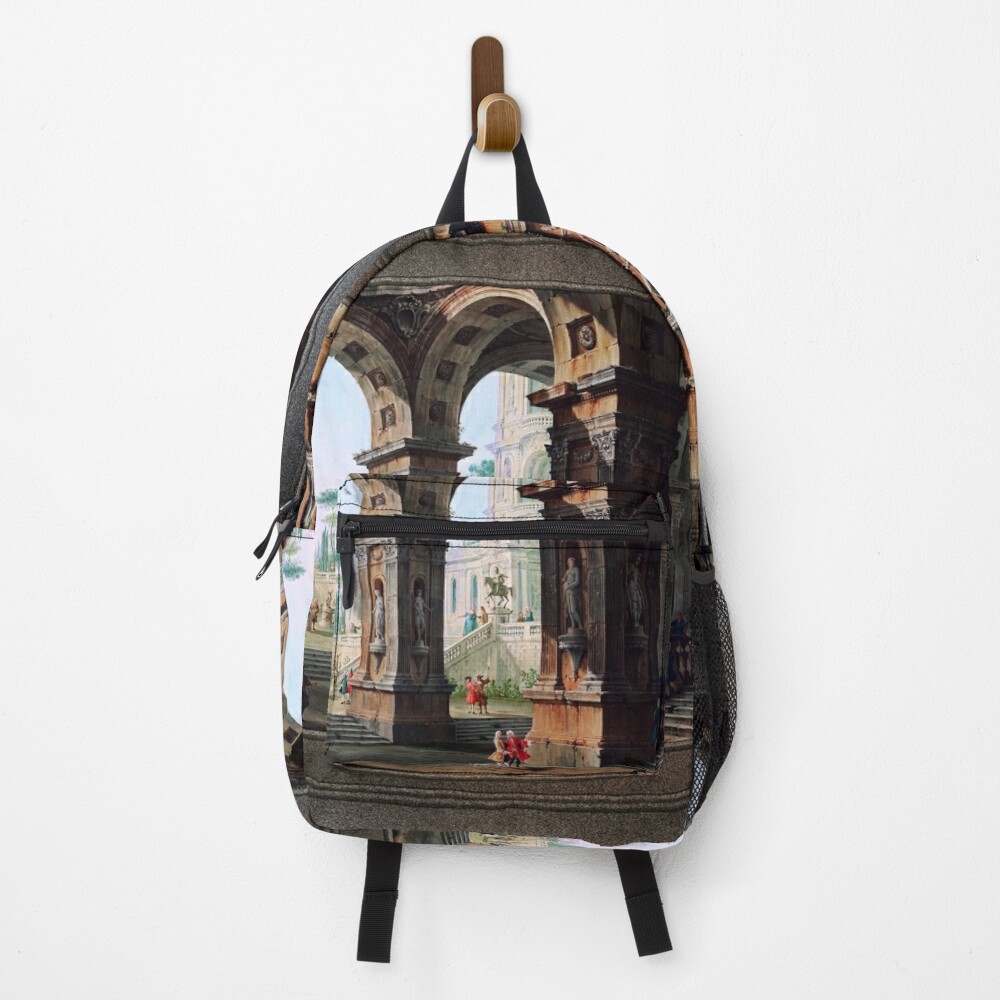
Capriccio With Elegant Figures est une reproduction remasterisée de maîtres anciens d'art numérique d'une image du domaine public disponible sous forme de impression sur toile.
Les informations ci-dessous sont dérivées de Wikipedia.org
Antonio est né à Modène, L'Italie en mars 13, 1700 et fut d'abord l'apprenti de Rafaello Rinaldi, également connu sous le nom d'Il Menia., aainsi que travailler dans l'atelier des Galli da Bibbiena; who were a family of Italian scene artist of the 17th and 18th centuries that spanned from 1625 – 1787.
He started his career as a painter of stage sets in Modena and Perugia, et à l'âge de 32 moved to Venice where he worked as a stage painter for the opera productions at the Teatro di San Giovanni Grisostomo and the Teatro San Samuele of the Grimani family.
Dans 1742 he traveled to Dresden, Germany and then to London, England where he remained from 1744 à 1748, then to Madrid, Spain from 1750 – 1754.
While he was living and working in London he decorated the Richmond mansion of the Swiss Count John James Heidegger (1666 – 1749), then the director of the King’s Theater (a West End theater situated on Haymarket in the City of Westminster, Londres).
When he was in Madrid he was also employed as a scene painter for the royal court; ainsi que pour le petit opéra et le palais d'Aranjuez. Il a également réalisé des peintures de grande taille de l'Esquadra del Tajo., la flotte de barges royales et autres navires sur le fleuve Tage à Aranjuez.
Dans 1754 Antonio est revenu de Venise, Italie et est devenu l'un des membres fondateurs de l'Académie des Beaux-Arts de Venise (Académie des Beaux-Arts de Venise); sept ans plus tard, il fut transféré à la cour des Bourbons de Naples, où il restera jusqu'à sa mort en avril 29, 1777.