

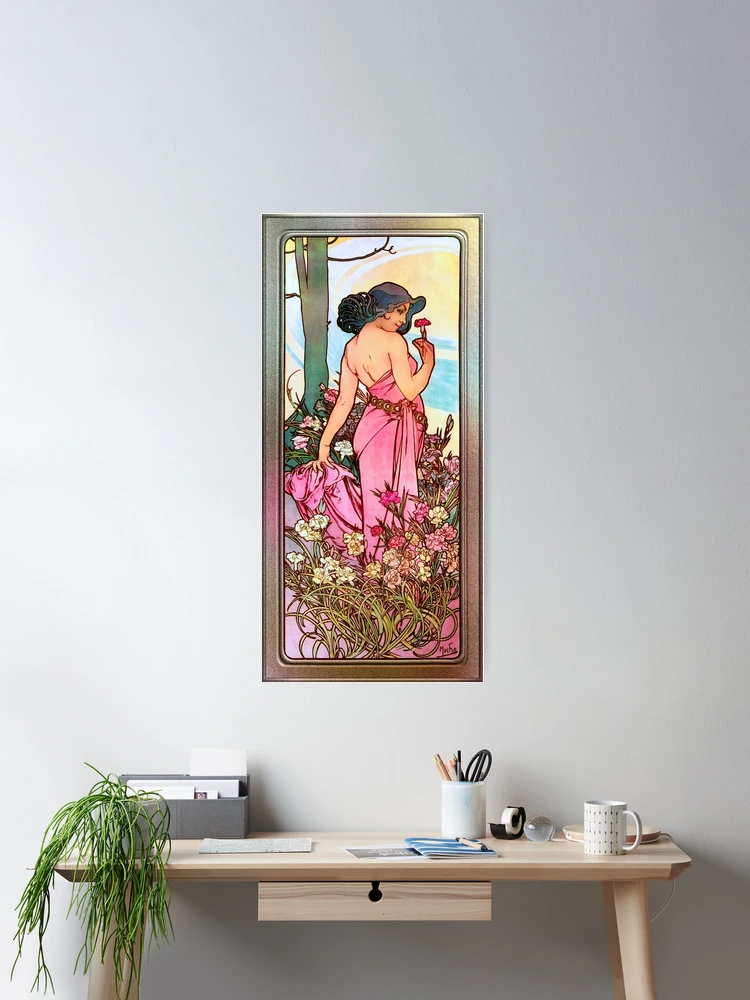
The “Carnation Art Nouveau Portrait,” búið til í 1898 by the Czech artist Alphonse Mucha (1860 – 1939), exemplifies the ethereal elegance and decorative artistry of the Art Nouveau movement. This work features a young woman draped in flowing pink garments amidst a vibrant garden of blooming carnations and other flora, rendered with delicate yet elaborate detail. Mucha’s composition, rooted in his hallmark style of harmonious curvilinear forms and soft hues, reflects the romantic idealization of the feminine figure intertwined with nature.
Efnisyfirlit
Viðfangsefni og samsetning
At the heart of the artwork is a graceful female figure depicted in three-quarter profile, turning slightly to reveal her serene yet enigmatic expression. Her flowing dark hair, styled with soft waves, frames her face and cascades down her back, enhancing her otherworldly beauty. She holds a single carnation delicately in one hand, bringing the viewer’s attention to her gentle interaction with nature. Her body is enveloped in a loosely draped pink gown, cinched at the waist with a decorative belt adorned with intricate circular patterns. This belt, a signature of Mucha’s ornamental style, adds an element of detail and luxury to the composition.
The woman’s pose exudes confidence and grace, bert bakið og örlítið upphækkað höfuð sem gefur til kynna fíngerða næmni sem er í samræmi við fagurfræði Art Nouveau. Framkoma hennar er bæði innsýn og aðlaðandi, vekur upp tímalausa töfra sem fer yfir hið venjulega. Náttúrulegt flæði klæða hennar og samþætting þeirra við nærliggjandi grasafræðilega þætti staðfesta hana enn frekar sem tákn um einingu við náttúruna.
Floral Motifs and Surroundings
Forgrunnur og bakgrunnur listaverksins er ríkur af blómstrandi nellikum, sem ráða ríkjum í samsetningunni með flóknum smáatriðum og líflegum litum. Allt frá mjúkum gulum og hvítum litum til dýpri bleikra og rauðra lita, nellikurnar eru vandlega gerðar, lagskiptu krónublöðin þeirra stuðla að áferðardýpt málverksins. Á milli nellikanna eru grannir grænir stilkar og laufblöð sem rísa og sveigjast tignarlega, echoing the sinuous lines characteristic of the Art Nouveau style.
Í bakgrunni, Mucha incorporates abstracted tree trunks and stylized branches that frame the figure, creating a subtle architectural framework that guides the viewer’s gaze. The pastel-hued sky, with its gentle swirls of blue and gold, forms an ethereal backdrop, adding a sense of tranquility and timelessness to the scene. The soft interplay of light and color imbues the painting with a dreamlike quality, enhancing its romantic and poetic atmosphere.
Artistic Style and Techniques
Mucha’s Art Nouveau style is unmistakable in this piece, characterized by its intricate ornamentation, flowing organic forms, and harmonious balance between figure and background. The painting’s composition is meticulously structured, yet it conveys an effortless naturalism that reflects Mucha’s mastery of integrating decorative and figurative elements. His use of curvilinear lines is evident in every aspect of the work, from the contours of the woman’s form to the undulating stems and petals of the flowers.
The color palette is a study in subtlety and sophistication. Mucha employs soft pastels, punctuated by deeper shades of pink and green, to create a sense of harmony and visual coherence. The interplay of light and shadow is delicate, adding depth and dimension to the composition without disrupting its overall unity. This restrained approach to color and shading underscores Mucha’s focus on the decorative and symbolic aspects of the artwork.
Þema og stemning
The “Carnation Art Nouveau Portrait” embodies the quintessential themes of the Art Nouveau movement: the celebration of nature, the idealization of the feminine form, and the synthesis of beauty and functionality. The woman at the center of the composition serves as both a muse and a metaphor, representing the harmony and vitality of the natural world. Her connection with the surrounding flora suggests a sense of unity and continuity, reflecting the movement’s reverence for organic forms and their intrinsic beauty.
The mood of the artwork is one of serenity and contemplation. The woman’s calm demeanor and the gentle interplay of colors and forms create an atmosphere of peace and introspection. Á sama tíma, the intricate details and dynamic lines lend the piece an underlying energy, drawing the viewer into its richly textured world.
Materials and Execution
While the specific medium of this piece is not mentioned, Verk Mucha á þessu tímabili fólu oft í sér blöndu af hefðbundinni málaratækni og steinþrykk, ferli sem hann náði tökum á til að búa til fræg veggspjöld sín og skrautspjöld. Nákvæmar og nákvæmar útfærslur á blómum og flíkum myndarinnar benda til þess að nota fína bursta og vandlega lagningu litarefna.. Hæfni Mucha til að blanda óaðfinnanlega saman fígúrugerð og skrautmuni kemur fram í gallalausri útfærslu og jafnvægi í samsetningu málverksins..
Legacy and Cultural Significance
Sem einn fremsti listamaður Art Nouveau hreyfingarinnar, Verk Mucha eru komin til að skilgreina tímabil listrænnar nýsköpunar og fegurðar. The “Carnation Art Nouveau Portrait” sýnir hæfileika hans til að fanga kjarna hinnar kvenlegu hugsjónar og flétta hana saman við dýrð náttúrunnar. Þetta stykki, eins og mikið af verkum hans, þjónar sem vitnisburður um varanlega aðdráttarafl Art Nouveau og áherslu þess á sátt, glæsileiki, og hátíð lífsins.
Með stórkostlegu handverki og tímalausri fagurfræði, the “Carnation Art Nouveau Portrait” heldur áfram að heilla áhorfendur, bjóða þeim að njóta fegurðar hennar og kanna flókið samband listarinnar, Náttúran, og mannsandinn.
Carnation Art Nouveau Portrait er lagfærð stafræn list af gömlum meistara eftirgerð af mynd í almenningseign.
Lífsmynd listamanns frá Wikipedia.org
Alfons Maria Mucha júlí 24, 1860 – júlí 14, 1939), var þekktur á alþjóðavettvangi sem Alphonse Mucha. Hann var þekktur tékkneskur málari, teiknari og grafíklistamaður, búsettur í París á Art Nouveau tímabilinu, og er þekktastur fyrir sérlega stílfærð og skrautleg leikhúsplaköt, sérstaklega Söru Bernhardt.
Hann framleiddi myndskreytingar, auglýsingar, skrautplötur, og hönnun, sem varð meðal þekktustu mynda tímabilsins.
Á seinni hluta ferils síns, á aldrinum 43, hann sneri aftur til heimalands síns, Bohemia-Moravia-héraðs í Austurríki og helgaði sig því að mála röð tuttugu stórbrotna striga sem kallast The Slav Epic, sem sýnir sögu allra slavneskra þjóða heimsins, sem hann málaði á milli 1912 og 1926.
Í 1928, á 10 ára afmæli sjálfstæðis Tékkóslóvakíu, hann kynnti þáttaröðina fyrir tékknesku þjóðinni. Hann taldi það mikilvægasta verk sitt. Það er nú til sýnis í Prag.