

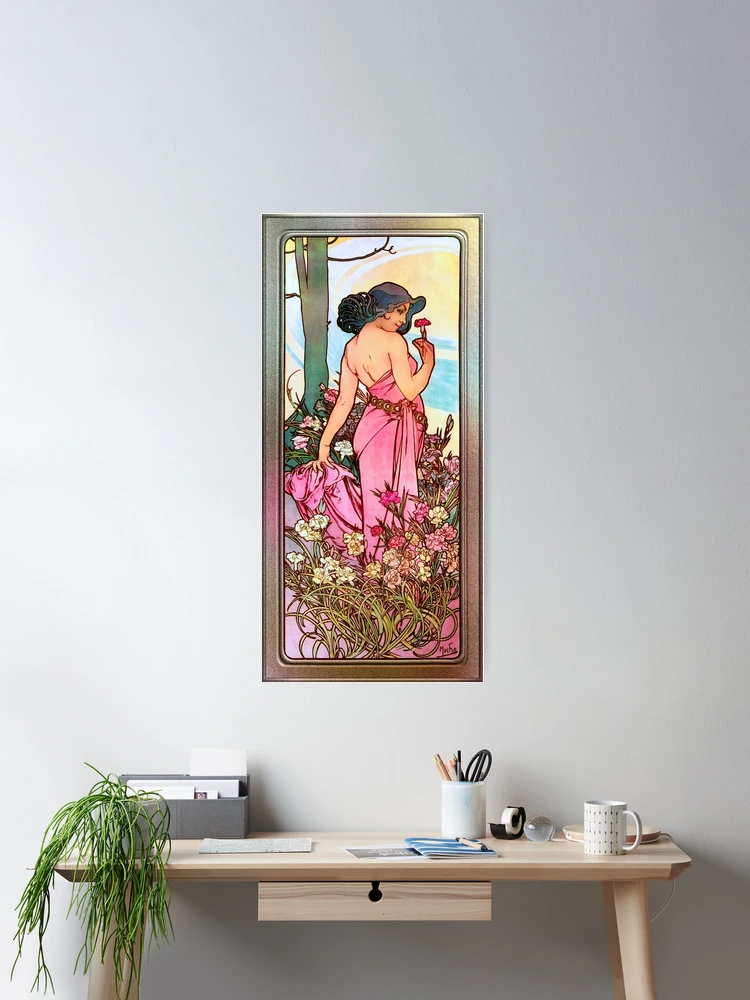
В “Гвоздика Портрет в стиле модерн,” создано в 1898 чешского художника Альфонс Муха (1860 – 1939), олицетворяет неземную элегантность и декоративное мастерство стиля модерн.. На этой работе изображена молодая женщина, одетая в струящиеся розовые одежды, среди яркого сада цветущих гвоздик и другой флоры., выполнено с деликатными, но тщательно продуманными деталями. Композиция Мухи, основан на его фирменном стиле гармоничных криволинейных форм и мягких оттенков., отражает романтическую идеализацию женской фигуры, переплетенной с природой..
Оглавление
Тема и состав
В основе произведения – изящная женская фигура, изображенная в трехчетвертный профиль., turning slightly to reveal her serene yet enigmatic expression. Her flowing dark hair, styled with soft waves, frames her face and cascades down her back, усиливая ее потустороннюю красоту. She holds a single carnation delicately in one hand, bringing the viewer’s attention to her gentle interaction with nature. Her body is enveloped in a loosely draped pink gown, cinched at the waist with a decorative belt adorned with intricate circular patterns. This belt, a signature of Mucha’s ornamental style, adds an element of detail and luxury to the composition.
The woman’s pose exudes confidence and grace, her bare back and slightly raised head suggestive of a subtle sensuality that aligns with the Art Nouveau aesthetic. Her demeanor is both introspective and inviting, evoking a timeless allure that transcends the ordinary. Естественный поток ее одежды и ее интеграция в окружающие ботанические элементы еще больше делают ее символом единения с природой..
Цветочные мотивы и антураж
Передний и задний план картины богаты цветущими гвоздиками., которые доминируют в композиции благодаря своим замысловатым деталям и ярким цветам.. От мягких желтых и белых до более насыщенных розовых и красных оттенков., гвоздики тщательно прорисованы, их многослойные лепестки придают картине текстурную глубину.. Среди гвоздик перемежаются тонкие зеленые стебли и листья, которые поднимаются и изящно изгибаются., повторяя извилистые линии, характерные для стиля модерн..
На заднем фоне, Муха сочетает в себе абстрактные стволы деревьев и стилизованные ветви, обрамляющие фигуру., creating a subtle architectural framework that guides the viewer’s gaze. The pastel-hued sky, with its gentle swirls of blue and gold, forms an ethereal backdrop, adding a sense of tranquility and timelessness to the scene. The soft interplay of light and color imbues the painting with a dreamlike quality, enhancing its romantic and poetic atmosphere.
Художественный стиль и методы
Mucha’s Art Nouveau style is unmistakable in this piece, characterized by its intricate ornamentation, flowing organic forms, and harmonious balance between figure and background. The painting’s composition is meticulously structured, yet it conveys an effortless naturalism that reflects Mucha’s mastery of integrating decorative and figurative elements. His use of curvilinear lines is evident in every aspect of the work, from the contours of the woman’s form to the undulating stems and petals of the flowers.
The color palette is a study in subtlety and sophistication. Mucha employs soft pastels, punctuated by deeper shades of pink and green, to create a sense of harmony and visual coherence. The interplay of light and shadow is delicate, adding depth and dimension to the composition without disrupting its overall unity. This restrained approach to color and shading underscores Mucha’s focus on the decorative and symbolic aspects of the artwork.
Тема и настроение
В “Гвоздика Портрет в стиле модерн” embodies the quintessential themes of the Art Nouveau movement: the celebration of nature, the idealization of the feminine form, and the synthesis of beauty and functionality. The woman at the center of the composition serves as both a muse and a metaphor, representing the harmony and vitality of the natural world. Her connection with the surrounding flora suggests a sense of unity and continuity, reflecting the movement’s reverence for organic forms and their intrinsic beauty.
The mood of the artwork is one of serenity and contemplation. The woman’s calm demeanor and the gentle interplay of colors and forms create an atmosphere of peace and introspection. В то же время, the intricate details and dynamic lines lend the piece an underlying energy, drawing the viewer into its richly textured world.
Материалы и исполнение
While the specific medium of this piece is not mentioned, Mucha’s work during this period often involved a combination of traditional painting techniques and lithography, a process he mastered to create his famous posters and decorative panels. The precise and meticulous detailing of the flowers and the figure’s garments suggests the use of fine brushes and a careful layering of pigment. Mucha’s ability to seamlessly blend figuration and ornamentation is evident in the painting’s flawless execution and balanced composition.
Наследие и культурное значение
As one of the foremost artists of the Art Nouveau movement, Mucha’s works have come to define an era of artistic innovation and beauty. В “Гвоздика Портрет в стиле модерн” exemplifies his talent for capturing the essence of the feminine ideal and intertwining it with nature’s splendor. Этот кусок, like much of his oeuvre, serves as a testament to the enduring appeal of Art Nouveau and its emphasis on harmony, элегантность, and the celebration of life.
Through its exquisite craftsmanship and timeless aesthetic, в “Гвоздика Портрет в стиле модерн” continues to captivate viewers, inviting them to revel in its beauty and explore the intricate relationship between art, природа, and the human spirit.
Carnation Art Nouveau Portrait is a retouched digital art old masters reproduction of a public domain image.
Художник биография от Wikipedia.org
Альфонс Мария Муха июль 24, 1860 – июль 14, 1939), был известен во всем мире как Альфонс Муха. Он был выдающимся чешским художником., иллюстратор и график, жить в Париже в период модерна, и наиболее известен своими отчетливо стилизованными и декоративными театральными афишами., особенно те из Сары Бернар.
Он подготовил иллюстрации, реклама, декоративные панели, и дизайн, которые стали одними из самых известных изображений периода.
Во второй части карьеры, в возрасте 43, он вернулся на свою родину в регион Богемия-Моравия в Австрии и посвятил себя написанию серии из двадцати монументальных полотен, известных как «Славянский эпос»., изображающий историю всех славянских народов мира, который он нарисовал между 1912 и 1926.
В 1928, к 10-летию независимости Чехословакии, он представил сериал чешскому народу. Он считал это своей самой важной работой. Сейчас он выставлен в Праге..