

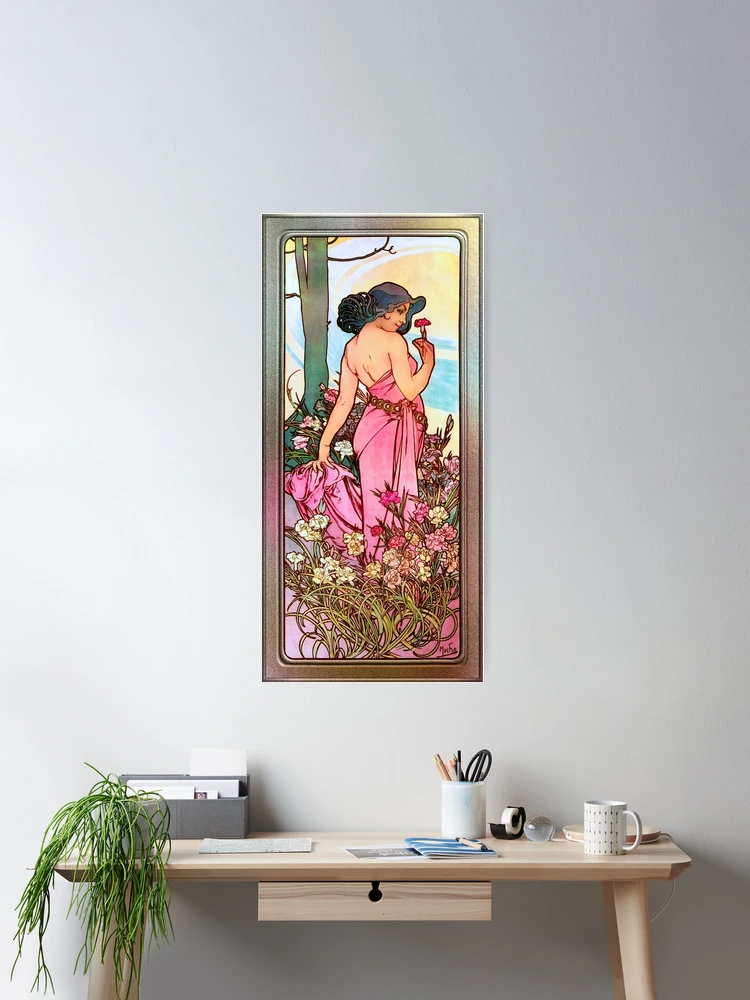
De “Carnation Art Nouveau Portrait,” skapad i 1898 by the Czech artist Alphonse Mucha (1860 – 1939), exemplifies the ethereal elegance and decorative artistry of the Art Nouveau movement. This work features a young woman draped in flowing pink garments amidst a vibrant garden of blooming carnations and other flora, rendered with delicate yet elaborate detail. Mucha’s composition, rooted in his hallmark style of harmonious curvilinear forms and soft hues, reflects the romantic idealization of the feminine figure intertwined with nature.
Innehållsförteckning
Ämne och komposition
At the heart of the artwork is a graceful female figure depicted in three-quarter profile, turning slightly to reveal her serene yet enigmatic expression. Her flowing dark hair, styled with soft waves, frames her face and cascades down her back, enhancing her otherworldly beauty. She holds a single carnation delicately in one hand, bringing the viewer’s attention to her gentle interaction with nature. Her body is enveloped in a loosely draped pink gown, cinched at the waist with a decorative belt adorned with intricate circular patterns. This belt, a signature of Mucha’s ornamental style, adds an element of detail and luxury to the composition.
The woman’s pose exudes confidence and grace, her bare back and slightly raised head suggestive of a subtle sensuality that aligns with the Art Nouveau aesthetic. Her demeanor is both introspective and inviting, evoking a timeless allure that transcends the ordinary. The natural flow of her garments and their integration into the surrounding botanical elements further establish her as a symbol of unity with nature.
Floral Motifs and Surroundings
The foreground and background of the artwork are rich with blooming carnations, which dominate the composition with their intricate details and vibrant colors. Ranging from soft yellows and whites to deeper pinks and reds, the carnations are meticulously rendered, their layered petals contributing to the painting’s textural depth. Interspersed among the carnations are slender green stems and leaves that rise and curve gracefully, echoing the sinuous lines characteristic of the Art Nouveau style.
I bakgrunden, Mucha incorporates abstracted tree trunks and stylized branches that frame the figure, creating a subtle architectural framework that guides the viewer’s gaze. The pastel-hued sky, with its gentle swirls of blue and gold, forms an ethereal backdrop, adding a sense of tranquility and timelessness to the scene. The soft interplay of light and color imbues the painting with a dreamlike quality, enhancing its romantic and poetic atmosphere.
Konstnärlig stil och tekniker
Mucha’s Art Nouveau style is unmistakable in this piece, characterized by its intricate ornamentation, flowing organic forms, and harmonious balance between figure and background. The painting’s composition is meticulously structured, yet it conveys an effortless naturalism that reflects Mucha’s mastery of integrating decorative and figurative elements. His use of curvilinear lines is evident in every aspect of the work, from the contours of the woman’s form to the undulating stems and petals of the flowers.
The color palette is a study in subtlety and sophistication. Mucha employs soft pastels, punctuated by deeper shades of pink and green, to create a sense of harmony and visual coherence. The interplay of light and shadow is delicate, adding depth and dimension to the composition without disrupting its overall unity. This restrained approach to color and shading underscores Mucha’s focus on the decorative and symbolic aspects of the artwork.
Tema och humör
De “Carnation Art Nouveau Portrait” embodies the quintessential themes of the Art Nouveau movement: the celebration of nature, the idealization of the feminine form, and the synthesis of beauty and functionality. The woman at the center of the composition serves as both a muse and a metaphor, representing the harmony and vitality of the natural world. Her connection with the surrounding flora suggests a sense of unity and continuity, reflecting the movement’s reverence for organic forms and their intrinsic beauty.
The mood of the artwork is one of serenity and contemplation. The woman’s calm demeanor and the gentle interplay of colors and forms create an atmosphere of peace and introspection. Samtidigt, the intricate details and dynamic lines lend the piece an underlying energy, drawing the viewer into its richly textured world.
Material och utförande
While the specific medium of this piece is not mentioned, Mucha’s work during this period often involved a combination of traditional painting techniques and lithography, a process he mastered to create his famous posters and decorative panels. The precise and meticulous detailing of the flowers and the figure’s garments suggests the use of fine brushes and a careful layering of pigment. Mucha’s ability to seamlessly blend figuration and ornamentation is evident in the painting’s flawless execution and balanced composition.
Legacy and Cultural Significance
As one of the foremost artists of the Art Nouveau movement, Mucha’s works have come to define an era of artistic innovation and beauty. De “Carnation Art Nouveau Portrait” exemplifies his talent for capturing the essence of the feminine ideal and intertwining it with nature’s splendor. Det här stycket, like much of his oeuvre, serves as a testament to the enduring appeal of Art Nouveau and its emphasis on harmony, elegans, and the celebration of life.
Through its exquisite craftsmanship and timeless aesthetic, de “Carnation Art Nouveau Portrait” continues to captivate viewers, inviting them to revel in its beauty and explore the intricate relationship between art, natur, and the human spirit.
Carnation Art Nouveau Portrait är en retuscherad digital konst gammal mästare reproduktion av en offentlig egendom.
Artist Bio från Wikipedia.org
Alfons Maria Mucha juli 24, 1860 – Juli 14, 1939), var internationellt känd som Alphonse Mucha. Han var en framstående tjeckisk målare, illustratör och grafiker, bor i Paris under jugendperioden, och är mest känd för sina tydligt stiliserade och dekorativa teateraffischer, särskilt Sarah Bernhardts.
Han tog fram illustrationer, reklam, dekorativa paneler, och design, som blev bland de mest kända bilderna under perioden.
I den andra delen av karriären, vid en ålder av 43, han återvände till sitt hemland i regionen Böhmen-Moravia i Österrike och ägnade sig åt att måla en serie av tjugo monumentala dukar som kallas The Slav Epic, skildrar historien om alla slaviska folk i världen, som han målade mellan 1912 och 1926.
I 1928, på 10 -årsdagen av Tjeckoslovakiens självständighet, han presenterade serien för den tjeckiska nationen. Han ansåg det vara sitt viktigaste arbete. Det visas nu i Prag.