

Magazine Photoplay de Carole Lombard
Carole Lombard Photoplay Magazine June Edition by the renowned American illustrator F. Comte Christy (1882 – 1961) showcases the golden age of Hollywood and the glamour of early 20th-century cinema. Christy, a celebrated figure in the art world known for his vibrant, dynamic magazine covers and promotional illustrations, was instrumental in capturing the allure of film stars of his era. Cette pièce particulière, featured on the cover of Photoplay magazine, is a vibrant portrayal of actress Carole Lombard, one of the most beloved actresses of the time, exuding both grace and seduction through Christy’s masterful brushwork.
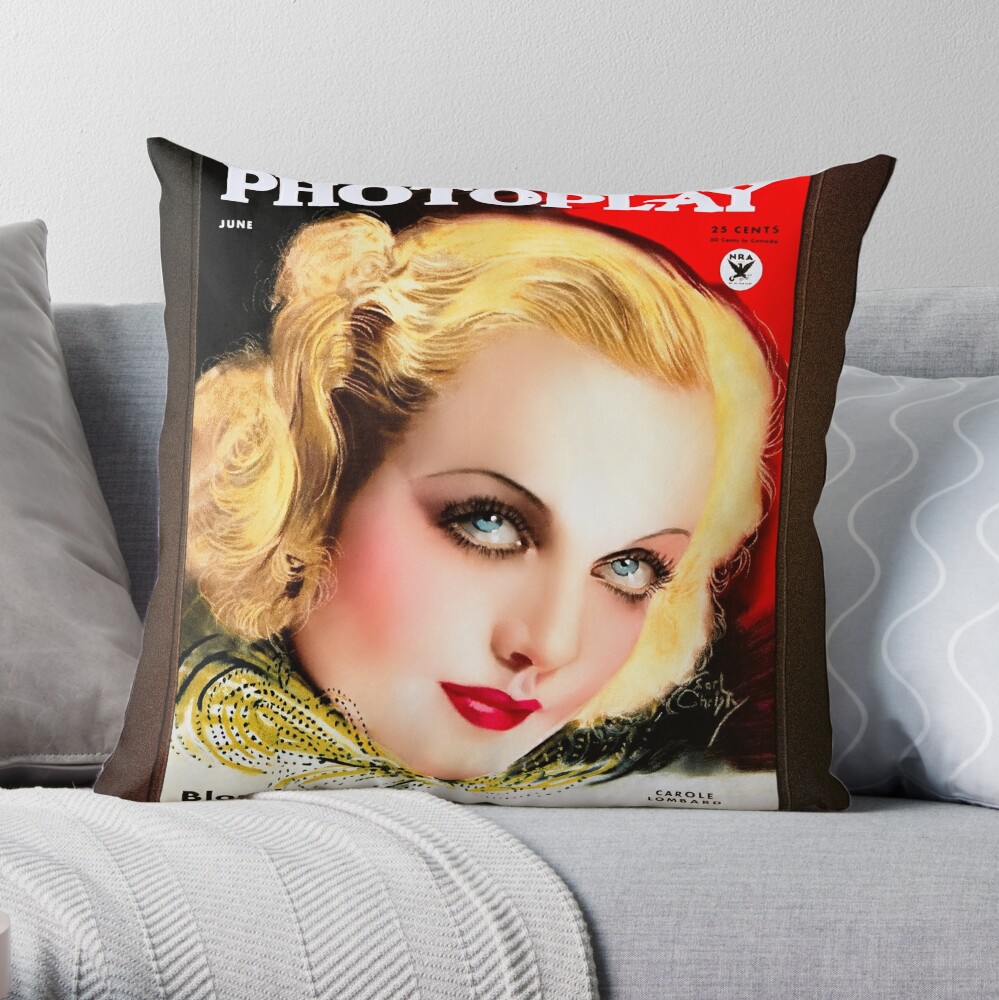
Table des matières
Le sujet principal
Cette œuvre d'art, is a close-up portrait of Carole Lombard, painted in such vivid detail that her facial features appear to come alive. Lombard is depicted in a glamorous, slightly exaggerated manner, her platinum blonde hair styled in soft curls that frame her face, while her eyes gaze directly at the viewer, creating a compelling, almost ethereal connection. Ses lèvres, painted in a bold, crimson hue, stand out against the pale complexion, adding an air of sophistication and elegance. The emphasis on her beautiful face and expressive eyes suggests an attempt to capture not just her physical features but her captivating screen presence.
Style, Technique, et moyen
F. Earl Christy’s technique in this artwork is quintessentially Art Deco, with its fluid lines, bold color contrasts, et composition dynamique. The style was popular in the early 20th century, en particulier dans les illustrations qui accompagnaient les magazines de cinéma, où le glamour et la beauté idéalisée étaient au centre. Christy a utilisé du soft, lignes fluides dans les cheveux et le visage de Lombard, contrastant avec les plus audacieux, motifs géométriques en arrière-plan. La palette de couleurs est riche, avec des nuances de rouge profond, or, et jaune, créant un contraste saisissant entre le sujet et l'arrière-plan. Cela donne à l'œuvre une impression de mouvement et de profondeur., comme si Lombard elle-même sortait de la toile.
L'utilisation de la lumière et de l'ombre par Christy est particulièrement efficace pour ajouter de la dimension à la pièce.. La douce illumination du visage de Lombard fait ressortir la douceur, texture de porcelaine de sa peau, tandis que le plus sombre, les zones ombrées autour de ses yeux et sous ses pommettes confèrent au portrait une impression tridimensionnelle. Cette attention particulière portée à la lumière fait partie de la capacité de l’artiste à imprégner ses sujets d’une qualité réaliste., mettant l'accent sur la beauté du sujet de manière à donner au spectateur l'impression de plonger dans le monde du glamour hollywoodien des années 1930.
Objets et composition
La composition de la pièce est dominée par le visage de Carole Lombard, qui occupe la majorité de la toile. Derrière elle se trouve un audacieux, un vaste fond de rouge ardent qui complète les tons de ses cheveux et de ses lèvres. Le contraste du rouge vif sur le pâle, la peau presque albâtre du Lombard crée un effet visuel puissant. Autour de son visage se trouve une zone sombre qui met en valeur les boucles blondes platine de ses cheveux., further intensifying the contrast and drawing the viewer’s eye to her captivating eyes and lips.
The magazine’s name, Photoplay, is prominently displayed at the top of the image in large, blanche, blocky letters. The typography is clean and sharp, typical of magazine covers during this time period, contributing to the retro, vintage feel of the illustration. The subtitle “Blondes Plus Curves Mean War” underneath the magazine title adds intrigue and emphasizes the playful, slightly provocative nature of the era’s media, which often sensationalized the allure and power of Hollywood starlets.
Another noteworthy feature is the inclusion of Christy’s signature at the bottom right corner of the image. This subtle yet important detail highlights the personal touch of the artist, reminding the viewer that this illustration is not merely an advertisement, but a carefully crafted work of art.
Thème et humeur
The theme of the artwork revolves around the glamorization of Hollywood stars, capturing the essence of the film industry during its heyday. Christy’s illustration reflects the prevailing attitude of the time toward actresses, who were often portrayed as larger-than-life figures, incarnant à la fois la beauté et la force. The theme of femininity, beauté, and allure is amplified by the title, which suggests that the combination of blondes and curves is a powerful force—perhaps even dangerous or capable of inciting conflict. This was a time when Hollywood and its stars were idolized, and Christy captured that idolization perfectly in his portrayal of Lombard.
The mood of the piece is one of sophisticated allure. Lombard’s direct gaze and confident posture convey both strength and sensuality, making the viewer feel as though they are witnessing a moment of cinematic magic. Les riches, vibrant colors and the bold use of shadow contribute to an intense, almost mysterious mood, while the luxurious portrayal of Lombard herself evokes glamour and exclusivity.
Dans son intégralité, the image conveys a sense of romanticized beauty that was central to the golden age of Hollywood cinema. Christy’s portrayal of Carole Lombard does more than capture her appearance—it immortalizes her as a symbol of grace, pouvoir, and allure that resonates beyond the screen.
Conclusion
Dans Carole Lombard Photoplay Magazine June Edition, F. Earl Christy created a timeless piece of artwork that not only celebrates the actress’s captivating beauty but also encapsulates the mood of Hollywood in the 1930s. Through his distinctive Art Deco style, Christy has brought Lombard to life, capturing the essence of a film star whose image dominated the silver screen. The illustration serves as a powerful reminder of a bygone era when magazine covers were works of art in themselves, designed to captivate and entertain audiences.
Background Info On The Magazine Cover
This June Edition of Photoplay Magazine features the Hollywood Starlet Carole Lombard (one of her best comedy roles was in My Man Godfrey with Dick Powell) of the Golden Age of Hollywood.
Her portrait is surrounded by a swirling combo of fiery red and black that transitions to stripes of violet on the lower right.
Her golden blonde hair is beautifully accented by this color combination, that brings out her blue-grey eyes and fiery red lips.
Below her chin is a flow of yellow gold loops with black solid and dotted lines that create bow type look; and on the side of her hair is the signature of the artist.
Below that on a white background to the right is the actress name and off to the left the words Blondes Plus Curves Mean War.
The magazine at the top on the right above her hair, but below the cost of the publication has the NRA Eagle Symbol.
The NRA or National Recovery Administration, was a prime agency created by this Nations Greatest President Franklin D. Roosevelt (FDR 1882 – 1945) dans 1933 (The only president to be elected four times to the White House).
The goal of the administration was to eliminate “cut throat competition” by bringing industry, labor, and government together to create codes of “fair practices” and set prices. Ref NRA
Il s'agit d'une reproduction de maîtres anciens d'art numérique remasterisée d'une image du domaine public qui est disponible en tant que impression sur toile.
Biographie de l'artiste dérivée de Askart.com
Christy est née en 1882 crême Philadelphia, Pennsylvanie; et en 1899 à l'âge avancé de 17 peignait des œuvres d'art originales pour la société Boardwalk Atlantic City Picture.
Beaucoup de ses premières œuvres ont également été publiées par le J. Hoover and Sons Calendar Company de Philadelphie; quand il était 23 ans, il a fréquenté la Pennsylvania Academy of Arts de 1905 à 1907.
Au cours de sa carrière, Christy a créé des dizaines de couvertures de magazines, illustrations et calendriers imprimés pour des publications telles que Dell Publishing Company, Stars modernes de l'écran et de la radio, Le magazine d'Ainslee, Magazine américain, L'hebdomadaire illustré de Leslie, Le magazine Photoplay de McClure, et plein d'autres.