

Время чата
“Время чата” Американский художник Гил Элвгрен (1914 – 1980)
“Время чата,” created by American artist Gil Elvgren, exemplifies the timeless allure of mid-century pin-up art, capturing the essence of playful flirtation, элегантность, and carefree sensuality. Гил Элвгрен, known for his masterful portrayals of women in soft, inviting poses, crafted works that showcased idealized beauty and the feminine form. Родился в 1914 и проходя внутрь 1980, Elvgren’s artistic style is steeped in realism and rich with narrative, often focusing on women in domestic, досуг, or comical situations. “Время чата” не исключение, illustrating a quintessential moment of feminine allure and charm.
Оглавление
Основной предмет и настроение
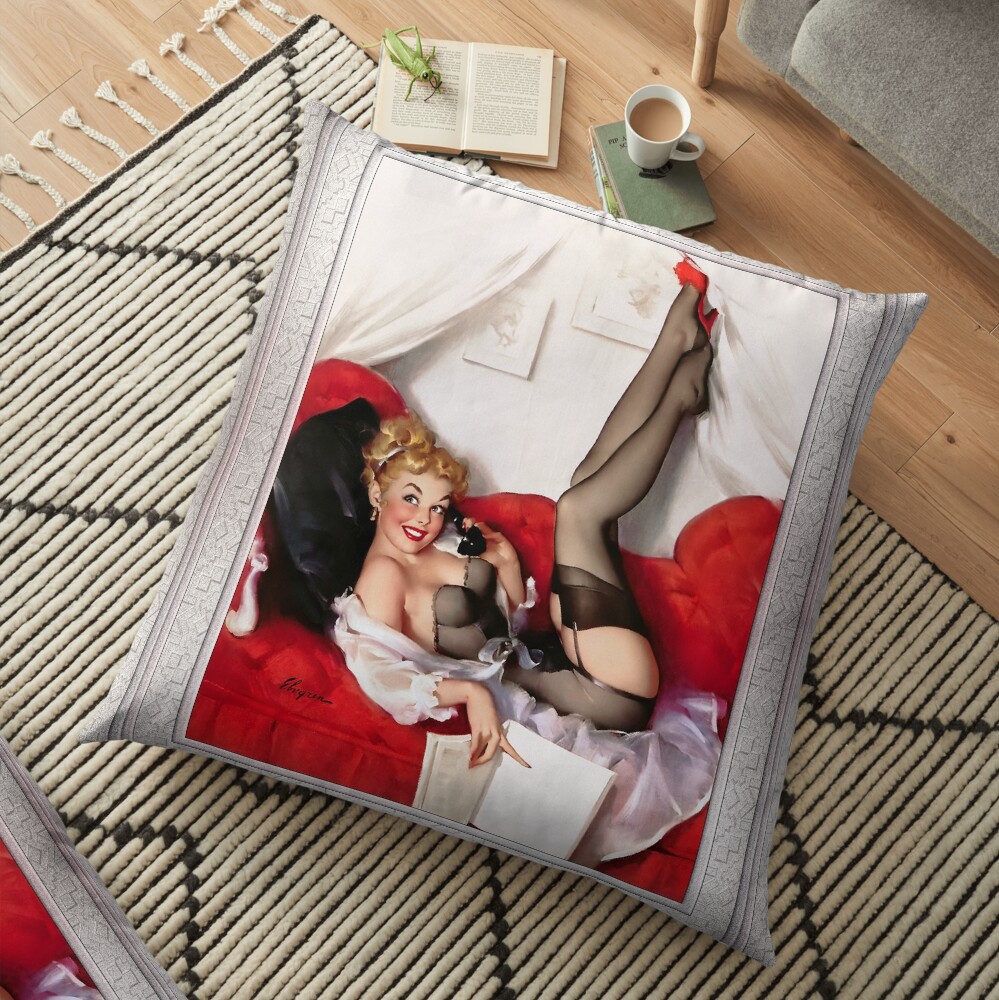
The central subject of the painting is a smiling woman in the midst of a telephone conversation. She is reclining comfortably on a plush red couch, her legs elegantly propped up in the air, drawing attention to her gartered stockings and high heels. The model’s playful posture, with one hand holding a vintage telephone receiver and the other draped over a white book, creates a sense of ease and casual confidence. Выражение лица женщины, a beaming smile and a glint in her eyes, conveys a feeling of joyful anticipation and engagement in her conversation, adding an intimate, personal touch to the scene.
The mood of the painting exudes lightheartedness, очарование, and flirtation. The relaxed position of the woman, her easy smile, and the inviting quality of the painting reflect a moment of indulgent leisure, an escape from the pressures of the day. It’s an intimate glimpse into a personal moment, with the viewer invited to observe without interruption. Мягкий, glowing lighting further enhances this mood, highlighting the subject’s beauty and the relaxed environment surrounding her.
Composition and Materials
Elvgren’s composition in “Время чата” is carefully designed to guide the viewer’s eye through the scene, balancing the subject with the surrounding elements. The deep red of the couch provides a striking contrast against the soft, neutral tones of the background, which is composed of light cream walls and minimal decorative elements. This serves to center attention on the woman while keeping the focus intimate and personal. The use of a minimalist setting emphasizes the subject’s beauty and the moment she is captured in.
The rich textures of the materials, from the velvet-like softness of the red couch to the delicate sheen of the woman’s sheer lingerie, add a tactile dimension to the artwork. The folds of fabric in her attire suggest a luxurious comfort, while the delicate details of the stockings and high heels reinforce the feminine, elegant mood of the painting. These carefully chosen textures bring a realism to the scene that makes it seem alive, almost as though the woman could step out of the frame at any moment.
Стиль и техника
“Время чата” is rendered in the traditional pin-up style, with Elvgren’s characteristic attention to detail in both the human form and the surrounding environment. The artist’s technique employs soft brushwork, creating a smooth finish that enhances the realistic appearance of the subject, while also imparting a dreamlike quality to the scene. Elvgren’s use of light and shadow is masterful, casting gentle highlights on the woman’s face and form to emphasize her youthful, radiant beauty, while soft shadows lend depth and dimension to her figure.
The painter’s skill in capturing the female form is evident in the precise rendering of the woman’s curves and the naturalistic portrayal of her pose. Her limbs are subtly accentuated through gentle highlights and shading, emphasizing the sensuality of her body without overt sexualization. This balance of form and function is a signature trait of Elvgren’s work, where the appeal lies in the suggestion of femininity rather than explicit exposure.
Objects and Setting
The surrounding objects in “Время чата” are integral to the overall composition and mood of the piece. The plush red couch serves as the focal point of the scene, its rich color creating a striking contrast to the light tones of the woman’s attire and the room’s background. The telephone, an essential prop in the painting, symbolizes communication and connection, adding an element of intimacy and interaction to the scene. The presence of a white book resting in the woman’s hand suggests a casual, comfortable moment, where she might have been reading before being interrupted by the phone call.
The setting itself is sparse, with only the bare essentials of a private room, yet it creates a sense of belonging and warmth. The soft white curtains, flowing gently behind the woman, provide a light, airy backdrop that complements her delicate features. The minimalism of the room draws the viewer’s attention entirely to the subject, enhancing the intimate nature of the painting.
Thematic Significance
По своей сути, “Время чата” plays with themes of femininity, domesticity, and casual allure. Субъект, seemingly caught in a moment of playful leisure, is portrayed as both elegant and approachable. She occupies a space between social propriety and flirtation, with her posture suggesting a balance between modesty and openness. This is characteristic of many of Elvgren’s works, where the depiction of women often focuses on their charm, уверенность, and beauty in everyday situations.
The telephone, a symbol of communication and connection, subtly implies the notion of private conversation and closeness, hinting at the idea that the woman is involved in a personal or intimate exchange. This adds a layer of narrative to the scene, where the viewer is invited to imagine the nature of the conversation, adding depth to the otherwise simple moment.
Заключение
В “Время чата,” Gil Elvgren delivers a moment frozen in time, capturing the beauty, элегантность, and charm of a woman enjoying a lighthearted conversation. The painting reflects the sensibilities of the mid-20th century, blending innocence with flirtation in a way that resonates even today. Through his detailed portrayal of the subject, настройка, и взаимодействие света и тени, Elvgren invites viewers to experience a world of beauty and charm, where each curve, цвет, and gesture tells a story of youthful allure and timeless elegance.
Это обновленная цифровая репродукция старых мастеров изображения, являющегося общественным достоянием, которое доступно в качестве Все эти ремастерированные изображения старых мастеров цифрового искусства, являющиеся общественным достоянием, доступны как.
Биография художника получена из Wikipedia.org
Gillette A. Эльвгрен родился в г.. Павел, Миннесота, и учился в средней школе университета. После выпуска, он начал изучать искусство в Институте искусств Миннеаполиса.
Позже он переехал в Чикаго, чтобы учиться в Американской академии искусств., и окончил Академию во время Великой депрессии, в возрасте двадцати двух лет.
После окончания учебы Элвгрен присоединился к конюшне художников Stevens and Gross., Самое престижное рекламное агентство Чикаго, и стал протеже художника Хэддона Сундблома.
В 1937, Гил начал рисовать пин-ап календаря для Louis F.. Доу, одна из ведущих издательских компаний Америки, за это время он создал около 60 Девушка в стиле пин-ап работает на холсте 22 ″ × 28 ″ и выделяет их печатной подписью..
Многие из его картинок в стиле пин-ап были воспроизведены как носовые рисунки на военных самолетах во время Второй мировой войны.; и это было примерно в это время в 1944, что к Эльвгрену обратилась издательская компания Brown and Bigelow Publishing Company; фирма, которая до сих пор доминирует в области производства календарей, рекламные специальности и рекламные товары.
В следующем году от 1945 до 1972, Эльвгрен был связан с Брауном & Издательская компания Bigelow, и начал работать с 24 дюйм мимо 30 дюймовые полотна, формат, который он будет использовать для следующего 30 годы, и подписал свою работу курсивом.
Эльвгрен имел коммерческий успех. Он жил в разных местах, и был активен с 1930-х по 1970-е гг.. В 1951 он начал рисовать в мастерской у себя дома, потом в виннетке, Иллинойс, с помощью помощника настроить освещение, строить реквизит и сцены, наборы фотографий, и приготовить его краски.
Среди его клиентов были такие известные компании, как Brown и Bigelow., Кока-Кола, General Electric и Sealy Mattress Company, назвать несколько. Кроме того, в 1940-х и 1950-х годах он иллюстрировал рассказы для множества журналов., например, The Saturday Evening Post и Good Housekeeping.
Среди моделей и голливудских легенд, которых Элвгрен рисовал за свою карьеру, была Мирна Хансен., Донна Рид, Барбара Хейл, Арлин Даль, Лола Олбрайт и Ким Новак.