

Chester – Korset tittar mot Watergate Street
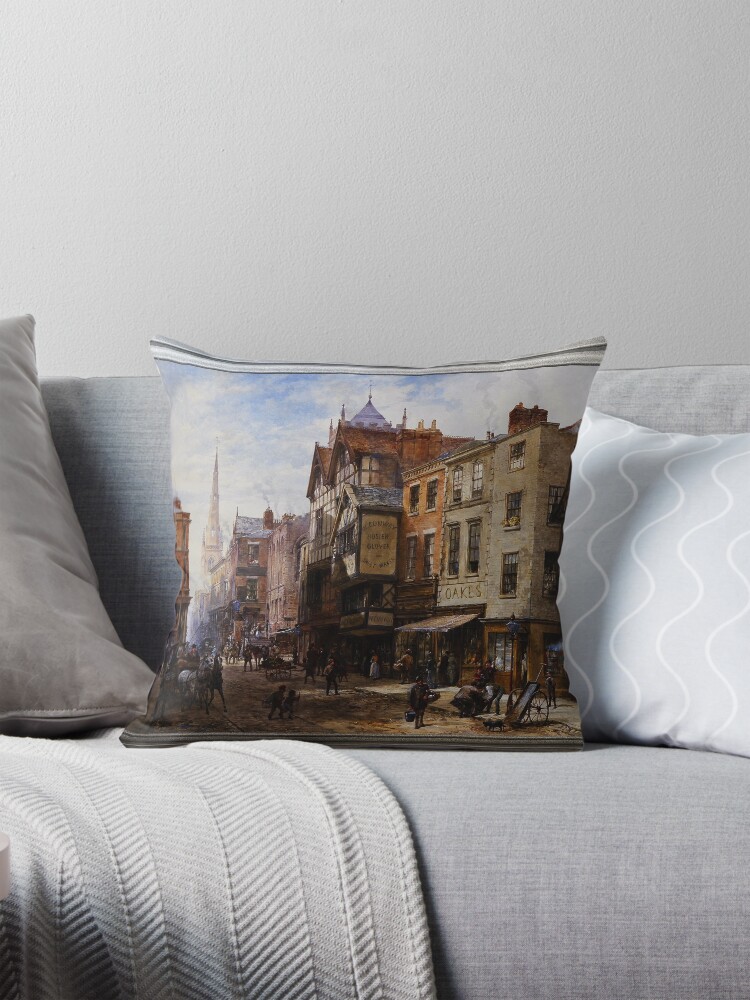
Louise Ingram Rayner (1832 – 1924), a celebrated British watercolor artist, produced the piece titled “Chester – The Cross looking towards Watergate Street” sometime between 1886 och 1903. In this stunning work, Rayner captures a bustling, detailed view of a historic street scene in Chester, a city in the northwest of England known for its Roman heritage and medieval architecture. Målningen, filled with delicate watercolors and meticulous attention to detail, reflects the artist’s mastery of capturing architectural and genrescener, which was central to her artistic career.
Innehållsförteckning
Huvudämne: Det urbana landskapet
The focal point of the painting is the view of Watergate Street as seen from The Cross, a famous junction in Chester. The scene is rich in visual information, portraying the intersection between urban life and the architectural beauty of a city steeped in history. I förgrunden, the street is busy with pedestrians, street vendors, and horse-drawn carts. This lively depiction of everyday life reflects the vibrancy of Chester during the late 19th century. The street is narrow, with buildings on either side appearing close together, towering over the crowd below.
The buildings in the painting represent a mix of traditional English architecture, with some half-timbered structures characteristic of medieval times, while others show the influence of Georgian and Victorian design. The facades are detailed, with ornate windows and signs hanging outside the shops, providing a glimpse into the commercial life of Chester during this period. One sign reads “OAKES” and another displays “COTTON HOUSE” which suggests that Chester, as a growing industrial city, had a thriving retail trade.
Terräng: Cobbled Streets and Atmospheric Elements
The cobbled streets of Chester are an essential feature of this watercolor painting. The uneven, worn surface is clearly visible in the foreground, adding a layer of realism to the artwork. The artist’s skillful use of light and shadow emphasizes the texture of the cobblestones, suggesting the time of day. The soft illumination of the buildings and streets hints at the late afternoon, when the sunlight gently bathes the scene in warm tones, lending the artwork a peaceful, nostalgic ambiance.
The skyline is punctuated by the spire of the church in the distance, towering above the rooftops. This spire likely represents one of the many historic churches of Chester, and it adds an element of verticality to the otherwise horizontal composition. Byggnaderna, with their haphazard, yet charming arrangement, lead the viewer’s eye down the street towards the distant horizon, where the viewer is left to imagine what lies beyond. The placement of the spire also serves to balance the composition, guiding the viewer’s attention away from the busy foreground toward the tranquil sky above.
Material och tekniker: Watercolor Mastery
Rayner’s skill with watercolor is evident in the way she captures the interplay of light and shadow, along with the texture of the buildings, the cobblestones, and the atmosphere. The use of delicate brushstrokes in the sky creates a soft, almost ethereal quality to the distant horizon, while the buildings themselves are painted with careful precision, capturing the intricacies of their design. The artist’s understanding of light is showcased in the way she portrays the natural environment—the dapples of sunlight creating patches of warmth on the buildings while the shadows stretch across the street. The attention to detail in the figures of the people adds depth to the painting, without overpowering the primary focus on the architectural features.
The buildings are depicted with such care that one can easily identify architectural elements such as the beams of the half-timbered houses, the intricate stonework of the churches, and the ornate window frames. Rayner’s brushwork conveys not only the form of these structures but also their weathered, lived-in quality, reinforcing the timeless feel of the piece. The careful layering of transparent pigments creates the illusion of depth, allowing the light to pass through the layers of paint, producing a luminous effect. This technique brings the scene to life, allowing it to resonate with the viewer.
Humör och tema: Nostalgia and Timelessness
Stämningen av “Chester – The Cross looking towards Watergate Street” is one of nostalgia. The scene captures a moment frozen in time, inviting the viewer to step into the past and experience the everyday life of Chester during the late 19th century. The bustling street, with its mix of shoppers, pedestrians, and horse-drawn carts, evokes a sense of community and simplicity. There is a sense of harmony between the people and their environment. The old-world charm of the city is palpable in Rayner’s careful portrayal of the historical architecture and the quiet, steady flow of life.
Samtidigt, the painting invites reflection on the passage of time. The figures in the painting are rendered in muted colors, contrasting with the brighter tones of the buildings. This suggests the transient nature of human life against the backdrop of the more permanent cityscape. Byggnaderna, seemingly untouched by time, stand as silent witnesses to the generations that have passed, adding to the melancholic yet serene mood of the scene.
Rayner’s work can be seen as a celebration of the beauty found in the everyday, with a focus on urban life in a historic setting. The busy street scene, with its blend of people, djur, and commerce, captures the essence of a time when cities were growing and changing, yet still deeply connected to their history. The piece also reflects a theme of preservation, as the artist’s careful rendering of the architectural details ensures that the charm of Chester’s old streets is immortalized for future generations to appreciate.
Slutsats
“Chester – The Cross looking towards Watergate Street c1886/1903” by Louise Ingram Rayner is a masterful representation of Chester’s urban landscape during the late 19th century. The painting conveys both the vibrancy of the street life and the timeless beauty of the city’s historic architecture. Through her use of watercolor, Rayner captures the intricate details of the buildings and the natural environment, creating a scene that is both realistic and evocative. The mood of nostalgia permeates the painting, inviting the viewer to pause and reflect on a moment from the past that remains forever preserved in this exquisite piece of art.
Artist Bio härledd från Wikipedia.org
Louise kom från en familj av målare. Hennes far Samuel Rayner (1806 – 1879) var en landskapsmålare och hennes mamma Ann Rayner (född Manser) var en gravör på Ashford Black Marble.
Louise hade fyra syskon; tre systrar och en bror som också var konstnär; och vid femton års ålder tog konstlektioner från sin far och senare från familjekonstnärsvänner som inkluderade George Cattermole, Edmund Niemann, David Roberts och Frank Stone.
I 1852 vid en ålder av 20, hon ställde ut sin första oljemålning som var av en serie oljefärger med titeln The Interior of Haddon Chapel, som visades på Royal Academy; dock från 1860 framåt bytte hon sitt medium från oljor till akvarell och ställde ut sina konstverk för nästa 50 år på Society of Lady Artists, Kungliga Akademien, Royal Watercolor Society och Royal Society of British Artists; för att nämna några.
Louise reste mycket under somrarna 1870- och 1880-talen, målning mycket detaljerad och pittoresk, Brittiska scener som av de befolkade gatorna i städer och städer under den blomstrande viktorianska perioden.