

At vælge sin mand
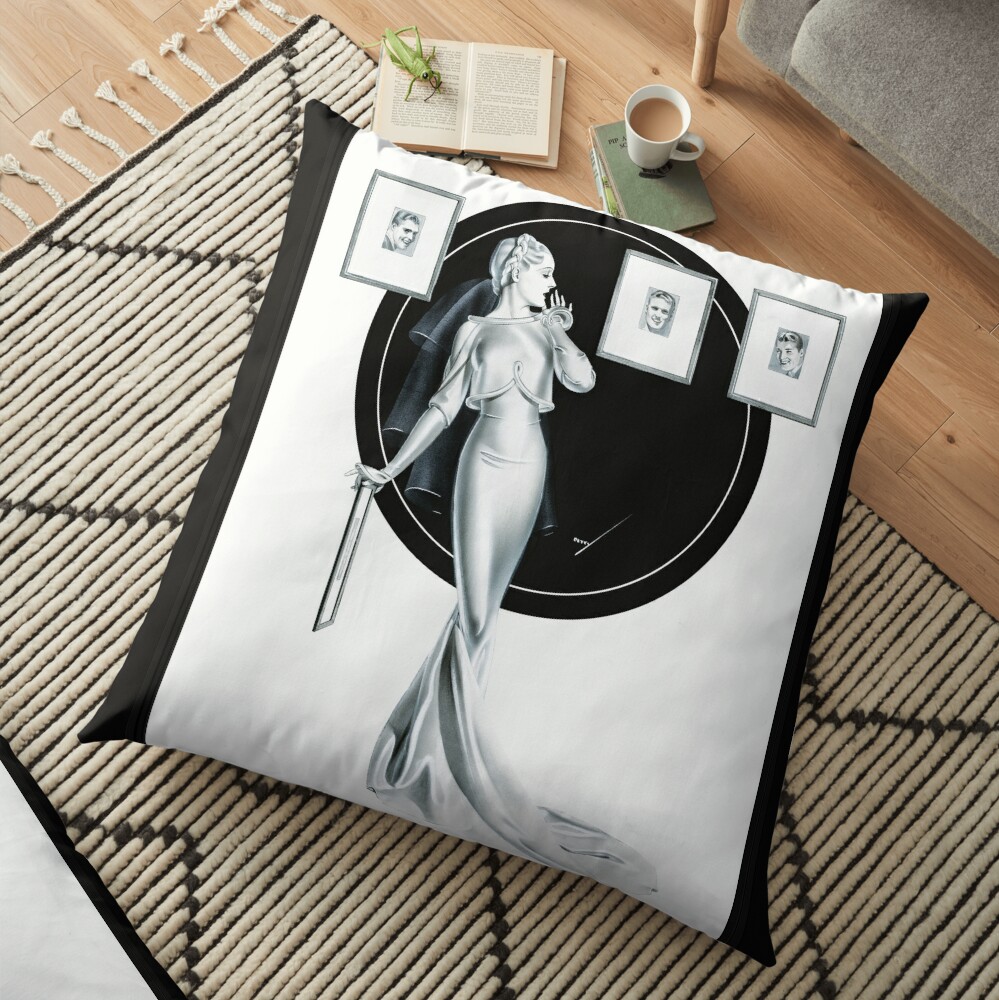
At vælge sin mand, ca. 1936-37, af den amerikanske maler George Brown Petty IV (1894 – 1975)
“At vælge sin mand,” skabt af amerikansk kunstner George Brown Petty IV i årene 1936-37, præsenterer en spændende udforskning af femininitet og romantisk udvalg i en stiliseret, næsten surrealistisk måde. Kendt for sine pin-up illustrationer og kommerciel kunst, Pettys arbejde lægger ofte vægt på skønhed og idealiserede former, med fokus på den menneskelige figur og dens skildring i omhyggeligt opbyggede scener. Dette særlige stykke, gennemsyret af sin tids glamour og visuelle æstetik, giver et overbevisende indblik i den raffinerede og sensuelle atmosfære fra den sene Art Deco-periode.
Indholdsfortegnelse
Hovedemne og komposition
Omdrejningspunktet for dette kunstværk er en elegant, klar kvinde, her figure rendered with stunning precision and an almost ethereal quality. She stands tall, elegantly composed, in a long, flowing silver gown that contours to her body with impeccable grace. Kjolen, designed in a sleek and smooth manner, highlights her poised, confident stature. The model’s hands are delicately placed in a subtle gesture, with one hand gently touching her lips as if in deep contemplation. This pose suggests a moment of hesitation, possibly symbolizing the process of making an important decision — in this case, the act of “choosing her man.”
She is framed by a strong geometric design, with the circular black backdrop drawing the viewer’s attention inward, accentuating the woman’s figure and emphasizing her position as the center of the narrative. Over hende, tre mindre indrammede fotografier hænger på væggen, skildrer mandlige portrætter. Ansigterne i disse rammer er subtilt stemningsfulde, deres udtryk svagt tegnede og næsten mystiske. Disse mænd tjener som de potentielle bejlere, subtilt placeret i kompositionen for at give en fortælling til kvindens beslutningsproces. Portrætterne står som symbolske repræsentationer af de valg, der venter hende, deres subtile, men alligevel tydelige tilstedeværelse, tilføjer et lag af psykologisk dybde til billedet.
Tematiske og symbolske elementer
Temaet for stykket kredser om ideen om valg og romantisk udvælgelse. Sammenstillingen af kvindefiguren med de indrammede portrætter af mænd bringer opmærksomheden på den følelsesmæssige og intellektuelle proces med at vælge en partner. The model’s contemplative expression suggests internal conflict or thoughtful consideration, presenting the choice as not merely superficial but a deeper, more thoughtful evaluation of each individual. The stark contrast between the bold circular form in the background and the fragile elegance of the woman’s figure speaks to the tension between the decisiveness of the choice and the gentleness of femininity. The work suggests that the decision is not made lightly, but with both elegance and purpose.
The long, flowing gown worn by the woman may be seen as a metaphor for the ideal of grace, skønhed, and sophistication — qualities often associated with the feminine ideal of the time. The silver hue of the gown, almost metallic in its shine, connects with the era’s Art Deco aesthetics, where modernity and luxury were often symbolized through such materials. The use of smooth, fluid lines in the gown also contrasts with the hard-edged geometric forms that surround the central figure, emphasizing a harmony between femininity and structure.
Stil og humør
“At vælge sin mand” is undeniably rooted in the Art Deco style, which dominated the visual arts from the 1920s through the 1940s. The precision, symmetry, and elegance of the design align with the aesthetic ideals of the movement, characterized by sleek lines, dristige farver, and a fascination with modernity and glamour. Petty’s careful use of black and white, with the occasional silver detail, further reinforces the refined mood of the piece, while the absence of color gives the work a timeless quality. This minimalist approach places emphasis on form and contrast, where the woman’s figure remains the central element amidst the stark background and the framed images.
The mood of the artwork is both contemplative and alluring, with the woman’s expression evoking a sense of quiet introspection. The decision she is facing, represented by the three portraits of men, seems both important and personal. There is a sense of suspense and anticipation, as if the viewer is witnessing a moment of pivotal emotional weight. The stark contrast between the woman’s soft, flowing form and the sharp, geometric lines of the background creates a subtle tension, symbolizing the inner conflict between the emotional and the rational aspects of making a decision.
Objekter, Terræn, og materialer
The physical elements in the piece, such as the woman’s gown, the photograph frames, and the background circle, are all presented with careful precision. The photographs, although not overtly detailed, are intricately framed and placed in such a way as to reinforce the theme of choice and evaluation. They are small and unobtrusive, yet they play an essential role in creating the story within the artwork. The frames themselves are finely detailed, contributing to the luxurious and polished aesthetic of the composition.
The terrain or setting of the piece is minimalistic — an abstracted interior space that prioritizes the visual impact of the figures and forms over the realism of a traditional setting. The lack of other physical details suggests that the scene is more about the emotional and intellectual climate of the moment rather than a depiction of a specific, physical location.
Petty’s use of materials is also noteworthy. The monochromatic color scheme, punctuated only by the metallic sheen of the woman’s gown, adds a sense of high-class sophistication. The style and treatment of the image resemble the polished look of commercial art and fashion illustrations of the era, designed to appeal to the upper-class sensibilities of the time.
Konklusion
“At vælge sin mand” by George Brown Petty IV (c. 1936-37) is a striking piece that embodies the elegance and sophistication of the Art Deco era. Through the careful portrayal of a woman poised in the act of selecting a partner, Petty examines the intersection of femininity, choice, og lokke. The artwork speaks to the emotional complexity of romantic decision-making while showcasing the artist’s mastery of form, sammensætning, and thematic depth. Med sin præcise udførelse og tankevækkende symbolik, “At vælge sin mand” forbliver en kraftfuld afspejling af sin tid og en tidløs kommentar til den delikate udvælgelsesproces i hjertesager.
Dette er en remasteret digital kunst, gamle mestre reproduktion af et offentligt domæne billede, der er tilgængeligt som et lærredstryk online.
Kunstner Bio
Info nedenfor stammer fra Wikipedia.org
George Petty kom første gang til offentlighedens opmærksomhed i løbet af gymnasietiden, hvor han var personalekunstner for skoleavisen.
Mens han gik i gymnasiet, meldte George sig til natundervisning på Chicago Academy of Fine Arts under ledelse af Ruth VanSickle Ford.
Mens han var på akademiet, underviste George sit eget tegnekursus, opkræver sine klassekammerater fem dollars pr. session; samt arbejde i sin fars fotobutik, hvor han lærte evnen til at bruge en airbrush.
Senere tog George til Paris og studerede på Académie Julian hos Jean-Paul Laurens og andre indtil 1916, da 1. Verdenskrig brød ud, hvilket fik ambassadør Myron T. Herrick, at beordre alle amerikanere til at forlade Paris og vende tilbage til USA.
Efter hjemkomsten til USA, George arbejdede som en airbrush -retoucher hos et lokalt trykkeri i Chicago; senere etablerede sig som freelancekunstner, male kalenderpiger og magasinomslag til The Household; og af 1926 han havde åbnet sit eget studie.
George er især kendt for Petty Girl-serien af pin-up pigemalerier, han lavede for Esquire Publications, fra efteråret 1933 igennem 1956.
George skildrede ofte sine pin-up-piger med relativt lange ben, og relativt mindre hoveder end hans faktiske modeller.
Hans arbejde optrådte primært i Esquire og Fawcett Publications – Sand også kendt som Sand, Mandens Blad; men var også i kalendere, der blev markedsført af Esquire, True og Ridgid Tool Company i North Ridgeville Ohio, som blev grundlagt i 1923.