

Choisir son homme
Choisir son homme, c.1936-37, par le peintre américain George Brown Petty IV (1894 – 1975)
“Choisir son homme,” créé par un artiste américain George Brown Petit IV in the years 1936-37, presents an intriguing exploration of femininity and romantic selection in a stylized, almost surreal manner. Known for his pin-up illustrations and commercial art, Petty’s work often emphasizes beauty and idealized forms, focusing on the human figure and its portrayal within carefully constructed scenes. Cette pièce particulière, steeped in the glamour and visual aesthetics of its era, offers a compelling glimpse into the refined and sensual atmosphere of the late Art Deco period.
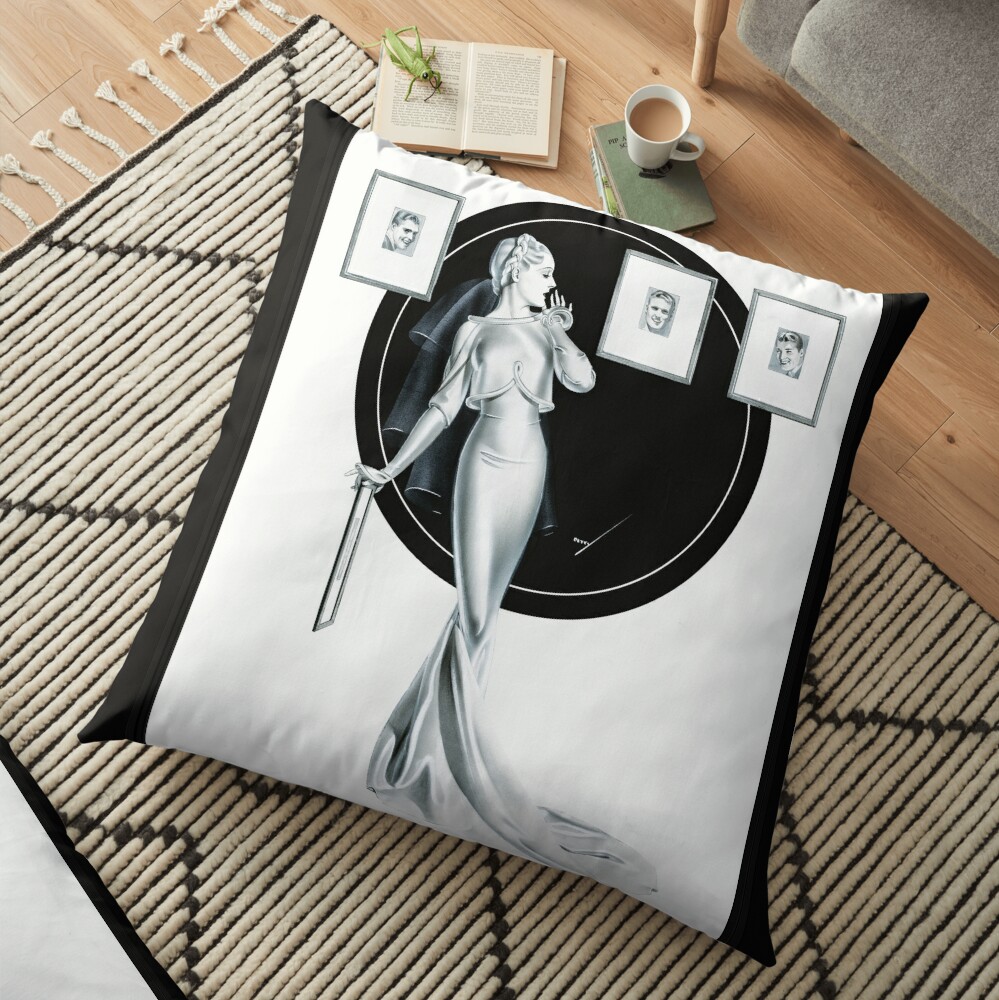
Table des matières
Sujet principal et composition
The focal point of this artwork is an elegant, poised woman, her figure rendered with stunning precision and an almost ethereal quality. She stands tall, elegantly composed, in a long, flowing silver gown that contours to her body with impeccable grace. La robe, designed in a sleek and smooth manner, highlights her poised, confident stature. The model’s hands are delicately placed in a subtle gesture, with one hand gently touching her lips as if in deep contemplation. This pose suggests a moment of hesitation, possibly symbolizing the process of making an important decision — in this case, the act of “choosing her man.”
She is framed by a strong geometric design, with the circular black backdrop drawing the viewer’s attention inward, accentuating the woman’s figure and emphasizing her position as the center of the narrative. Au-dessus d'elle, three smaller framed photographs hang on the wall, depicting male portraits. The faces in these frames are subtly evocative, their expressions faintly drawn and almost mysterious. These men serve as the potential suitors, subtly placed within the composition to give a narrative to the woman’s decision-making process. The portraits stand as symbolic representations of the choices that await her, their subtle yet distinct presence adding a layer of psychological depth to the image.
Thematic and Symbolic Elements
The theme of the piece revolves around the idea of choice and romantic selection. The juxtaposition of the female figure with the framed portraits of men brings attention to the emotional and intellectual process of selecting a partner. The model’s contemplative expression suggests internal conflict or thoughtful consideration, presenting the choice as not merely superficial but a deeper, more thoughtful evaluation of each individual. The stark contrast between the bold circular form in the background and the fragile elegance of the woman’s figure speaks to the tension between the decisiveness of the choice and the gentleness of femininity. The work suggests that the decision is not made lightly, but with both elegance and purpose.
Le long, flowing gown worn by the woman may be seen as a metaphor for the ideal of grace, beauté, and sophistication — qualities often associated with the feminine ideal of the time. The silver hue of the gown, almost metallic in its shine, connects with the era’s Art Deco aesthetics, where modernity and luxury were often symbolized through such materials. L'utilisation de lisse, fluid lines in the gown also contrasts with the hard-edged geometric forms that surround the central figure, emphasizing a harmony between femininity and structure.
Style et humeur
“Choisir son homme” is undeniably rooted in the Art Deco style, which dominated the visual arts from the 1920s through the 1940s. The precision, symétrie, and elegance of the design align with the aesthetic ideals of the movement, characterized by sleek lines, couleurs vives, and a fascination with modernity and glamour. Petty’s careful use of black and white, with the occasional silver detail, further reinforces the refined mood of the piece, while the absence of color gives the work a timeless quality. This minimalist approach places emphasis on form and contrast, where the woman’s figure remains the central element amidst the stark background and the framed images.
L'ambiance de l'œuvre d'art est à la fois contemplative et séduisante, avec l’expression de la femme évoquant un sentiment d’introspection tranquille. La décision à laquelle elle est confrontée, représenté par les trois portraits d'hommes, semble à la fois important et personnel. Il y a un sentiment de suspense et d'anticipation, comme si le spectateur était témoin d'un moment de poids émotionnel crucial. Le contraste saisissant entre la douceur de la femme, forme fluide et nette, les lignes géométriques du fond créent une tension subtile, symbolisant le conflit intérieur entre les aspects émotionnels et rationnels de la prise de décision.
Objets, Terrain, et matériaux
Les éléments physiques de la pièce, comme la robe de la femme, les cadres photo, et le cercle de fond, sont tous présentés avec une précision minutieuse. Les photographies, bien que pas ouvertement détaillé, sont finement structurés et placés de manière à renforcer le thème du choix et de l’évaluation.. Ils sont petits et discrets, pourtant, ils jouent un rôle essentiel dans la création de l’histoire au sein de l’œuvre d’art.. Les cadres eux-mêmes sont finement détaillés, contribuant à l'esthétique luxueuse et raffinée de la composition.
Le terrain ou le décor de l'œuvre est minimaliste : un espace intérieur abstrait qui donne la priorité à l'impact visuel des figures et des formes plutôt qu'au réalisme d'un décor traditionnel.. L'absence d'autres détails physiques suggère que la scène concerne davantage le climat émotionnel et intellectuel du moment plutôt que la représentation d'un personnage spécifique., emplacement physique.
L’utilisation des matériaux par Petty est également remarquable. La palette de couleurs monochromes, punctuated only by the metallic sheen of the woman’s gown, adds a sense of high-class sophistication. The style and treatment of the image resemble the polished look of commercial art and fashion illustrations of the era, designed to appeal to the upper-class sensibilities of the time.
Conclusion
“Choisir son homme” by George Brown Petty IV (c. 1936-37) is a striking piece that embodies the elegance and sophistication of the Art Deco era. Through the careful portrayal of a woman poised in the act of selecting a partner, Petty examines the intersection of femininity, choix, Et Allure. The artwork speaks to the emotional complexity of romantic decision-making while showcasing the artist’s mastery of form, composition, et profondeur thématique. With its precise execution and thoughtful symbolism, “Choisir son homme” remains a powerful reflection of its time and a timeless commentary on the delicate process of selection in matters of the heart.
Il s'agit d'une reproduction de maîtres anciens d'art numérique remasterisée d'une image du domaine public qui est disponible sous forme d'impression sur toile en ligne.
Biographie de l'artiste
Informations ci-dessous dérivées de Wikipedia.org
George Petty's a attiré l'attention du public pour la première fois pendant ses années de lycée, où il était l'artiste du personnel pour le journal de l'école.
Pendant ses études secondaires, George s'est inscrit à des cours du soir à la Chicago Academy of Fine Arts sous la tutelle de Ruth VanSickle Ford.
À l'académie, George a enseigné son propre cours de dessin, faire payer ses camarades de classe cinq dollars par session; ainsi que de travailler dans le magasin de photographie de son père où il a appris à utiliser un aérographe.
Plus tard, George est allé à Paris et a étudié à l'Académie Julian avec Jean-Paul Laurens et d'autres jusqu'à 1916, quand la Première Guerre mondiale a éclaté, qui a causé l'ambassadeur Myron T. Herrick, ordonner à tous les Américains de quitter Paris et de retourner aux États-Unis.
Après son retour aux États-Unis, George a travaillé comme retoucheur à l'aérographe dans une imprimerie locale à Chicago; s'établissant plus tard en tant qu'artiste indépendant, calendrier de peinture pour filles et couvertures de magazines pour The Household; et par 1926 il avait ouvert son propre studio.
George est particulièrement connu pour la série Petty Girl de peintures de pin-up qu'il a réalisées pour Esquire Publications, de l'automne de 1933 par 1956.
George a souvent représenté ses pin-up avec des jambes relativement longues, et des têtes relativement plus petites que celles de ses modèles actuels.
Son travail est principalement apparu dans Esquire et Fawcett Publications – Vrai aussi connu sous le nom de Vrai, Le magazine de l'homme; mais était aussi dans les calendriers commercialisés par Esquire, True et la Ridgid Tool Company de North Ridgeville Ohio, qui a été fondée en 1923.