

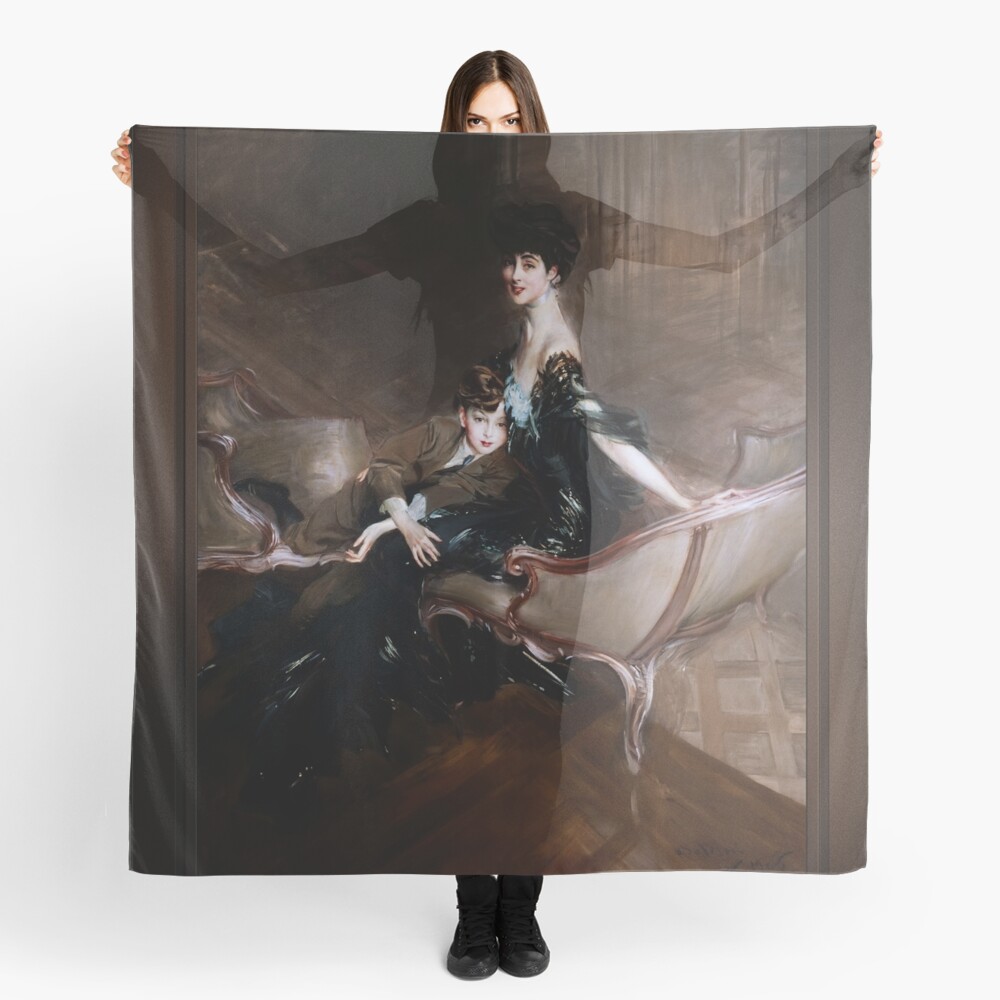
Consuelo Vanderbilt c1906
A pintura “Consuelo Vanderbilt c1906” by the renowned Italian painter Giovanni Boldini (1842 – 1931) offers a striking glimpse into the world of opulence, graça, and aristocratic culture at the turn of the 20th century. Neste retrato, Boldini captures the elegance and poise of Consuelo Vanderbilt (1876 -1964), Duchess of Marlborough, and Her Son, Lord Ivor Spencer-Churchill (1898 – 1956), an American heiress who was one of the most admired figures of her time.
Esta obra-prima, criado em torno 1906, exemplifies the sophisticated charm and dynamism of the Belle Époque period, an era that was characterized by prosperity, beleza, and refined social circles. The portrait exudes a sense of timeless glamour, blending traditional portraiture with the modern techniques of the time, establishing Boldini as a master of his craft.
Índice
Assunto Principal e Composição
The focal point of the painting is Consuelo Vanderbilt herself, portrayed seated gracefully on a chaise longue. She is elegantly dressed in a black gown that shimmers with opulence, its billowing fabric almost flowing out of the canvas. The texture of the fabric is expertly rendered, capturing the luxurious quality of the material. Boldini’s use of broad, fluid brushstrokes lends the gown a sense of movement, as if the dress is caught in a moment of motion. The contrast between the soft, o tecido preto fluido e os detalhes nítidos da expressão serena e equilibrada de Consuelo criam um equilíbrio impressionante entre formalidade e vivacidade.
A postura de Vanderbilt é de confiança relaxada, exalando uma compostura aristocrática. Sua postura, com um braço colocado delicadamente nas costas da chaise longue, contribui para o comportamento geral elegante. Na pintura, ela é vista olhando ligeiramente para o lado, um sorriso gentil enfeitando seus lábios, sugerindo um ar de mistério e introspecção silenciosa. Seu cabelo escuro, varrido em um updo intrincado, emoldura seu rosto delicadamente, enquanto os brincos de diamante pendurados em suas orelhas brilham com elegância discreta.
Ao lado de Consuelo, sentado um pouco mais perto dela, é o filho dela. A criança está vestida com um terno marrom, contrastando fortemente com a grandeza do traje de Vanderbilt. A expressão da criança parece um tanto pensativa, com uma postura relaxada que espelha a graça da mulher. Esta inclusão da criança adiciona uma camada de profundidade narrativa, simbolizando a continuação do legado de Vanderbilt e talvez sugerindo as relações familiares que muitas vezes eram centrais para a dinâmica social da época.
The Surrounding Environment and Objects
O fundo do retrato é levemente desfocado, representação quase abstrata de um interior luxuoso. Os ricos tons marrons e a luz nebulosa sugerem um ambiente quente, atmosfera luxuosa. A falta de detalhes específicos em segundo plano, onde a figura da chaise longue se funde com o ambiente indefinido, direciona o foco do espectador inteiramente para as figuras de Consuelo e seu filho. Esta técnica exemplifica a habilidade de Boldini em enfatizar os assuntos humanos enquanto cria uma sensação de profundidade e sofisticação na composição geral..
A chaise longue em si é uma peça de mobiliário elegante, estofado em macio, tons silenciados, que complementa a paleta de cores de toda a pintura. É curvo, linhas amplas são emblemáticas dos estilos de móveis populares no final do século 19 e início do século 20, enfatizando um estilo de vida luxuoso. A superfície suavemente reflexiva da madeira polida da cadeira adiciona um leve brilho, chamando a atenção do espectador. No entanto, a mobília não prejudica as figuras no centro do retrato; em vez de, serve para enquadrá-los no cenário de um grande, casa aristocrática.
Estilo, Técnica, e humor
O estilo de Boldini é imediatamente reconhecível pela sua fluidez, vitality, e movimento. He was known for his masterful brushwork and ability to convey motion and life through the manipulation of light and shadow. Neste retrato, the brushstrokes are dynamic and expressive, creating a sense of immediacy and energy. While the detailed areas, such as the face and hands of Consuelo, show the artist’s attention to realism, the flowing gown and background elements are treated with a freer, almost impressionistic technique.
The mood of the portrait is one of serene sophistication. Consuelo’s relaxed yet poised demeanor, combinado com o suave, inviting tones of the painting, conveys a sense of calm confidence and timeless beauty. The portrait does not try to overemphasize any particular emotion, but rather captures the subject at a moment of tranquility, possibly reflecting her position in society as a woman of great wealth and influence. The inclusion of the child suggests that the figure of the mother is one of both personal and familial importance, further enhancing the aristocratic atmosphere of the scene.
Boldini’s work is also marked by his ability to integrate the subject into the environment, making the background and surroundings essential to the narrative of the portrait. The slightly abstract treatment of the background allows the viewer to focus more on the subject while still giving the impression of a luxurious setting. The interplay between the formal portrait style and the more dynamic brushwork is characteristic of Boldini’s approach, making this work a powerful example of the Italian painter’s legacy.
The Legacy of Giovanni Boldini
Giovanni Boldini foi um pintor italiano que passou grande parte de sua carreira em Paris, onde ficou conhecido por seus retratos da alta sociedade. Seus súditos eram frequentemente indivíduos ricos e influentes, muito parecido com Consuelo Vanderbilt, que foi uma figura proeminente na aristocracia americana e europeia. Os retratos de Boldini são conhecidos por sua fluidez graciosa, técnica requintada, e ênfase na elegância e requinte. Ele capturou o espírito de sua época com uma sensação de movimento e drama, tornando-o um dos retratistas mais célebres do final do século 19 e início do século 20.
“Consuelo Vanderbilt c1906” é um excelente exemplo da capacidade de Boldini de fundir o realismo com uma abstração quase pictórica. Através de suas pinceladas vibrantes e contrastes tonais sutis, he immortalized his subject not only as an individual but also as a reflection of the social and cultural environment in which she lived. The portrait remains a testament to the grandeur of the Belle Époque era, showcasing both the artist’s technical skill and his ability to capture the essence of his subjects.
Esta é uma reprodução remasterizada de arte digital de antigos mestres de uma imagem de domínio público que está disponível como um impressão em tela on-line.
Biografia do artista derivada de Wikipédia.org
Boldini was born in Ferrara, Italy on December 31, 1842, to the son of a painter of religious subject matter. Em 1862 com a idade de 20, he went to Florence for six years to study and pursue painting.
He only infrequently attended classes at the Academy of Fine Arts, but in Florence, met other realist painters known as the Macchiaioli, who were Italian precursors to Impressionism.
Their influence is seen in Boldini’s landscapes which show his spontaneous response to nature, although it is for his portraits that he became best known
Moving to London, Boldini attained success as a portraitist. He completed portraits of premier members of society including Lady Holland and the Duchess of Westminster.
Em 1872 he moved to Paris, where he met and became friends with Edgar Degas. During the late 19th century he became the most fashionable portrait painter in Paris, with a dashing style of painting that highlights some of the Macchiaioli influence and a brio reminiscent of the work of younger artists, such as John Singer Sargent and Paul Helleu.
Em 1889, he was nominated commissioner of the Italian section of the Paris Exposition, and received the Légion d’honneur for this appointment. Em 1897 he had a solo exhibition in New York City; and he also participated in the Venice Biennale in 1895, 1903, 1905, e 1912.