

Portrait of Contessa Ortensia Ianna Stella
Portrait of Contessa Ortensia Ianna Stella by Flemish Painter Jacob Ferdinand Voet (1639 – 1689); considered to be one of the most fashionable portrait painters of the late Baroque period.
This is a beautiful portrait of the Contessa in a seated pose, wearing a wreath of white and blue flowers on the back of her hair and wearing a gold colored off shoulder deep neck gown with pinned sleeves and a bouquet of red, white and pink flowers pinned to the center of her gown.
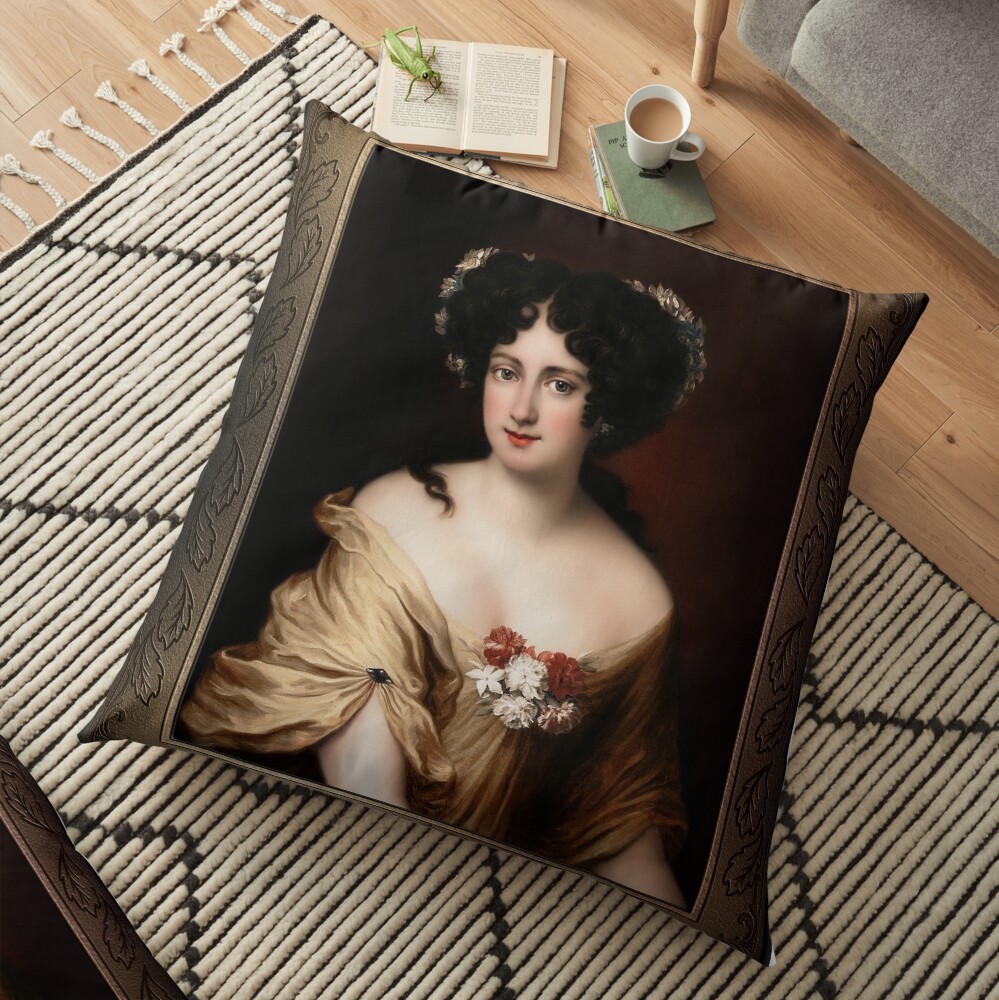
Es tracta d'una reproducció retocada d'art digital antic d'una imatge de domini públic que està disponible com a canvas art print online.
Utilitzeu aquest enllaç per comprar el Actius ornamentals used in the frame of this piece; el paquet inclou 400 elements d'ornaments bellament dissenyats.
Below Information Courtesy Wikipedia.org
Few details about Voet’s early life, training and career have been preserved. Voet was born in Antwerp as the son of the painter Elias Voet. He was one of the fifteen children; his older brother Carlo moved to Amsterdam and married in 1661 a daughter of the wealthy Joan Coymans and Sophia Trip. Jacob left his native Antwerp and travelled to Rome where he resided from 1663 a 1680.
Voet became a member of the Bentvueghels, an association of mainly Dutch and Flemish artists active in Rome. Voet drew a picture in charcoal of all the members of the Bentvueghels on the white-washed wall of an inn in Rome that was a popular meeting place of this group. The picture was treasured enough to be spared whenever the walls were repainted.
In Rome Voet’s skills as a portrait painter were much in demand at the Papal court and by the Roman aristocracy, including the prominent Colonna and Odescalchi families. He was patronised by Christina, Queen of Sweden, who was then resident in Rome. He painted her portrait as well as that of her friend, Cardinal Azzolino. Englishmen and other Europeans visiting Rome on their Grand Tour also commissioned portraits from Voet.
En 1671 – 1672 Voet received a commission from Cardinal Chigi to paint portraits of young woman who were prominent in Roman society. He created a first series of 37 portraits of the most enchanting women of Rome (‘Galleria delle Belle’) between 1672 i 1678 for Cardinal Chigi’s dining room in his palace in Ariccia (in the Alban hills outside Rome). He later copied and even enlarged the series for other Roman and Italian noble families. This started a rage for portraits of young women in Rome and abroad.