

Cressida
Introduction and Overview The andlitsmynd artwork “Cressida” by British painter Edward John Poynter (1836 – 1919), painted in the 19th century, showcases the artist’s expertise in capturing figures from classical mythology and Shakespearean drama with the refined techniques of the Academic tradition. This piece depicts the tragic figure of Cressida from Shakespeare’s Troilus and Cressida, a character whose beauty and emotional complexity have fascinated many artists. Poynter’s rendering of her, bathed in soft light and delicate hues, invites the viewer to step into a moment of quiet reflection, capturing her vulnerability and emotional depth. Málverkið, executed with precision and an almost photographic level of detail, draws upon classical themes, blending realism with allegory.
Efnisyfirlit
Aðalviðfangsefnið: Cressida
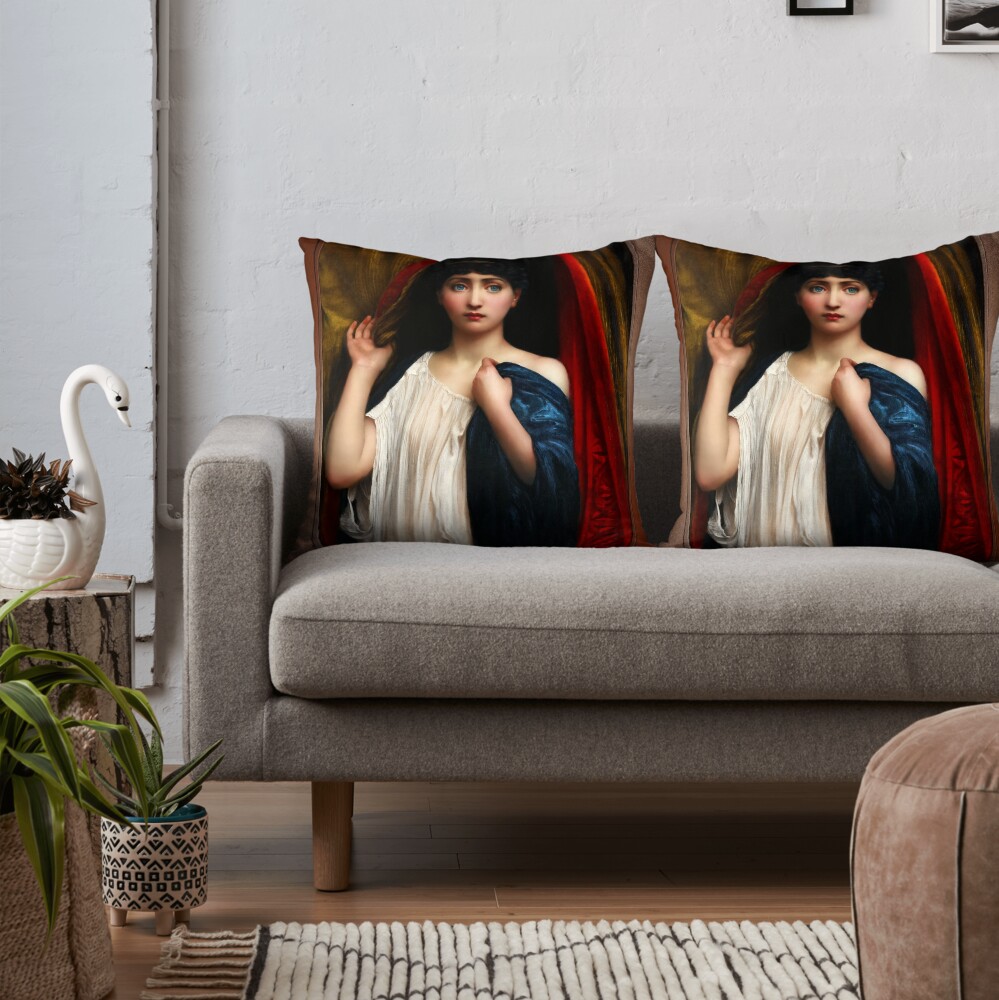
At the heart of the composition is Cressida herself, a young woman with deep blue eyes that seem to gaze directly into the viewer’s soul, evoking a sense of melancholy. Her expression is pensive, næstum sorglegt, hinting at her inner turmoil and the conflicted emotions she endures in the play. Cressida stands in a poised, graceful position, her figure draped in a delicate, white garment that clings to her form, suggesting both her vulnerability and her beauty. The fabric is meticulously painted, capturing every fold and texture with remarkable realism. Over her shoulder, a rich, deep blue cloak cascades down, adding a striking contrast to the pale tones of her attire.
Hægri hönd hennar snertir varlega efni skikkjunnar nálægt öxlinni, á meðan vinstri hönd hennar hvílir létt við fortjald af djúprauðum og gylltum litbrigðum. Þessi staðsetning handa hennar skapar ró, eins og hún sé bæði róleg og þó tilfinningalega föst í augnabliki einkaíhugunar. Lúxus efnin, silki og flauel, gegna mikilvægu hlutverki í að auka sjónrænan auð myndarinnar, eykur dýpt og tilfinningu fyrir glæsileika í atriðið. Athygli listamannsins á efninu og hvernig það hefur samskipti við mannlegt form sýnir vald hans á áferð og efni.
Bakgrunnur og umgjörð
Bakgrunnur málverksins er dökkur, dúkaðar gardínur í djúpum rauðum og gylltum litum, sem ramma inn myndefnið. Þessir ríku, warm colors not only enhance the figure of Cressida but also convey a sense of intimacy and drama, creating a stage-like setting that echoes the themes of the play. The drapery is rendered in a way that emphasizes both its weight and softness, almost suggesting the presence of a theatrical space. The choice of such vivid tones behind Cressida acts as a visual metaphor for the passionate and often tragic emotions that she experiences throughout the play.
Umgjörðin, although somewhat undefined beyond the drapery, contributes to the overall mood of the painting. The heavy, sumptuous fabrics suggest that Cressida exists within a world of aristocracy and courtly intrigue, a realm of opulence and moral complexity. This backdrop, þó einfalt, enhances the psychological depth of the scene, suggesting a private moment of introspection in an otherwise tumultuous world.
Tækni, Efni, og Stíll
Poynter’s approach to painting in “Cressida” reflects the precision and detail typical of the Academic style. His technique, often characterized by highly polished surfaces and an almost photographic attention to detail, is evident in every aspect of the piece. The meticulous rendering of textures, from the delicate sheen of Cressida’s garment to the soft, voluminous folds of her cloak, speaks to the artist’s deep understanding of materials and his ability to translate these onto canvas with remarkable fidelity.
The light in the painting is soft and diffused, highlighting the subject’s features in a naturalistic way. Poynter employs a careful balance between light and shadow, skapa tilfinningu fyrir þrívídd og dýpt sem dregur auga áhorfandans að andliti og líkamsstöðu myndefnisins. Notkun ljóss til að leggja áherslu á andlitseinkenni Cressida, sérstaklega augun hennar, eykur enn frekar tilfinningalegan hljómgrunn verksins, leyfa áhorfandanum að finna fyrir varnarleysi hennar og þunga tilfinningalegrar stöðu hennar.
Hvað varðar litatöflu, Val Poynters eru bæði háþróuð og vekjandi. Svalir tónar kjóla Cressida og andstæður hlýir litir bakgrunnsins skapa sjónræna sátt sem eykur tilfinningaleg áhrif málverksins. Notkun listamannsins á lifandi, mettaðir litir bæta stórkostlegum áhrifum, while the subtle transitions between light and dark convey the complex interplay of emotions that define Cressida’s character in Shakespeare’s play.
Þema og stemning
The overarching theme of the painting is one of emotional complexity and vulnerability. Poynter’s “Cressida” is not merely a portrait of a woman in an opulent setting; it is a study of a character caught between love, loyalty, and betrayal. Cressida’s eyes, wide and filled with an almost innocent sadness, reflect her inner conflict and emotional turmoil. Stilling hennar, composed yet delicate, suggests a woman who is in the midst of a private struggle, uncertain of her place in the world around her.
The mood of the painting is somber and reflective, underscored by the warm, dark tones of the background and the soft, diffused light that envelops Cressida. Tilfinningalega þungi tjáningar hennar, ásamt lúxusefnum í klæðnaði hennar, bendir til togstreitu á milli ytri fegurðar hennar og innri óróa sem hún stendur frammi fyrir. Þessi tvöfeldni er kjarninn í málverkinu, þar sem Poynter fangar ekki aðeins líkamlega fegurð myndefnis síns heldur einnig tilfinningalega dýptina sem liggur undir yfirborðinu.
Niðurstaða
“Cressida” eftir Edward John Poynter er meistaraleg lýsing á einni af flóknustu og hörmulegust kvenpersónum Shakespeares.. Fín litanotkun listamannsins, Ljós, og áferð skapar ríka sjónræna upplifun sem endurspeglar tilfinningalega dýpt myndefnisins. Málverkið þjónar ekki aðeins sem tæknilegt afrek heldur einnig sem könnun á ástandi mannsins, fanga augnablik sjálfsskoðunar og tilfinningalegrar varnarleysis. Í gegnum þetta verk, Poynter invites the viewer to engage with Cressida’s inner world, offering a poignant meditation on love, svik, and the complexities of the human heart.
Þetta er endurgerð stafræn list af gömlum meistara eftirgerð af mynd sem er í almenningseign sem er fáanleg sem strigaprentun á netinu.
Listamaður Bio fenginn frá Wikipedia.org
Edward was born in Paris, France to British Architect and founder of the Institute of British Architects (c1834) Ambrose Poynter (1796 – 1886) and Emma Forster (? – 1848); and soon after his birth his parents returned to Great Britain.
Edward went to Brighton College and the Ipswich school, but was forced to leave early due to poor health; which led him to spend his winters in Madeira, Portugal and in Rome, Ítalíu.
Þegar hann var 17 ára, while in Rome he met the British Painter Frederick Leighton, and that meeting made a significant impression on; such that when he returned to London he enrolled at the Leigh’s Academy, which was founded by James Mathews Leigh (1808 – 1860) og myndi að lokum verða Heatherley School of Fine Art í dag; og hann myndi einnig læra við Royal Academy Schools.
Þaðan fór hann til Parísar til að læra á vinnustofu svissneska klassíkarans Marc Gabriel Charles Gleyre (1806 – 1874).
Á ferli sínum gegndi Edward fjölda opinberra starfa þar á meðal Slade prófessor við University College London (1871 – 1875), skólastjóri Listaskólans (1875 – 1881) og forstöðumaður Listasafns Íslands (1894 – 1904); umsjón með opnun Tate Gallery.
Edward var þekktur sem málari stórra sögulegra málverka allan sinn feril, með verkum eins og Ísrael í Egyptalandi c1867, fylgt eftir af St George fyrir England c1869, sýnir heilagan Georg og drekann og náði kannski hámarki með heimsókn drottningarinnar af Saba til Salómons konungs c1884-90.