

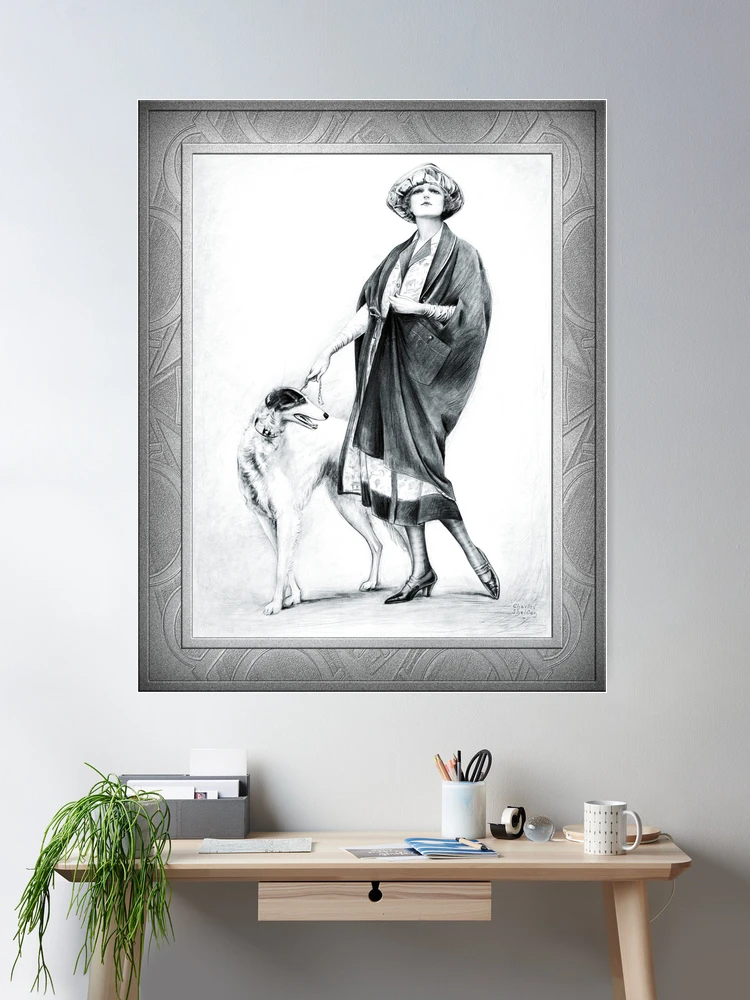
Damsel and Her Saluki
Listaverkið sem heitir Damsel and Her Saluki was created by Charles Gates Sheldon (1889 – 1961) inn 1920, a renowned American painter celebrated for his portrayals of women and animals. BSheldon became recognized for his skill in capturing the elegance and beauty of the human figure, particularly through portraits.
Damsel and Her Saluki exemplifies his mastery of delicate lines and the refinement of both his subjects and surroundings. The art nouveau scene showcases a poised, aristocratic woman alongside her saluki, a breed known for its grace and agility. Sheldon imbues this piece with a sense of both tranquility and a subtle power, creating an image that communicates the elegance of the early 20th century.
Efnisyfirlit
Aðalviðfangsefnið: The Damsel
At the center of the composition stands the damsel, a woman dressed in sophisticated attire that reflects the high-society fashion of the 1920s. She is posed with an air of self-assurance, her posture upright and graceful. The woman’s dress, with its flowing lines and luxurious fabric, evokes a sense of refinement. She wears a fitted gown, with a soft collar that rests elegantly around her neck. The dress flows smoothly to the floor, with subtle folds that suggest movement. A wide belt is visible around her waist, adding structure to the otherwise soft fabric of her gown. Her clothing also seems to convey a sense of quiet dignity, with the dark tones of her attire emphasizing her calm presence.
Andlit hennar, though delicately drawn, is the focal point of the portrait. With soft features and a serene expression, she gazes slightly to the side, conveying a sense of inward reflection. Her hair is styled in an elegant updo, a fashionable choice for women of the period. The carefully placed curls and waves frame her face, adding to her sense of grace and refinement. The soft shading around her features enhances her ethereal presence, and her expression gives off a sense of quiet nobility. The positioning of her hands, gracefully placed along her side, contributes to the formal tone of the portrait.
The Saluki: A Noble Companion
Standing beside the damsel is her saluki, a symbol of nobility and elegance in itself. The breed is often associated with royalty, particularly in the Middle East, and Sheldon’s rendering of the animal emphasizes its grace and poise. The dog is shown in profile, with its body elongated and posture poised. Its fur is depicted in fine, detailed strokes, giving the impression of sleekness and softness.
The saluki’s face is noble, with an almost human-like expression that suggests intelligence and awareness. The gentle eyes of the dog seem to mirror those of the woman, suggesting a deep bond between the two. Its collar, simple yet elegant, serves as a subtle indication of its status as a companion to someone of high social rank.
Landið: An Intimate Interior
The setting of the artwork is intimate, with an undetermined interior space that serves as a quiet backdrop. The background is relatively subdued in detail, allowing the focus to remain on the figures of the damsel and her saluki. The absence of elaborate décor creates a sense of isolation, as though the viewer has entered a private, serene space.
The soft shading in the background contrasts with the detailed rendering of the subjects, enhancing their presence and drawing attention to their nobility. There are no distractions in the environment; í staðinn, the minimalistic surroundings complement the elegance of the figures themselves.
Efni og tækni
The piece is executed with exceptional attention to detail, particularly in the rendering of textures such as the fabric of the woman’s dress and the fine, silky fur of the saluki. The medium appears to be graphite or pencil, a medium Sheldon was known to work with, which allows for delicate gradations of light and shadow. The use of fine lines and careful shading in the woman’s attire contrasts beautifully with the smoother, softer textures of the dog’s fur.
This contrast not only highlights the physical differences between the two subjects but also serves to enhance the overall composition. The monochromatic color palette, consisting solely of varying shades of gray, emphasizes the timeless quality of the image, further underscoring its sense of elegance and refinement.
Stíll, Þema, og skap
Stíllinn á Damsel and Her Saluki is rooted in the early 20th-century academic tradition, characterized by fine detailing and the use of classical techniques. The composition is orderly, with both the woman and her dog placed in balanced positions. This balance reflects a harmonious relationship between the two figures, reinforcing the theme of companionship and elegance.
The overall mood of the piece is one of quiet sophistication. The woman and her saluki are presented as a pair, symbolizing a shared sense of nobility and grace. The lack of overt emotion in their expressions gives the piece a contemplative tone, as though both the woman and her dog are lost in quiet thought. The subdued atmosphere, with its focus on the figures’ jafnvægi, exudes a feeling of timelessness, as if capturing a moment frozen in history.
Þetta er endurgerð stafræn list af gömlum meistara eftirgerð af mynd sem er í almenningseign sem er fáanleg sem strigaprentun á netinu.
Artist Bio Information Derived From
Fineartphotographyvideoart.com
Charles fæddist í Worcester, Massachusetts Bandaríkin, en eyddi mestum hluta ævi sinnar í Springfield, Massachusetts.
Hann hóf listnám sitt við Arts Students League sem staðsett er í New York borg kl 215 Vesturstræti 57, sem var stofnað árið 1875 og upphaflega til húsa í leiguherbergjum við 16th street og 5th Avenue.
Charles skapaði listaverk í Art Nouveau, Edwardískt (sem skarast, en þar sem Edwardíski stíllinn er mun einfaldari í hönnun) auk Art Deco stíla og þegar hann lauk námi við Listnemadeild, hann ferðaðist til Parísar Frakklands til að læra undir tékkneska málaranum Alphonse Mucha (Alfonso Maria Mucha 1860 – 1939).
Við heimkomuna til Bandaríkjanna, hann byrjaði að framleiða tískumyndskreytingar fyrir Ladies Home Journal Publication; og myndi framleiða auglýsingalist fyrir viðskiptavini eins og Fox Shoe Company, Gainsborough, Fiberloid hárburstar, Vaxið & Bigelow og La Vogue undirföt þar sem hann fékk fyrstu umboðið sitt í 1918 fyrir pinup mynd.
Hann myndi einnig halda áfram að framleiða forsíður fyrir Collier's Magazine, Laugardagskvöldpósturinn, Heimilisfélagi konunnar, Leikhúsblað og ljósmyndaspil frá 1925 – 1930; sem hóf feril hans sem andlitsmyndaforsíðulistamaður.
Þessi viðurkenning leiddi til þess að hann fékk umboð frá frægum konum alls staðar að úr heiminum, sem sat fyrir honum á vinnustofu hans í Carnegie Hall; staðsett í New York borg, Bandaríkin.
Þetta leiddi til þess að margar af Hollywood-stjörnum þess tíma stilltu sér upp fyrir hann eins og Mae West, Gréta Garbó, Mary Pickford, Jean Harlow, Clara Bow, Shirley Temple og margir, margir aðrir frá gullaldaröld Hollywood.