

Damsel and Her Saluki
Het kunstwerk getiteld Damsel and Her Saluki was created by Charles Gates Sheldon (1889 – 1961) in 1920, a renowned American painter celebrated for his portrayals of women and animals. BSheldon became recognized for his skill in capturing the elegance and beauty of the human figure, particularly through portraits.
Damsel and Her Saluki exemplifies his mastery of delicate lines and the refinement of both his subjects and surroundings. De Art Nouveau scene showcases a poised, aristocratic woman alongside her saluki, a breed known for its grace and agility. Sheldon imbues this piece with a sense of both tranquility and a subtle power, creating an image that communicates the elegance of the early 20th century.
Inhoudsopgave
Het belangrijkste onderwerp: The Damsel
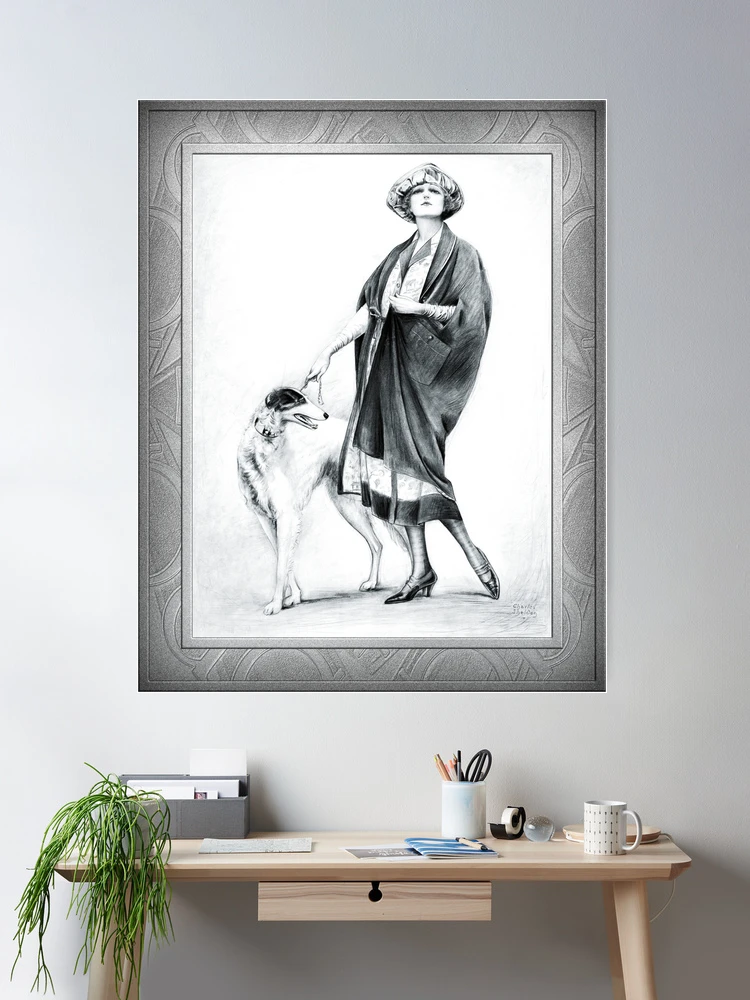
At the center of the composition stands the damsel, a woman dressed in sophisticated attire that reflects the high-society fashion of the 1920s. She is posed with an air of self-assurance, her posture upright and graceful. The woman’s dress, with its flowing lines and luxurious fabric, evokes a sense of refinement. She wears a fitted gown, with a soft collar that rests elegantly around her neck. The dress flows smoothly to the floor, with subtle folds that suggest movement. A wide belt is visible around her waist, adding structure to the otherwise soft fabric of her gown. Her clothing also seems to convey a sense of quiet dignity, with the dark tones of her attire emphasizing her calm presence.
Haar gezicht, though delicately drawn, is the focal point of the portrait. With soft features and a serene expression, she gazes slightly to the side, conveying a sense of inward reflection. Her hair is styled in an elegant updo, a fashionable choice for women of the period. The carefully placed curls and waves frame her face, adding to her sense of grace and refinement. The soft shading around her features enhances her ethereal presence, and her expression gives off a sense of quiet nobility. The positioning of her hands, gracefully placed along her side, contributes to the formal tone of the portrait.
The Saluki: A Noble Companion
Standing beside the damsel is her saluki, a symbol of nobility and elegance in itself. The breed is often associated with royalty, particularly in the Middle East, and Sheldon’s rendering of the animal emphasizes its grace and poise. The dog is shown in profile, with its body elongated and posture poised. Its fur is depicted in fine, detailed strokes, giving the impression of sleekness and softness.
The saluki’s face is noble, with an almost human-like expression that suggests intelligence and awareness. The gentle eyes of the dog seem to mirror those of the woman, suggesting a deep bond between the two. Its collar, simple yet elegant, serves as a subtle indication of its status as a companion to someone of high social rank.
Het terrein: An Intimate Interior
The setting of the artwork is intimate, with an undetermined interior space that serves as a quiet backdrop. The background is relatively subdued in detail, allowing the focus to remain on the figures of the damsel and her saluki. The absence of elaborate décor creates a sense of isolation, as though the viewer has entered a private, serene space.
The soft shading in the background contrasts with the detailed rendering of the subjects, enhancing their presence and drawing attention to their nobility. There are no distractions in the environment; in plaats van, the minimalistic surroundings complement the elegance of the figures themselves.
Materialen en techniek
The piece is executed with exceptional attention to detail, particularly in the rendering of textures such as the fabric of the woman’s dress and the fine, silky fur of the saluki. The medium appears to be graphite or pencil, a medium Sheldon was known to work with, which allows for delicate gradations of light and shadow. The use of fine lines and careful shading in the woman’s attire contrasts beautifully with the smoother, softer textures of the dog’s fur.
This contrast not only highlights the physical differences between the two subjects but also serves to enhance the overall composition. The monochromatic color palette, consisting solely of varying shades of gray, emphasizes the timeless quality of the image, further underscoring its sense of elegance and refinement.
Stijl, Thema, en stemming
The style of Damsel and Her Saluki is rooted in the early 20th-century academic tradition, characterized by fine detailing and the use of classical techniques. The composition is orderly, with both the woman and her dog placed in balanced positions. This balance reflects a harmonious relationship between the two figures, reinforcing the theme of companionship and elegance.
The overall mood of the piece is one of quiet sophistication. The woman and her saluki are presented as a pair, symbolizing a shared sense of nobility and grace. The lack of overt emotion in their expressions gives the piece a contemplative tone, as though both the woman and her dog are lost in quiet thought. The subdued atmosphere, with its focus on the figures’ evenwicht, exudes a feeling of timelessness, as if capturing a moment frozen in history.
Dit is een remastered reproductie van digitale kunst oude meesters van een openbaar domeinafbeelding dat beschikbaar is als a canvas print online.
Artist Bio Information Derived From
Fineartphotographyvideoart.com
Charles werd geboren in Worcester, Massachusetts VS, maar bracht het grootste deel van zijn leven door in Springfield, Massachusetts.
Hij begon zijn artistieke studie aan de Arts Students League in New York City at 215 West 57th Street, die werd opgericht in 1875 en oorspronkelijk gehuisvest in gehuurde kamers op 16th Street en 5th Avenue.
Charles maakte kunstwerken in de Art Nouveau, Edwardiaans (die elkaar overlappen, maar met de Edwardiaanse stijl die veel eenvoudiger is qua ontwerp) evenals Art Deco-stijlen en toen hij zijn studie aan de Arts Students League afrondde, hij reisde naar Parijs Frankrijk om te studeren bij de Tsjechische schilder Alphonse Mucha (Alfons Maria Mucha 1860 – 1939).
Bij zijn terugkeer naar de Verenigde Staten, hij begon met het produceren van mode-illustraties voor de Ladies Home Journal Publication; en zou reclamekunst produceren voor klanten zoals de Fox Shoe Company, Gainsborough, Fiberloid Haarborstels, Gegroeid & Bigelow en La Vogue Lingerie waarin hij zijn eerste opdracht ontving in 1918 voor een pin-up illustratie.
He would also go on to produces covers for Collier’s Magazine, The Saturday Evening Post, Woman’s Home Companion, Theater Magazine and Photoplay from 1925 – 1930; which launched his career as a portrait cover artist.
Deze erkenning leidde ertoe dat hij opdrachten kreeg van beroemde vrouwen van over de hele wereld, die voor hem zat in zijn studio in Carnegie Hall; gevestigd in New York City, Verenigde Staten van Amerika.
Dit resulteerde in veel van de Hollywood-sterretjes uit die tijd die voor hem poseerden, zoals Mae West, Greta Garbo, Mary Pickford, Jean Harlow, Clara Bow, Shirley Temple en velen, vele anderen uit de Gouden Eeuw van Hollywood.