

Dans Le Boudoir
“Dans Le Boudoir” is a captivating work of art by French painter Delphin Enjolras (1857 – 1945), renowned for his mastery of light, texture, and the intimate portrayal of feminine beauty. Painted in the late 19th to early 20th century, this piece epitomizes the artist’s skill in rendering delicate domestic scenes with a focus on elegance and sensuality. Enjolras, often celebrated for his depictions of women in private, tranquil moments, demonstrates his artistic acumen through the meticulous attention to detail, interplay of light, and a reverence for the natural grace of his subject.
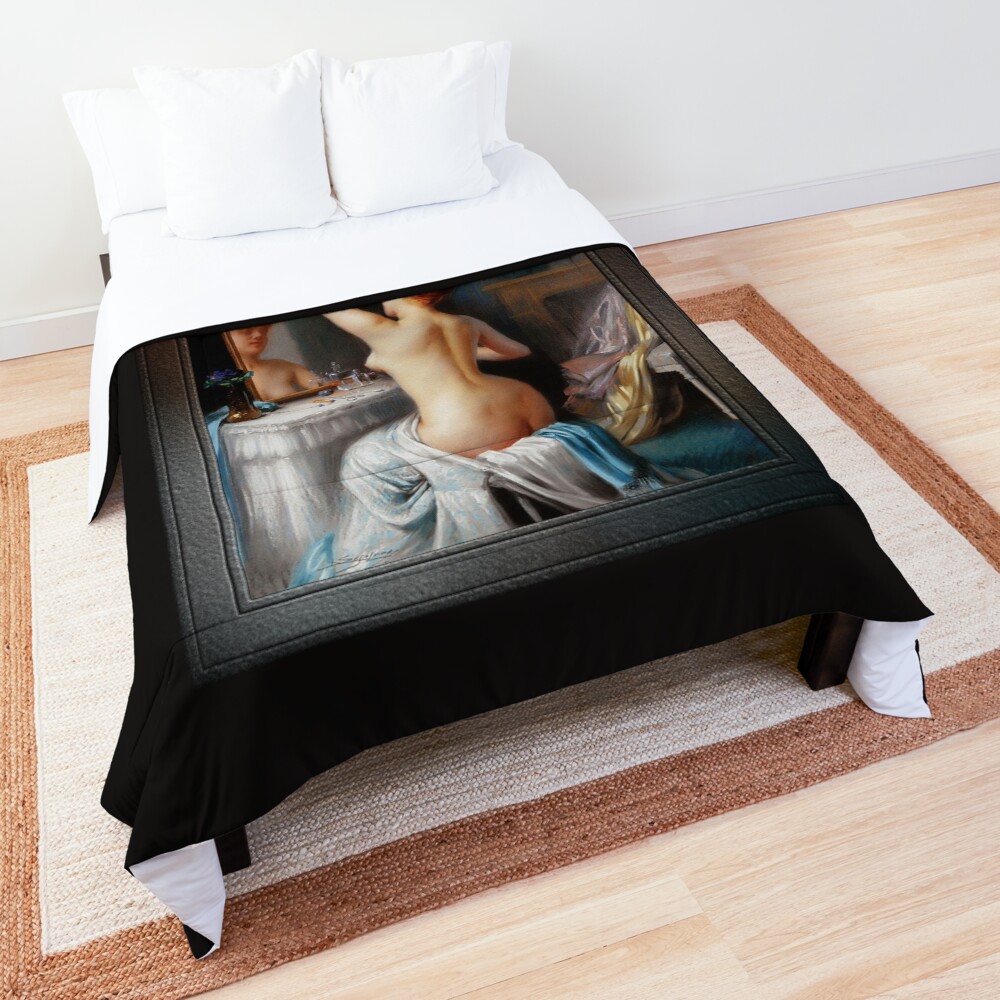
Table des matières
The Subject and Setting
Au coeur de “Dans Le Boudoir” lies a tender depiction of a woman engaged in an intimate act of grooming. The subject is seated before an ornate gilded mirror, her back partially turned to the viewer, creating a composition that is both voyeuristic and reverent. Her auburn hair is styled meticulously, and her hand gently touches her head in a gesture of refinement, suggesting an unhurried moment of preparation. The viewer is drawn into the quiet serenity of her boudoir—a personal, private space filled with subtle opulence and delicate details.
The woman’s posture exudes poise and elegance, her bare skin illuminated by the soft, diffused light that Enjolras masterfully employs. The soft curves of her form are accentuated by the contrast between her pale complexion and the rich textures surrounding her. Draped fabric, rendered in hues of pristine white and muted turquoise, cascades over the edges of the vanity, emphasizing the luxurious setting. This balance between sensuality and grace is a hallmark of Enjolras’s oeuvre.
Objects and Their Symbolism
Enjolras fills the boudoir with objects that enhance the intimacy and refinement of the scene. The central focus beyond the subject is the gilded mirror, framed in an ornate Rococo-style design, which reflects the woman’s partially obscured face. The reflection creates a layered depth, inviting the viewer to ponder both the physical and psychological dimensions of the moment. This duality of perception—what is seen versus what is suggested—imbues the artwork with an air of mystery.
On the vanity, a delicate arrangement of objects adds further richness to the composition. Crystal perfume bottles glint in the light, hinting at the woman’s rituals of self-care and femininity. A soft blue vase, holding a sprig of vibrant violet flowers, adds a touch of natural beauty, complementing the warmth of the indoor setting. Ces articles, though small, are rendered with exquisite precision, reflecting the artist’s keen observation of material culture during his time.
En arrière-plan, a floral arrangement in a blue ceramic vase graces the corner of the room, subtly anchoring the composition and extending the theme of grace and refinement. The setting is completed with a glimpse of draped golden fabric on a nearby chair, further emphasizing the luxurious yet understated atmosphere.
Style et technique
Delphin Enjolras’s style in “Dans Le Boudoir” demonstrates his affiliation with late Academic painting, influenced by Impressionism’s emphasis on light and atmosphere. His brushwork is soft and blended, creating an ethereal quality that lends the scene a dreamlike intimacy. La gradation minutieuse de la lumière, de la peau doucement éclairée du sujet aux ombres atténuées en arrière-plan, met en valeur la maîtrise du clair-obscur d’Enjolras.
La palette chaleureuse des ors, bleus doux, et les tons chair délicats évoquent une sensation de chaleur et de tranquillité. Enjolras joue un délicat jeu de textures : la douceur du tissu, l'éclat du bois poli, et la douceur de la porcelaine et du verre, soulignant sa capacité à restituer les éléments tactiles de manière convaincante. Ce réalisme tactile, combiné à la lueur subtile de l'éclairage intérieur, plonge le spectateur dans l'élégance sereine du boudoir.
Thème et humeur
Le thème général de “Dans Le Boudoir” est une question d'introspection, féminité, et la beauté tranquille des rituels quotidiens. En se concentrant sur le moment privé de la toilette d’une femme, Enjolras élève le banal au sublime, offering a glimpse into the personal sphere often hidden from public view. This theme is emblematic of his broader body of work, which frequently celebrates the grace and dignity of women in domestic settings.
The mood of the painting is serene and contemplative, underscored by the soft, diffuse lighting and the woman’s relaxed posture. There is an inherent intimacy in the scene, as though the viewer has been granted a privileged glimpse into a private world. Encore, this intimacy is tempered by the elegance of the composition, which maintains a sense of decorum and respect for the subject.
Conclusion
“Dans Le Boudoir” is a testament to Delphin Enjolras’s ability to capture the beauty and grace of the feminine form within a meticulously rendered domestic setting. Grâce à son utilisation magistrale de la lumière, texture, et composition, he transforms an intimate, moment quotidien en une œuvre d'art intemporelle. L’équilibre entre sensualité et raffinement du tableau, combiné avec son atmosphère évocatrice, assure son attrait durable en tant que célébration de la beauté et de l'élégance féminines.
Il s'agit d'une reproduction de maîtres anciens d'art numérique remasterisée d'une image du domaine public qui est disponible en tant que toile roulée, acrylique, impressions sur métal et bois en ligne.
Biographie de l'artiste dérivée de Wikipedia.org
Delphin est né à Coucouron, situé dans le sud de la France à Casimir Enjolras et Delphine Laurens en 1857.
Il a étudié l'aquarelle auprès de l'aquarelliste français Gaston Gérard au “Ecole de Dessin de la Ville de Paris” ou Ecole de Dessin de la Ville de Paris et il a également étudié auprès de Jean-Léon Gérôme (1824 – 1904) aux Beaux-Arts (École des beaux-arts), et au Pascal Dagnan-Bouveret.
Au début de la carrière de peintre de Delphin, il a surtout peint des paysages; mais passerait plus tard dans la peinture de portraits de jeunes femmes, dans lequel il excellait.
Son portrait axé sur de belles et élégantes jeunes femmes, généralement à la lumière d'une lampe effectuant des tâches banales telles que la lecture ou la couture; habillé ou nu; beaucoup de ses œuvres ultérieures étant de nature sensuelle et érotique.