

No boudoir
“No boudoir” é uma obra de arte cativante do pintor francês Delfim Enjolras (1857 – 1945), conhecido por seu domínio da luz, textura, e o retrato íntimo da beleza feminina. Pintado no final do século 19 ao início do século 20, esta peça resume a habilidade do artista em representar delicadas cenas domésticas com foco na elegância e sensualidade. Enjolras, frequentemente celebrado por suas representações de mulheres em ambientes privados, momentos tranquilos, demonstra sua perspicácia artística através da atenção meticulosa aos detalhes, interação de luz, e uma reverência pela graça natural de seu assunto.
Índice
O assunto e o cenário
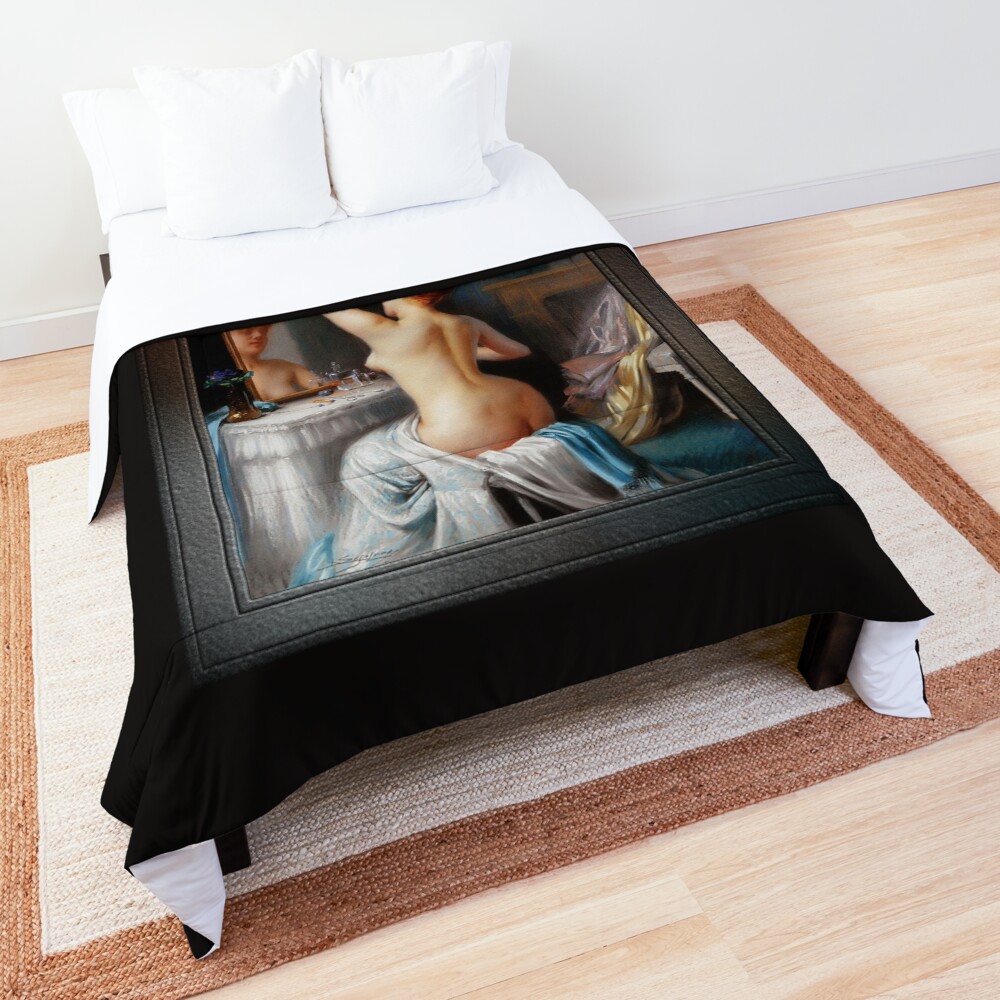
No coração de “No boudoir” lies a tender depiction of a woman engaged in an intimate act of grooming. The subject is seated before an ornate gilded mirror, her back partially turned to the viewer, creating a composition that is both voyeuristic and reverent. Her auburn hair is styled meticulously, and her hand gently touches her head in a gesture of refinement, suggesting an unhurried moment of preparation. The viewer is drawn into the quiet serenity of her boudoir—a personal, private space filled with subtle opulence and delicate details.
The woman’s posture exudes poise and elegance, her bare skin illuminated by the soft, diffused light that Enjolras masterfully employs. The soft curves of her form are accentuated by the contrast between her pale complexion and the rich textures surrounding her. Draped fabric, renderizado em tons de branco imaculado e turquesa suave, cascatas sobre as bordas da vaidade, enfatizando o ambiente luxuoso. Este equilíbrio entre sensualidade e graça é uma marca registrada da obra de Enjolras.
Objetos e seu simbolismo
Enjolras preenche o boudoir com objetos que realçam a intimidade e o requinte da cena. O foco central além do assunto é o espelho dourado, emoldurado em um design ornamentado em estilo rococó, que reflete o rosto parcialmente obscurecido da mulher. A reflexão cria uma profundidade em camadas, convidando o espectador a refletir sobre as dimensões físicas e psicológicas do momento. Esta dualidade de percepção – o que é visto versus o que é sugerido – confere à obra de arte um ar de mistério.
Na vaidade, um delicado arranjo de objetos acrescenta ainda mais riqueza à composição. Crystal perfume bottles glint in the light, hinting at the woman’s rituals of self-care and femininity. A soft blue vase, holding a sprig of vibrant violet flowers, adds a touch of natural beauty, complementing the warmth of the indoor setting. Esses itens, though small, are rendered with exquisite precision, reflecting the artist’s keen observation of material culture during his time.
Em segundo plano, a floral arrangement in a blue ceramic vase graces the corner of the room, subtly anchoring the composition and extending the theme of grace and refinement. The setting is completed with a glimpse of draped golden fabric on a nearby chair, further emphasizing the luxurious yet understated atmosphere.
Estilo e Técnica
Delphin Enjolras’s style in “No boudoir” demonstrates his affiliation with late Academic painting, influenced by Impressionism’s emphasis on light and atmosphere. His brushwork is soft and blended, creating an ethereal quality that lends the scene a dreamlike intimacy. The careful gradation of light, from the softly illuminated skin of the subject to the muted shadows in the background, showcases Enjolras’s mastery of chiaroscuro.
The warm palette of golds, soft blues, and delicate skin tones evokes a sense of warmth and tranquility. Enjolras employs a delicate interplay of textures—the softness of fabric, the sheen of polished wood, and the smoothness of porcelain and glass—highlighting his ability to render tactile elements convincingly. This tactile realism, combined with the subtle glow of the interior lighting, immerses the viewer in the serene elegance of the boudoir.
Tema e humor
The overarching theme of “No boudoir” is one of introspection, feminilidade, and the quiet beauty of everyday rituals. By focusing on the private moment of a woman’s grooming, Enjolras elevates the mundane to the sublime, offering a glimpse into the personal sphere often hidden from public view. This theme is emblematic of his broader body of work, which frequently celebrates the grace and dignity of women in domestic settings.
The mood of the painting is serene and contemplative, underscored by the soft, diffuse lighting and the woman’s relaxed posture. There is an inherent intimacy in the scene, as though the viewer has been granted a privileged glimpse into a private world. Ainda, this intimacy is tempered by the elegance of the composition, which maintains a sense of decorum and respect for the subject.
Conclusão
“No boudoir” is a testament to Delphin Enjolras’s ability to capture the beauty and grace of the feminine form within a meticulously rendered domestic setting. Through his masterful use of light, textura, e composição, he transforms an intimate, everyday moment into a timeless work of art. The painting’s balance of sensuality and refinement, combined with its evocative atmosphere, ensures its enduring appeal as a celebration of feminine beauty and elegance.
Esta é uma reprodução remasterizada de arte digital de antigos mestres de uma imagem de domínio público que está disponível como um rolled canvas, acrílico, metal and wood prints on-line.
Biografia do artista derivada de Wikipédia.org
Delphin was born in Coucouron, located in southern France to Casimir Enjolras and Delphine Laurens in 1857.
He studied watercolors under the French watercolorist Gaston Gérard at the “Ecole de Dessin de la Ville de Paris” or City of Paris Drawing School and he also studied under Jean-Léon Gérôme (1824 – 1904) at the Beaux-Arts (Escola de Belas Artes), and at the Pascal Dagnan-Bouveret.
In the early part of Delphins painting career, he mainly painted landscapes; but would later transition in painting portraits of young women, which he excelled at.
His portraiture focused on beautiful and elegant young women, usually by lamp light doing mundane task such as reading or sewing; clothed or in nude; with many of his later works being of a sensual and erotic nature.