

Y sampl esgidiau (Y Gosod Esgidiau), c1918
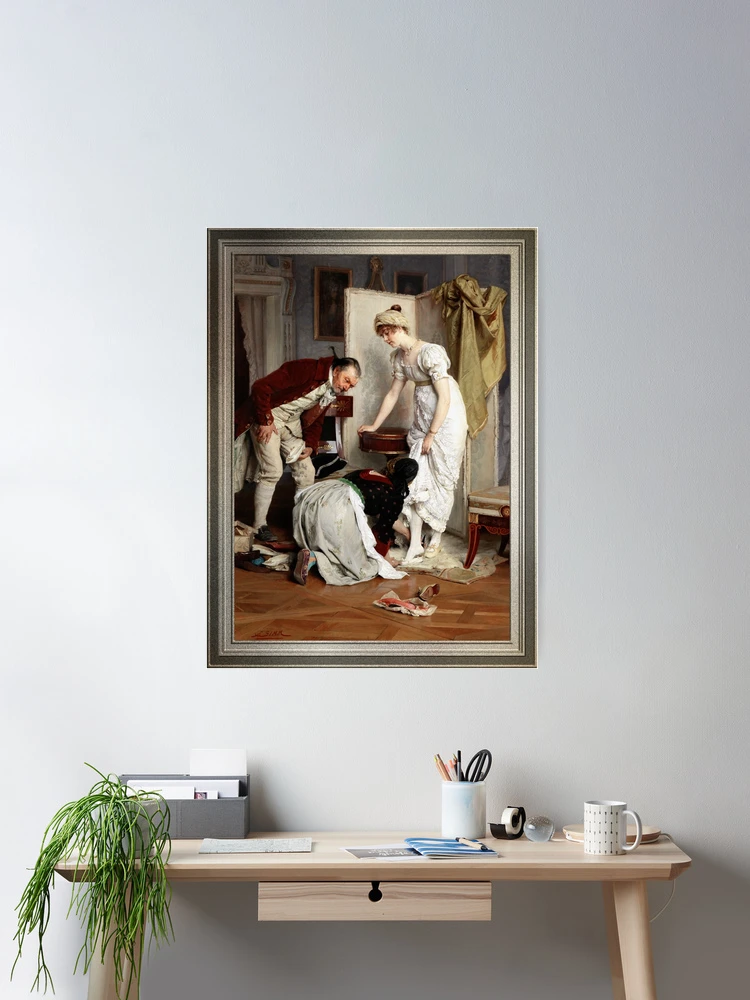
“Y sampl esgidiau (Y Gosod Esgidiau)” yn fanwl iawn, paentiad cain wedi'i greu yn 1918 gan yr artist o Awstria Franz Xaver Simm, eni yn 1853 ac a fu farw yn 1918. Mae'r paentiad yn crynhoi momentyn agos-atoch a braidd yn theatraidd o fewn cartref Ewropeaidd digon da. Simm, arlunydd amlwg o ddiwedd y 19eg ganrif a dechrau'r 20fed ganrif, yn adnabyddus am ei ddarluniau byw o fywyd bob dydd, yn enwedig y rhai sy'n arddangos rhyngweithio cymdeithasol o fewn lleoliadau mireinio. Mae'r paentiad hwn yn adlewyrchu ei feistrolaeth wrth ddal ymadroddion cain, gweadau, ac emosiynau.
Mae'r olygfa wedi'i gosod dan do, mewn mawredd, ystafell wedi'i phenodi'n dda sy'n awgrymu cyfuniad o chwaeth aristocrataidd a cheinder clasurol. Mae techneg Simm yma yn siarad â'i sylw acíwt i fanylion. Mae'r ystafell ei hun yn cynnwys cymysgedd o elfennau addurnol, dodrefn addurnedig, realistig tecstilau cyfoethog, a lloriau moethus sy'n rhoi ymdeimlad o ofod, moethusrwydd, a choethder. Mae'r lliwiau'n gynnes, gyda chydadwaith meddal o olau naturiol yn hidlo trwy'r ystafell, gan amlygu cyfoeth y llawr pren a dillad y ffigurau sy'n ymwneud â'r olygfa.
Tabl Cynnwys
Pwnc a Ffigurau
Ffocws canolog y paentiad yw'r foment agos-atoch rhwng y cymeriadau, tri unigolyn mewn gwahanol gamau o ryngweithio. Yn y blaendir, gwraig ifanc wedi gwisgo'n dda yn sefyll, yn barod ag awyr o ras. Ei gwisg, gŵn gwyn cain wedi'i addurno â les mân, yn dwyn i gof arddull diwedd y 18fed ganrif neu ddechrau'r 19eg ganrif, nod i ffasiwn yn ystod cyfnod Rococo a chyfnod y Rhaglywiaeth cynnar.
Mae hi'n cymryd rhan mewn ffitiad esgidiau, with one of her shoes being carefully adjusted by a female servant kneeling on the floor at her feet. The servant, dressed in traditional, modest attire, is focused on her task, with her back slightly arched as she attends to the shoes of the lady. The gesture of the servant kneeling emphasizes the social dynamics of the period, where women of the lower class served those of the higher class with humility and care.
To the left of the composition, an older man in a red jacket bends forward, seemingly inspecting the process of the shoe fitting. His posture is one of authority and interest, as he leans over, his head tilted toward the young woman. The elderly man appears to be an attentive observer, possibly the woman’s father or an influential figure in her life, who watches with a look of concern or approval.
This interaction between the figures, an elegantly dressed young woman, a modest servant, and a concerned older man, suggests a story of domestic life in a noble or wealthy household. The figures embody a sense of hierarchy, where the servant occupies the lowest position, while the man and woman occupy positions of power and refinement.
The body language of the servant, with her head lowered in humility, contrasts sharply with the straight posture of the woman, who embodies the grace and composure expected of women in such high society.
Gwrthrychau a Manylion
Several key objects in the scene further add to the luxurious atmosphere of the room. The finely crafted wooden furniture, a cabinet and a small table, appear in the background. These objects, designed with intricate carvings, reflect the period’s taste for ornate craftsmanship. On the floor, just to the right of the kneeling servant, a pair of shoes and a piece of cloth are strewn carelessly, giving the impression that the shoe fitting process has been underway for some time.
The shoes themselves, although not detailed in full, seem to suggest high fashion, consistent with the refined style of the central female figure. These objects, along with the delicate rug beneath the feet of the characters, evoke a sense of wealth and comfort.
The background of the painting is filled with subtle details, such as a framed portrait and soft drapery hanging from the side, which hint at the overall opulence of the room. The walls are decorated with light colors and fine art, possibly reflecting the taste of the household’s inhabitants, which includes portraits and references to classical themes.
Naws a Thema
The mood of the painting is dignified yet intimate, with an underlying sense of quiet interaction. Y gosodiad, though formal and elegant, speaks to a more private, domestic moment that contrasts with the often grander and more public moments of aristocratic life.
The theme of shoe fitting could symbolize the mundane yet essential rituals of daily life, with the woman’s posture and attire suggesting a deep connection to her status and her social role. It speaks to themes of grace, harddwch, and the ever-present hierarchy in society during this period.
There is a distinct calmness to the atmosphere, punctuated only by the action of the servant as she bends to adjust the shoe. The older man, while not directly involved in the process, adds an element of paternal or authoritative oversight, which enhances the idea of the woman’s status and her relationship to those around her.
The choice of subject matter in “Y Gosod Esgidiau” reveals Simm’s interest in depicting a refined social order where class distinctions are visible in the most intimate of settings. The careful rendering of fabrics, gweadau, and the interplay of light and shadow all contribute to the painting’s overall sense of reality and elegance. This scene, which could easily have been witnessed in any noble household of the period, encapsulates a world of sophistication and the complex dynamics between class, gender, ac awdurdod.
Arddull a Thechneg
The style of Franz Xaver Simm’s work is characterized by highly realistic representation and meticulous attention to the details of clothing, ymadroddion, and interior decor. His use of light and shadow to create depth and atmosphere, combined with the soft color palette, contributes to the painting’s overall harmonious and refined look. The detailed brushwork captures the texture of the clothing, dodrefn, and skin with remarkable accuracy, showcasing Simm’s skills as a painter of domestic scenes.
The composition itself, with the figures positioned around the central action of the shoe fitting, is well-balanced and lends a sense of order to the piece. The way light gently bathes the figures highlights their roles within the scene, with the servant slightly shadowed, the man brightly illuminated, and the woman catching a soft glimmer of light on her face and attire.
Simm’s “Y sampl esgidiau” is a prime example of the historical realism movement, where artists sought to present life as it was, with all its textures, emosiynau, and relationships.
Mae hwn yn atgynhyrchiad hen feistri celf ddigidol wedi'i atgynhyrchu o ddelwedd parth cyhoeddus.